Castrejón-Jiménez Nayeli Shantal, Leyva-Paredes Kahiry, Baltierra-Uribe Shantal Lizbeth, Castillo-Cruz Juan, Campillo-Navarro Marcia, Hernández-Pérez Alma Delia, Luna-Angulo Alexandra Berenice, Chacón-Salinas Rommel, Coral-Vázquez Ramón Mauricio, Estrada-García Iris, Sánchez-Torres Luvia Enid, Torres-Torres Carlos, García-Pérez Blanca Estela
Departamento de Microbiología, Escuela Nacional de Ciencias Biológicas, Instituto Politécnico Nacional, Prolongación de Carpio y Plan de Ayala s/n, Ciudad de México 11340, Mexico.
Área Académica de Medicina Veterinaria y Zootecnia, Instituto de Ciencias Agropecuarias-Universidad Autónoma del Estado de Hidalgo, Av. Universidad km. 1. Exhacienda de Aquetzalpa A.P. 32, Tulancingo 43600, Hidalgo, Mexico.
Molecules. 2019 Sep 23;24(19):3444. doi: 10.3390/molecules24193444.
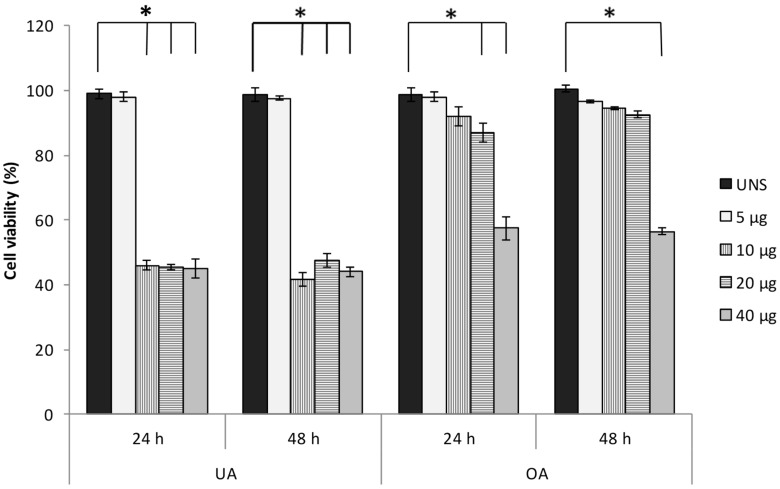
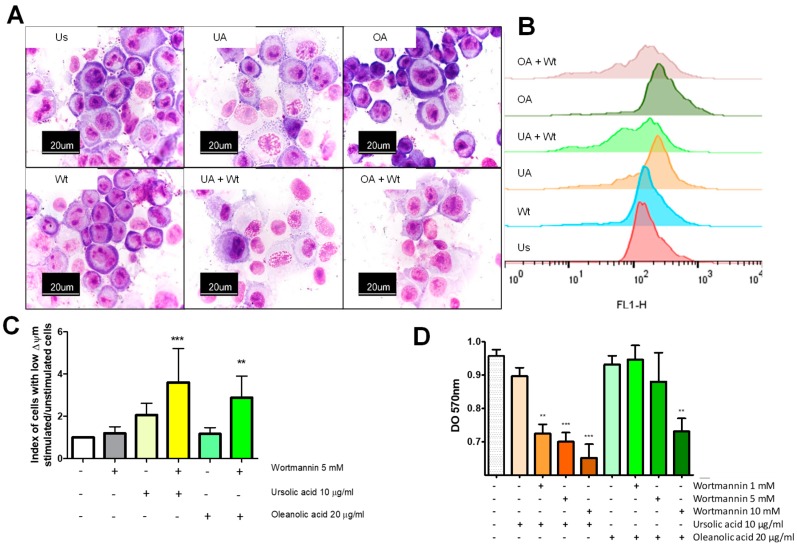
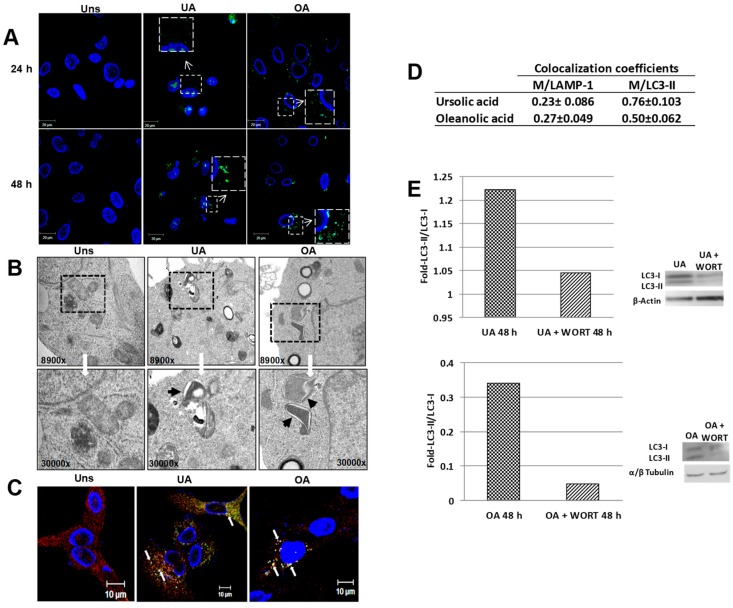
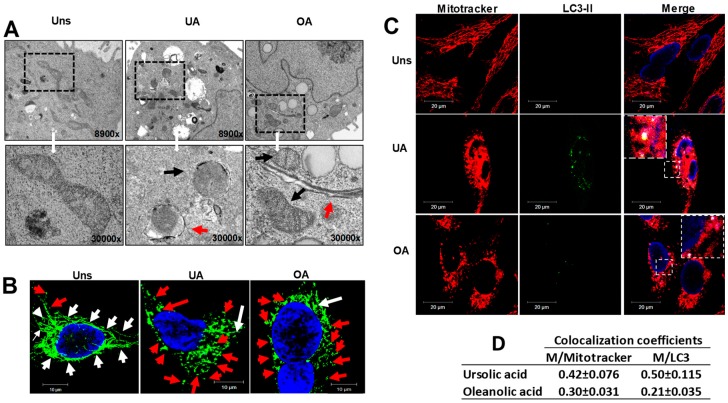
Ursolic and oleanolic acids are natural isomeric triterpenes known for their anticancer activity. Here, we investigated the effect of triterpenes on the viability of A549 human lung cancer cells and the role of autophagy in their activity. The induction of autophagy, the mitochondrial changes and signaling pathway stimulated by triterpenes were systematically explored by confocal microscopy and western blotting. Ursolic and oleanolic acids induce autophagy in A549 cells. Ursolic acid activates AKT/mTOR pathways and oleanolic acid triggers a pathway independent on AKT. Both acids promote many mitochondrial changes, suggesting that mitochondria are targets of autophagy in a process known as mitophagy. The PINK1/Parkin axis is a pathway usually associated with mitophagy, however, the mitophagy induced by ursolic or oleanolic acid is just dependent on PINK1. Moreover, both acids induce an ROS production. The blockage of autophagy with wortmannin is responsible for a decrease of mitochondrial membrane potential (Δψ) and cell death. The wortmannin treatment causes an over-increase of p62 and Nrf2 proteins promote a detoxifying effect to rescue cells from the death conducted by ROS. In conclusion, the mitophagy and p62 protein play an important function as a survival mechanism in A549 cells and could be target to therapeutic control.
熊果酸和齐墩果酸是具有抗癌活性的天然同分异构三萜类化合物。在此,我们研究了三萜类化合物对A549人肺癌细胞活力的影响以及自噬在其活性中的作用。通过共聚焦显微镜和蛋白质印迹法系统地探究了三萜类化合物诱导的自噬、线粒体变化及信号通路。熊果酸和齐墩果酸可诱导A549细胞发生自噬。熊果酸激活AKT/mTOR通路,而齐墩果酸触发一条不依赖于AKT的通路。两种酸均会引发许多线粒体变化,这表明线粒体是自噬过程(即线粒体自噬)中的靶点。PINK1/Parkin轴是一条通常与线粒体自噬相关的通路,然而,熊果酸或齐墩果酸诱导的线粒体自噬仅依赖于PINK1。此外,两种酸均会诱导活性氧(ROS)生成。渥曼青霉素阻断自噬会导致线粒体膜电位(Δψ)降低及细胞死亡。渥曼青霉素处理会使p62和Nrf2蛋白过度增加,从而促进解毒作用,以挽救细胞免于ROS介导的死亡。总之,线粒体自噬和p62蛋白在A549细胞中作为一种存活机制发挥着重要作用,可能成为治疗控制的靶点。