Department of Food and Drug, University of Parma, Parco Area delle Scienze 23A, 43124 Parma, Italy.
Institute of Biosciences and BioResources (IBBR), CNR, Via Pietro Castellino 111, 80131 Napoli, Italy.
Mar Drugs. 2019 Sep 23;17(10):544. doi: 10.3390/md17100544.
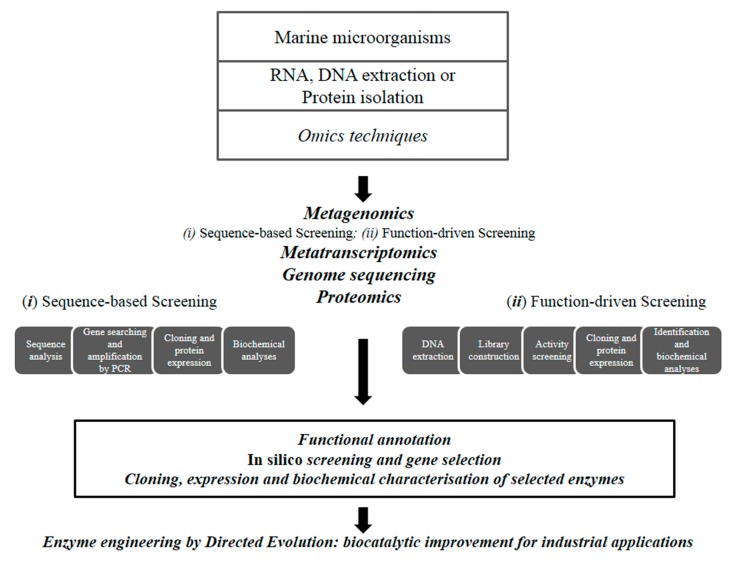
The microorganisms that evolved at low temperatures express cold-adapted enzymes endowed with unique catalytic properties in comparison to their mesophilic homologues, i.e., higher catalytic efficiency, improved flexibility, and lower thermal stability. Cold environments are therefore an attractive research area for the discovery of enzymes to be used for investigational and industrial applications in which such properties are desirable. In this work, we will review the literature on cold-adapted enzymes specifically focusing on those discovered in the bioprospecting of polar marine environments, so far largely neglected because of their limited accessibility. We will discuss their existing or proposed biotechnological applications within the framework of the more general applications of cold-adapted enzymes.
在低温下进化的微生物表达的冷适应酶与中温同源物相比具有独特的催化特性,即更高的催化效率、更好的灵活性和更低的热稳定性。因此,低温环境是发现酶的一个有吸引力的研究领域,这些酶可用于研究和工业应用,在这些应用中需要这些特性。在这项工作中,我们将回顾文献中关于冷适应酶的研究,特别是那些在极地海洋环境生物勘探中发现的酶,到目前为止,由于其有限的可及性,这些酶在很大程度上被忽视了。我们将在更广泛的冷适应酶应用框架内讨论它们现有的或提议的生物技术应用。