Department of Grassland Science, College of Animal Science and Technology, Sichuan Agricultural University, Chengdu 611130, China.
Int J Mol Sci. 2019 Sep 23;20(19):4713. doi: 10.3390/ijms20194713.
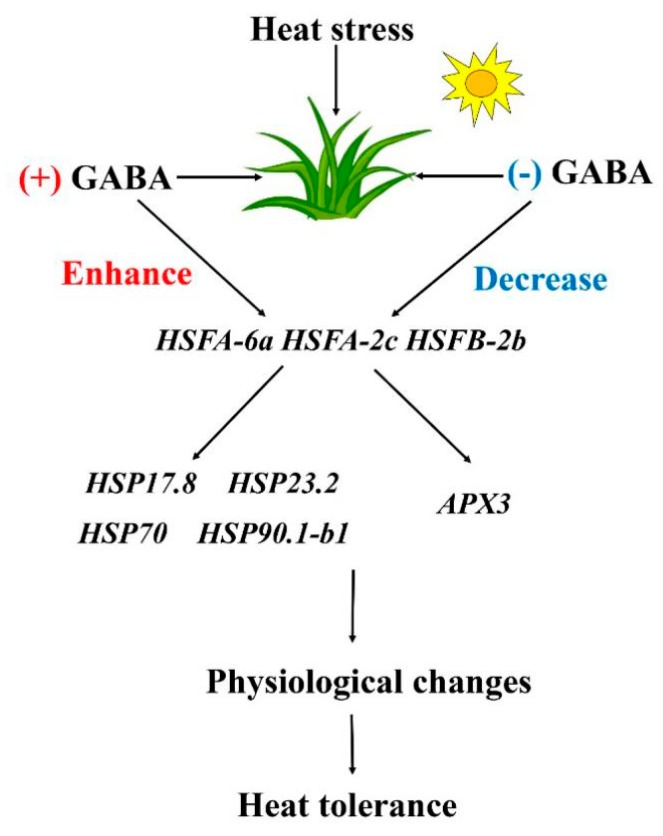
Activation and enhancement of heat shock factor (HSF) pathways are important adaptive responses to heat stress in plants. The γ-aminobutyric acid (GABA) plays an important role in regulating heat tolerance, but it is unclear whether GABA-induced thermotolerance is associated with activation of HSF pathways in plants. In this study, the changes of endogenous GABA level affecting physiological responses and genes involved in HSF pathways were investigated in creeping bentgrass during heat stress. The increase in endogenous GABA content induced by exogenous application of GABA effectively alleviated heat damage, as reflected by higher leaf relative water content, cell membrane stability, photosynthesis, and lower oxidative damage. Contrarily, the inhibition of GABA accumulation by the application of GABA biosynthesis inhibitor further aggravated heat damage. Transcriptional analyses showed that exogenous GABA could significantly upregulate transcript levels of genes encoding heat shock factor HSFs (, , and ), heat shock proteins (, , , and ), and ascorbate peroxidase 3 (), whereas the inhibition of GABA biosynthesis depressed these genes expression under heat stress. Our results indicate GABA regulates thermotolerance associated with activation and enhancement of HSF pathways in creeping bentgrass.
激活和增强热休克因子 (HSF) 途径是植物应对热应激的重要适应性反应。γ-氨基丁酸 (GABA) 在调节耐热性方面起着重要作用,但尚不清楚 GABA 诱导的耐热性是否与植物 HSF 途径的激活有关。在这项研究中,研究了热应激期间匍匐翦股颖中内源性 GABA 水平变化对生理反应和 HSF 途径相关基因的影响。GABA 外源处理诱导内源性 GABA 含量增加,有效缓解了热损伤,表现为较高的叶片相对含水量、细胞膜稳定性、光合作用和较低的氧化损伤。相反,应用 GABA 生物合成抑制剂抑制 GABA 积累进一步加重了热损伤。转录分析表明,外源 GABA 可显著上调编码热休克因子 HSFs(、、和)、热休克蛋白(、、、和)和抗坏血酸过氧化物酶 3()的基因的转录水平,而 GABA 生物合成的抑制则在热胁迫下抑制这些基因的表达。我们的结果表明,GABA 调节耐热性与匍匐翦股颖中 HSF 途径的激活和增强有关。