Enger Martine, Skjaker Stein Arve, Nordsletten Lars, Pripp Are Hugo, Melhuus Knut, Moosmayer Stefan, Brox Jens Ivar
Division of Orthopaedic Surgery, Oslo University Hospital, Oslo, Norway.
Institute of Clinical Medicine, University of Oslo, Oslo, Norway.
BMJ Open Sport Exerc Med. 2019 Aug 12;5(1):e000551. doi: 10.1136/bmjsem-2019-000551. eCollection 2019.
More than a third of sports injuries involve the upper extremity. The primary aim was to quantify and describe sports-related shoulder injuries in a general population cohort. A secondary aim was to compare aspects of these injuries to those that were not sports-related.
We performed a prospective registration of the activity at the time of shoulder injury in all cases admitted during 1 year in a combined primary care and orthopaedic emergency department serving a defined population. The electronic patient records and patient reported questionnaires were reviewed.
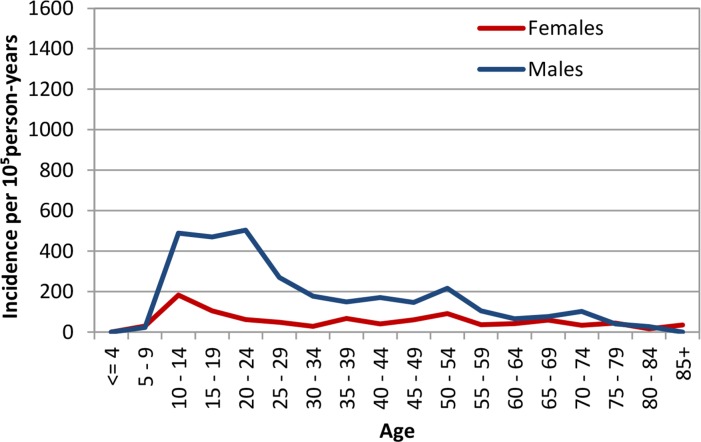
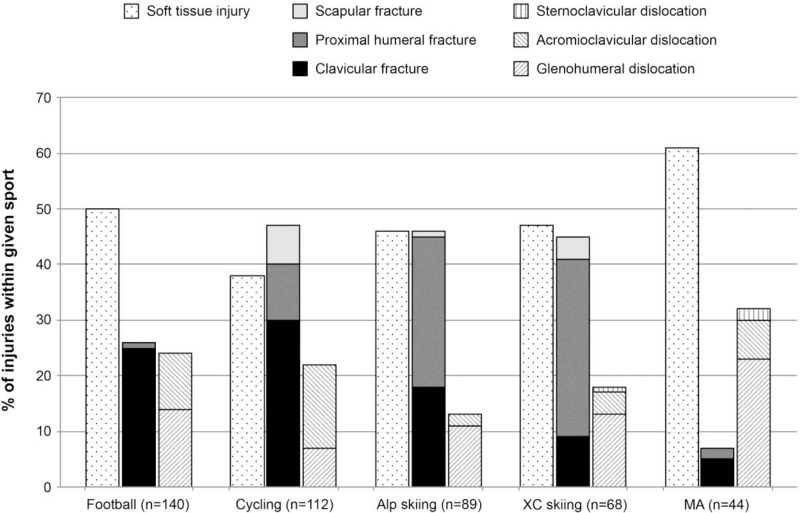
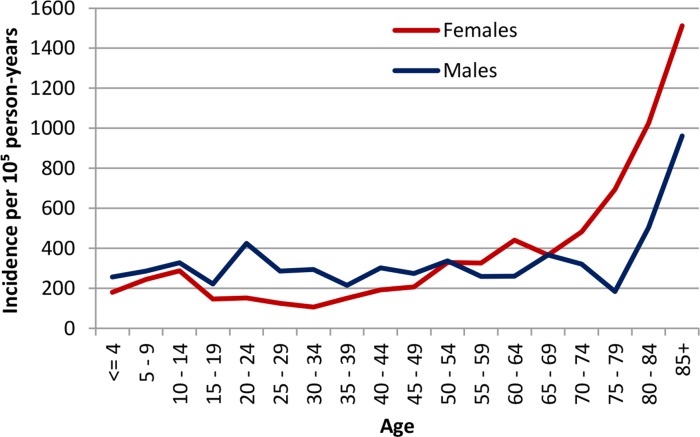
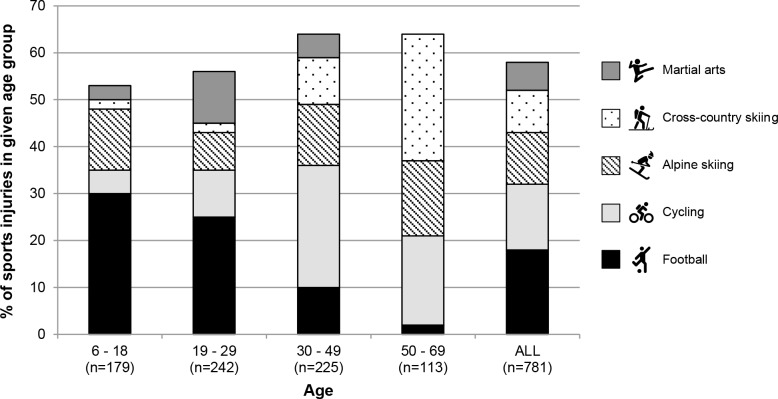
Twenty-nine per cent (n=781) of 2650 registered shoulder injuries were reported to be sports-related, with the highest proportion in acromioclavicular injuries (>50%). Patients with sports injuries were younger than those injured during other activities (median age 28 and 43 years, respectively, p<0.001), and more often male (78% and 52%, respectively, p<0.001). There was a strong gender disparity in incidence of sports-related shoulder injuries in adolescents and young adults, which was not observed in non-sports shoulder injuries. Football (soccer) (6-29 years), cycling (30-49 years), skiing (50-69 years) and martial arts were the dominating sports activities. Fractures were more common in skiing and cycling than in other major sports in the study.
Almost a third of the shoulder injuries occurred during sports. The types of sports involved varied with age and gender. The comparison of sport to non-sport shoulder injury incidence rates suggests that the increased risk of shoulder injuries in young males is mainly attributable to sports injuries.
超过三分之一的运动损伤累及上肢。主要目的是对普通人群队列中与运动相关的肩部损伤进行量化和描述。次要目的是将这些损伤的各方面情况与非运动相关的损伤进行比较。
我们对一家为特定人群服务的综合初级保健和骨科急诊科在1年期间收治的所有肩部损伤病例,在受伤时的活动情况进行了前瞻性登记。对电子病历和患者报告的问卷进行了审查。
在2650例登记的肩部损伤中,29%(n = 781)被报告为与运动相关,其中肩锁关节损伤的比例最高(>50%)。运动损伤患者比其他活动受伤的患者更年轻(中位年龄分别为28岁和43岁,p<0.001),且男性更多(分别为78%和52%,p<0.001)。青少年和年轻人中与运动相关的肩部损伤发病率存在明显的性别差异,而非运动性肩部损伤则未观察到这种差异。足球(6 - 29岁)、自行车运动(30 - 49岁)、滑雪(50 - 69岁)和武术是主要的运动项目。骨折在滑雪和自行车运动中比研究中的其他主要运动更常见。
近三分之一的肩部损伤发生在运动期间。所涉及的运动类型随年龄和性别而有所不同。运动性与非运动性肩部损伤发病率的比较表明,年轻男性肩部损伤风险增加主要归因于运动损伤。