Ashe Killian, Kelso Wendy, Farrand Sarah, Panetta Julie, Fazio Tim, De Jong Gerard, Walterfang Mark
Neuropsychiatry Unit, Royal Melbourne Hospital, Melbourne, VIC, Australia.
Statewide Adult Metabolic Service, Royal Melbourne Hospital, Melbourne, VIC, Australia.
Front Psychiatry. 2019 Sep 10;10:561. doi: 10.3389/fpsyt.2019.00561. eCollection 2019.
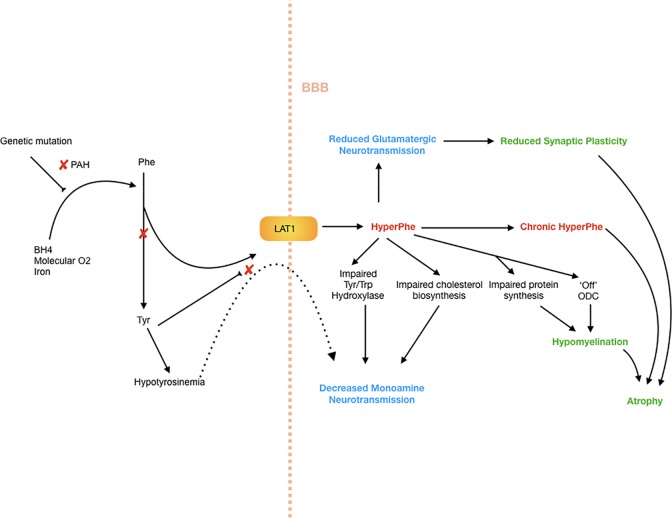
Phenylketonuria (PKU) is a recessive disorder of phenylalanine metabolism due to mutations in the gene for phenylalanine hydroxylase (PAH). Reduced PAH activity results in significant hyperphenylalaninemia, which leads to alterations in cerebral myelin and protein synthesis, as well as reduced levels of serotonin, dopamine, and noradrenaline in the brain. When untreated, brain development is grossly disrupted and significant intellectual impairment and behavioral disturbance occur. The advent of neonatal heel prick screening has allowed for diagnosis at birth, and the institution of a phenylalanine restricted diet. Dietary treatment, particularly when maintained across neurodevelopment and well into adulthood, has resulted in markedly improved outcomes at a cognitive and psychiatric level for individuals with PKU. However, few individuals can maintain full dietary control lifelong, and even with good control, an elevated risk remains of-in particular-mood, anxiety, and attentional disorders across the lifespan. Increasingly, dietary recommendations focus on maintaining continuous dietary treatment lifelong to optimize psychiatric and cognitive outcomes, although the effect of long-term protein restricted diets on brain function remains unknown. While psychiatric illness is very common in adult PKU populations, very little data exist to guide clinicians on optimal treatment. The advent of new treatments that do not require restrictive dietary management, such as the enzyme therapy Pegvaliase, holds the promise of allowing patients a relatively normal diet alongside optimized mental health and cognitive functioning.
苯丙酮尿症(PKU)是一种苯丙氨酸代谢的隐性疾病,由苯丙氨酸羟化酶(PAH)基因的突变引起。PAH活性降低导致显著的高苯丙氨酸血症,这会引起脑髓鞘和蛋白质合成的改变,以及大脑中血清素、多巴胺和去甲肾上腺素水平的降低。未经治疗时,脑发育会受到严重破坏,出现显著的智力障碍和行为紊乱。新生儿足跟采血筛查的出现使得在出生时就能进行诊断,并开始实施限制苯丙氨酸饮食。饮食治疗,尤其是在整个神经发育阶段及成年期持续进行时,已使PKU患者在认知和精神层面的预后得到显著改善。然而,很少有人能终身完全保持饮食控制,即使控制良好,在整个生命周期中,尤其是情绪、焦虑和注意力障碍的风险仍然较高。越来越多的饮食建议侧重于终身维持持续的饮食治疗以优化精神和认知预后,尽管长期限制蛋白质饮食对脑功能的影响尚不清楚。虽然精神疾病在成年PKU患者中非常常见,但几乎没有数据可指导临床医生进行最佳治疗。新的不需要严格饮食管理的治疗方法的出现,如酶疗法培格瓦酶,有望让患者在保持相对正常饮食的同时,优化心理健康和认知功能。