Gentili Charlotte, Rickardsson Jenny, Zetterqvist Vendela, Simons Laura E, Lekander Mats, Wicksell Rikard K
Functional Area Medical Psychology, Functional Unit Behavior Medicine, Karolinska University Hospital, Stockholm, Sweden.
Department of Clinical Neuroscience, Karolinska Institutet, Stockholm, Sweden.
Front Psychol. 2019 Sep 3;10:2016. doi: 10.3389/fpsyg.2019.02016. eCollection 2019.
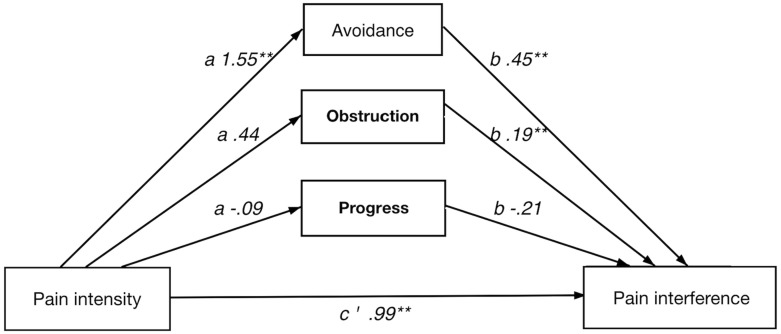
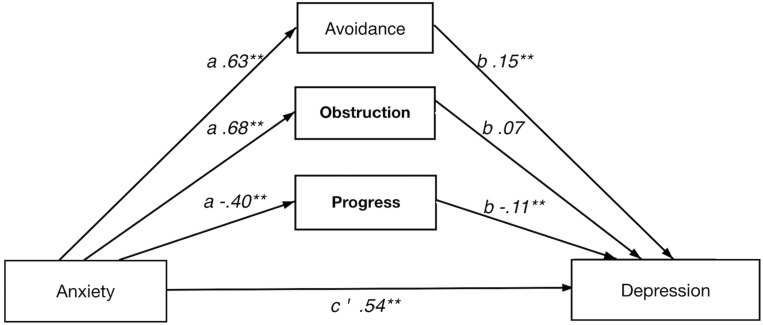
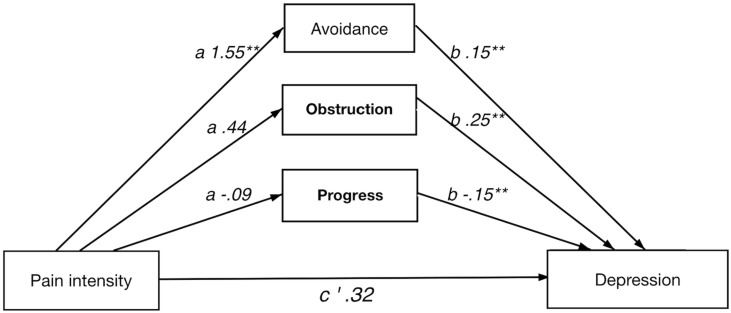
Resilience factors have been suggested as key mechanisms in the relation between symptoms and disability among individuals with chronic pain. However, there is a need to better operationalize resilience and to empirically evaluate its role and function. The present study examined psychological flexibility as a resilience factor in relation to symptoms and functioning among 252 adults with chronic pain applying for participation in a digital ACT-based self-help treatment. Participants completed measures of symptoms (pain intensity, and anxiety), functioning (pain interference and depression), as well as the hypothesized resilience factor psychological flexibility (measured as avoidance, value obstruction, and value progress). As expected, symptoms, functioning and resilience factors were significantly associated. Hierarchical linear regression analyses showed that psychological flexibility significantly contributed to the prediction of pain interference and depression when adjusting for age, pain and anxiety. Also, participants with low levels of psychological flexibility were more likely to be on sick leave. Furthermore, a series of multiple mediation analyses showed that psychological flexibility had a significant indirect effect on the relationship between symptoms and functioning. Avoidance was consistently shown to contribute to the indirect effect. Results support previous findings and suggest the importance of psychological flexibility as a resilience factor among individuals with chronic pain and anxiety.
复原力因素被认为是慢性疼痛患者症状与残疾之间关系的关键机制。然而,有必要更好地对复原力进行操作化,并实证评估其作用和功能。本研究将心理灵活性作为一种复原力因素,对252名申请参与基于接纳与承诺疗法(ACT)的数字自助治疗的慢性疼痛成年人的症状和功能进行了研究。参与者完成了症状(疼痛强度和焦虑)、功能(疼痛干扰和抑郁)的测量,以及假设的复原力因素心理灵活性(以回避、价值阻碍和价值进展来衡量)的测量。正如预期的那样,症状、功能和复原力因素显著相关。分层线性回归分析表明,在调整年龄、疼痛和焦虑因素后,心理灵活性对疼痛干扰和抑郁的预测有显著贡献。此外,心理灵活性水平较低的参与者更有可能休病假。此外,一系列多重中介分析表明,心理灵活性在症状与功能的关系中具有显著的间接效应。回避始终被证明对间接效应有贡献。研究结果支持了先前的发现,并表明心理灵活性作为慢性疼痛和焦虑患者复原力因素的重要性。