Kalds Peter, Zhou Shiwei, Cai Bei, Liu Jiao, Wang Ying, Petersen Bjoern, Sonstegard Tad, Wang Xiaolong, Chen Yulin
Key Laboratory of Animal Genetics, Breeding and Reproduction of Shaanxi Province, College of Animal Science and Technology, Northwest A&F University, Yangling, China.
Department of Animal and Poultry Production, Faculty of Environmental Agricultural Sciences, Arish University, El-Arish, Egypt.
Front Genet. 2019 Sep 3;10:750. doi: 10.3389/fgene.2019.00750. eCollection 2019.
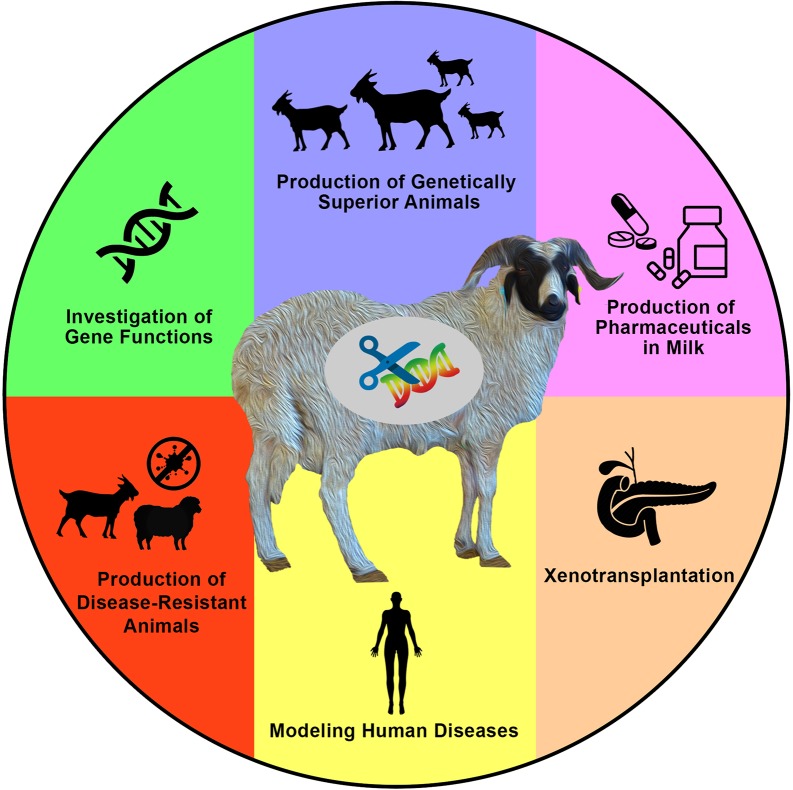
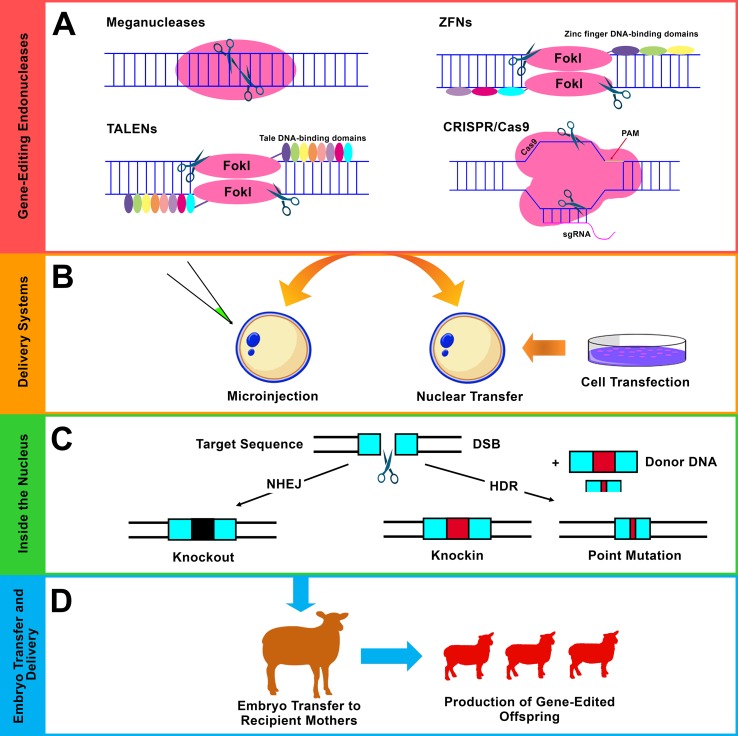
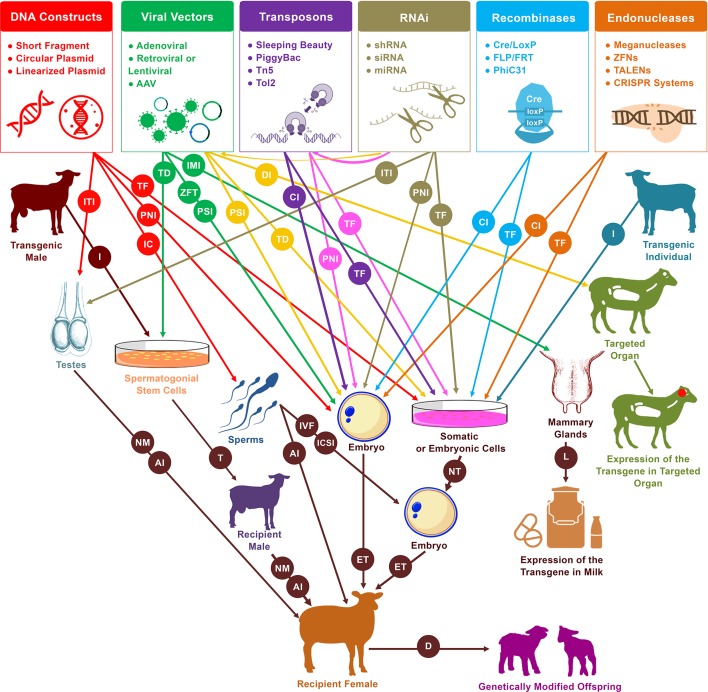
Sheep and goats are valuable livestock species that have been raised for their production of meat, milk, fiber, and other by-products. Due to their suitable size, short gestation period, and abundant secretion of milk, sheep and goats have become important model animals in agricultural, pharmaceutical, and biomedical research. Genome engineering has been widely applied to sheep and goat research. Pronuclear injection and somatic cell nuclear transfer represent the two primary procedures for the generation of genetically modified sheep and goats. Further assisted tools have emerged to enhance the efficiency of genetic modification and to simplify the generation of genetically modified founders. These tools include sperm-mediated gene transfer, viral vectors, RNA interference, recombinases, transposons, and endonucleases. Of these tools, the four classes of site-specific endonucleases (meganucleases, ZFNs, TALENs, and CRISPRs) have attracted wide attention due to their DNA double-strand break-inducing role, which enable desired DNA modifications based on the stimulation of native cellular DNA repair mechanisms. Currently, CRISPR systems dominate the field of genome editing. Gene-edited sheep and goats, generated using these tools, provide valuable models for investigations on gene functions, improving animal breeding, producing pharmaceuticals in milk, improving animal disease resistance, recapitulating human diseases, and providing hosts for the growth of human organs. In addition, more promising derivative tools of CRISPR systems have emerged such as base editors which enable the induction of single-base alterations without any requirements for homology-directed repair or DNA donor. These precise editors are helpful for revealing desirable phenotypes and correcting genetic diseases controlled by single bases. This review highlights the advances of genome engineering in sheep and goats over the past four decades with particular emphasis on the application of CRISPR/Cas9 systems.
绵羊和山羊是重要的家畜品种,因其能生产肉、奶、纤维及其他副产品而被饲养。由于其体型适中、妊娠期短且产奶量丰富,绵羊和山羊已成为农业、制药及生物医学研究中的重要模式动物。基因组工程已广泛应用于绵羊和山羊研究。原核注射和体细胞核移植是产生转基因绵羊和山羊的两种主要方法。此外,还出现了一些辅助工具来提高基因改造效率并简化转基因创始动物的产生过程。这些工具包括精子介导的基因转移、病毒载体、RNA干扰、重组酶、转座子和核酸内切酶。在这些工具中,四类位点特异性核酸内切酶(巨型核酸酶、锌指核酸酶、转录激活样效应因子核酸酶和规律成簇间隔短回文重复序列)因其诱导DNA双链断裂的作用而备受关注,这使得基于天然细胞DNA修复机制的刺激实现所需的DNA修饰成为可能。目前,规律成簇间隔短回文重复序列系统在基因组编辑领域占据主导地位。利用这些工具产生的基因编辑绵羊和山羊为基因功能研究、改良动物育种、利用乳汁生产药物、提高动物抗病性、模拟人类疾病以及为人类器官生长提供宿主等方面提供了有价值的模型。此外,规律成簇间隔短回文重复序列系统还出现了更有前景的衍生工具,如碱基编辑器,它能够诱导单碱基改变,而无需任何同源定向修复或DNA供体。这些精确的编辑器有助于揭示理想的表型并纠正由单碱基控制的遗传疾病。本综述重点介绍了过去四十年来绵羊和山羊基因组工程的进展,尤其强调了规律成簇间隔短回文重复序列/ Cas9系统的应用。