Department of Microbiology, The University of Georgia, Athens, Georgia, 30602, USA.
Center for Metalloenzyme Studies, The University of Georgia, Athens, Georgia, 30602, USA.
Sci Rep. 2019 Sep 25;9(1):13851. doi: 10.1038/s41598-019-50027-0.
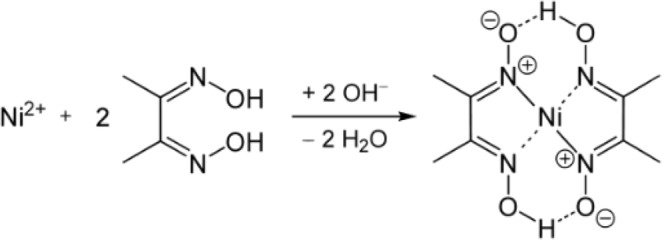
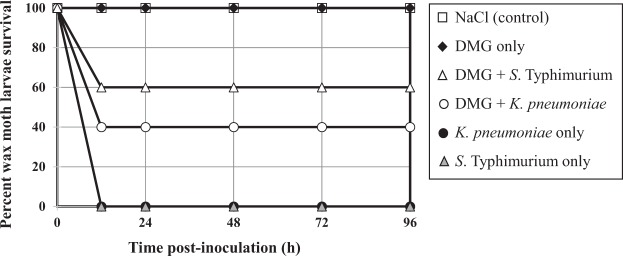
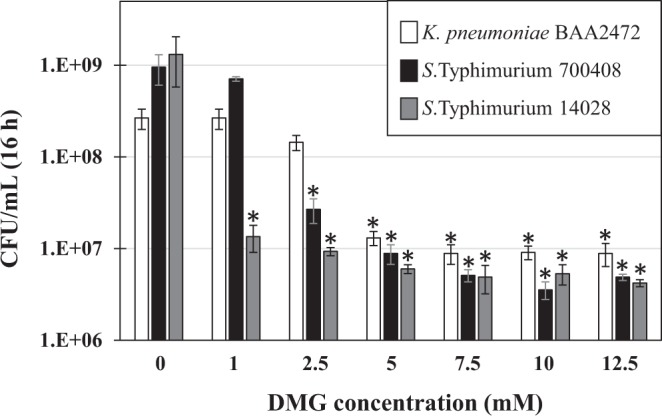
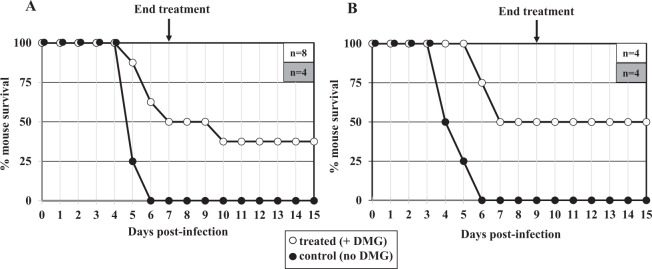
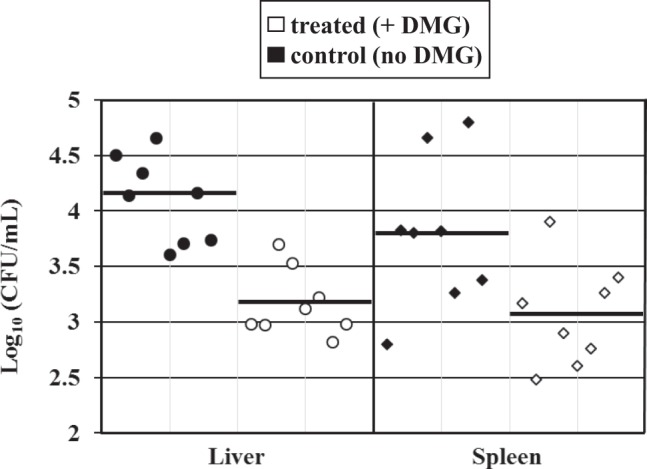
The nickel (Ni)-specific chelator dimethylglyoxime (DMG) has been used for many years to detect, quantitate or decrease Ni levels in various environments. Addition of DMG at millimolar levels has a bacteriostatic effect on some enteric pathogens, including multidrug resistant (MDR) strains of Salmonella Typhimurium and Klebsiella pneumoniae. DMG inhibited activity of two Ni-containing enzymes, Salmonella hydrogenase and Klebsiella urease. Oral delivery of nontoxic levels of DMG to mice previously inoculated with S. Typhimurium led to a 50% survival rate, while 100% of infected mice in the no-DMG control group succumbed to salmonellosis. Pathogen colonization numbers from livers and spleens of mice were 10- fold reduced by DMG treatment of the Salmonella-infected mice. Using Nuclear Magnetic Resonance, we were able to detect DMG in the livers of DMG-(orally) treated mice. Inoculation of Galleria mellonella (wax moth) larvae with DMG prior to injection of either MDR K. pneumoniae or MDR S. Typhimurium led to 40% and 60% survival, respectively, compared to 100% mortality of larvae infected with either pathogen, but without prior DMG administration. Our results suggest that DMG-mediated Ni-chelation could provide a novel approach to combat enteric pathogens, including recalcitrant multi-drug resistant strains.
镍(Ni)特异性螯合剂二甲基乙二肟(DMG)多年来一直用于检测、定量或降低各种环境中的 Ni 水平。在毫摩尔水平添加 DMG 对某些肠道病原体具有抑菌作用,包括多重耐药(MDR)鼠伤寒沙门氏菌和肺炎克雷伯菌。DMG 抑制了两种含 Ni 的酶的活性,即沙门氏氢酶和肺炎克雷伯脲酶。先前用鼠伤寒沙门氏菌接种的小鼠口服给予非毒性水平的 DMG,导致 50%的存活率,而无 DMG 对照组中 100%的感染小鼠死于沙门氏菌病。DMG 处理感染沙门氏菌的小鼠后,其肝脏和脾脏中的病原体定植数量减少了 10 倍。通过核磁共振,我们能够在 DMG(口服)处理的小鼠肝脏中检测到 DMG。在注射 MDR 肺炎克雷伯菌或 MDR 鼠伤寒沙门氏菌之前,先用 DMG 接种家蚕幼虫,与未用 DMG 处理的感染幼虫相比,分别导致 40%和 60%的存活率,而两种病原体感染的幼虫的死亡率均为 100%。我们的结果表明,DMG 介导的 Ni 螯合作用可能为治疗肠道病原体提供一种新方法,包括顽固性多药耐药菌株。