Department of Neurology, Johns Hopkins University, Baltimore, Maryland.
Department of Epidemiology, Johns Hopkins Bloomberg School of Public Health, Baltimore, Maryland.
Ann Clin Transl Neurol. 2019 Oct;6(10):2088-2096. doi: 10.1002/acn3.50904. Epub 2019 Sep 27.
To assess the effect of diabetes type on the long-term rate and extent of epidermal nerve regeneration.
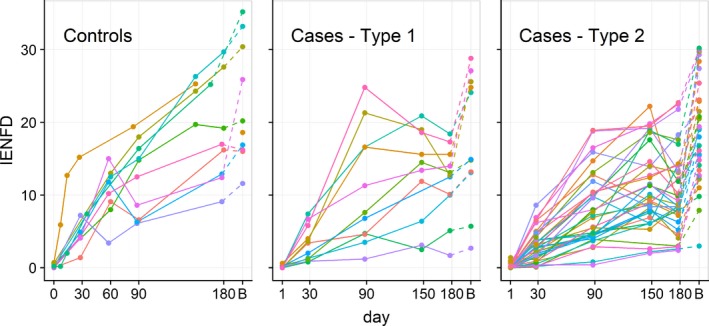
Subjects with well controlled type 1 diabetes mellitus (n = 11) or type 2 diabetes mellitus (n = 36), with normal nerve conduction studies and baseline intraepidermal nerve fiber density (IENFD), and healthy controls (n = 10) underwent chemical axotomy of the intraepidermal nerves at the thigh using topical capsaicin. Skin biopsies were performed at 30, 90, 150, and 180 days post-axotomy.
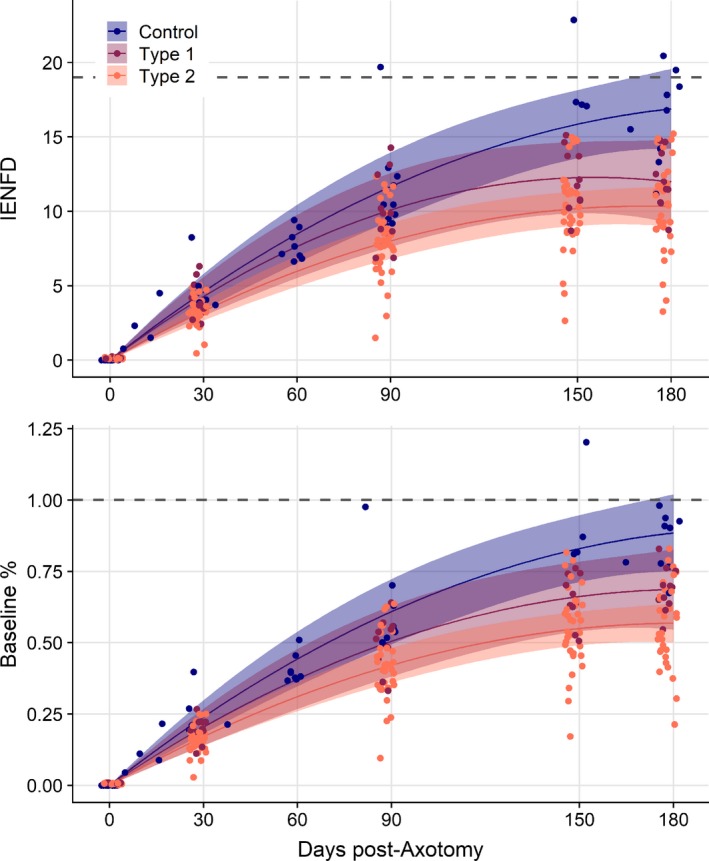
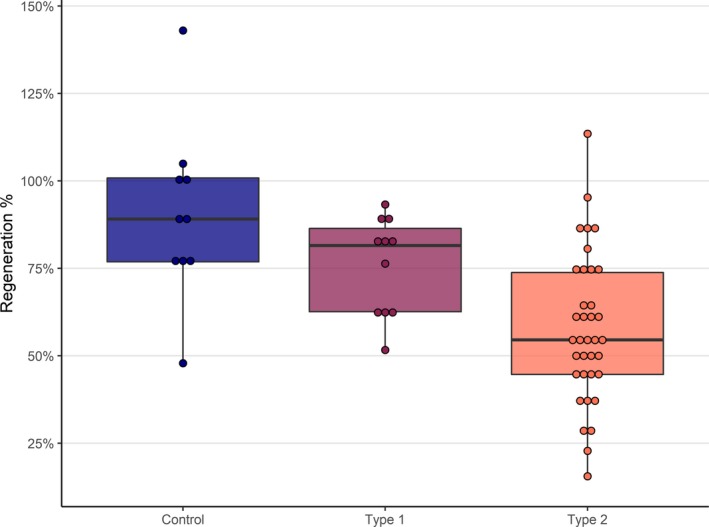
After 180 days, IENFD in diabetic subjects remained significantly below baseline levels, while healthy controls returned to normal. At each time point, regeneration rates were significantly slower among diabetic subjects, although type 1 subjects regenerated significantly faster and achieved higher percentages of baseline IENFD compared with type 2.
Among diabetic patients, nerve injury recovery is likely to take significantly longer than in healthy individuals, and remains incomplete, particularly among type 2 patients. This may partially explain the progression of neuropathy among diabetic patients: damage accumulates because nerve recovery is slowed and incomplete. Furthermore, these findings support caution when recommending certain procedures, such as carpal tunnel repair, to patients with progressed diabetic disease.
评估糖尿病类型对表皮神经再生的长期速率和程度的影响。
将血糖控制良好的 1 型糖尿病(n=11)或 2 型糖尿病患者(n=36)、神经传导研究正常且基线时表皮内神经纤维密度(IENFD)正常的患者以及健康对照者(n=10)纳入研究,采用局部辣椒素对大腿表皮内神经进行化学性轴索切断。在轴索切断后 30、90、150 和 180 天进行皮肤活检。
180 天后,糖尿病患者的 IENFD 仍明显低于基线水平,而健康对照组则恢复正常。在每个时间点,糖尿病患者的再生速度均明显较慢,尽管 1 型患者的再生速度明显较快,且达到的基线 IENFD 百分比高于 2 型患者。
在糖尿病患者中,神经损伤的恢复可能明显长于健康个体,且仍不完全,尤其是 2 型患者。这可能部分解释了糖尿病患者神经病变的进展:由于神经恢复缓慢且不完全,因此损伤会不断累积。此外,这些发现支持在向进展期糖尿病患者推荐某些手术(如腕管松解术)时应持谨慎态度。