Department of Anesthesiology, Vanderbilt University Medical Center, Nashville, TN.
Department of Pathology, Microbiology and Immunology, Vanderbilt University Medical Center, Nashville, TN.
Crit Care Med. 2019 Nov;47(11):e930-e938. doi: 10.1097/CCM.0000000000003967.
To determine whether synthetic phosphorylated hexa-acyl disaccharides provide antimicrobial protection in clinically relevant models of bacterial infection.
Laboratory study.
University laboratory.
BALB/c, C57BL/10J, and C57BL/10ScNJ mice.
Mice were treated with lactated Ringer's (vehicle) solution, monophosphoryl lipid A, or phosphorylated hexa-acyl disaccharides at 48 and 24 hours prior to intraperitoneal Pseudomonas aeruginosa or IV Staphylococcus aureus infection. Leukocyte recruitment, cytokine production, and bacterial clearance were measured 6 hours after P. aeruginosa infection. In the systemic S. aureus infection model, one group of mice was monitored for 14-day survival and another for S. aureus tissue burden at 3 days postinfection. Duration of action for 3-deacyl 6-Acyl phosphorylated hexa-acyl disaccharide was determined at 3, 10, and 14 days using a model of intraperitoneal P. aeruginosa infection. Effect of 3-deacyl 6-Acyl phosphorylated hexa-acyl disaccharide on in vivo leukocyte phagocytosis and respiratory burst was examined. Leukocyte recruitment, cytokine production, and bacterial clearance were measured after P. aeruginosa infection in wild-type and toll-like receptor 4 knockout mice treated with 3-deacyl 6-Acyl phosphorylated hexa-acyl disaccharide or vehicle to assess receptor specificity.
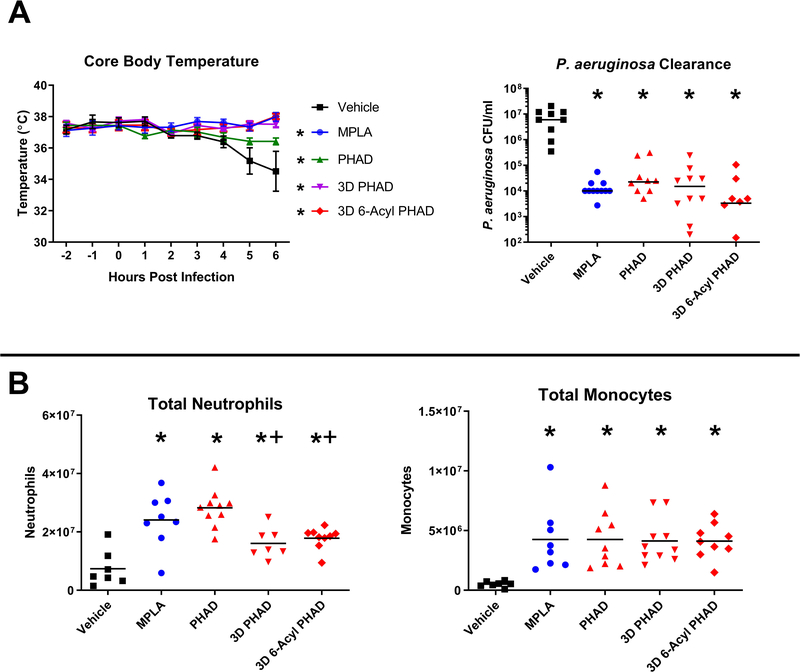
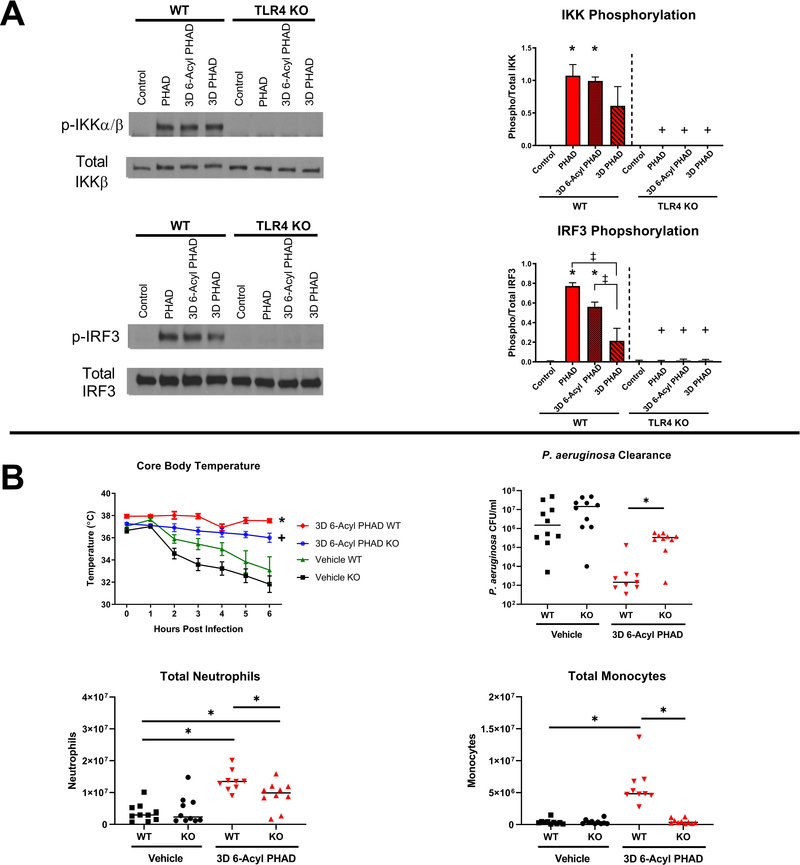
During intraperitoneal P. aeruginosa infection, phosphorylated hexa-acyl disaccharides significantly attenuated infection-induced hypothermia, augmented leukocyte recruitment and bacterial clearance, and decreased cytokine production. At 3 days post S. aureus infection, bacterial burden in lungs, spleen, and kidneys was significantly decreased in mice treated with monophosphoryl lipid A or phosphorylated hexa-acyl disaccharides, which was associated with improved survival. Leukocyte phagocytosis and respiratory burst functions were enhanced after treatment with monophosphoryl lipid A or phosphorylated hexa-acyl disaccharides. A time course study showed that monophosphoryl lipid A- and 3-deacyl 6-Acyl phosphorylated hexa-acyl disaccharide-mediated protection against P. aeruginosa lasts for up to 10 days. Partial loss of augmented innate antimicrobial responses was observed in toll-like receptor 4 knockout mice treated with 3-deacyl 6-Acyl phosphorylated hexa-acyl disaccharide.
Phosphorylated hexa-acyl disaccharides significantly augment resistance against clinically relevant Gram-negative and Gram-positive infections via enhanced leukocyte recruitment, phagocytosis, and respiratory burst functions of innate leukocytes. Improved antimicrobial protection persists for up to 10 days and is partially mediated through toll-like receptor 4.
确定合成磷酸化六酰基二糖是否能在具有临床相关性的细菌感染模型中提供抗菌保护。
实验室研究。
大学实验室。
BALB/c、C57BL/10J 和 C57BL/10ScNJ 小鼠。
在腹腔感染铜绿假单胞菌或静脉注射金黄色葡萄球菌之前 48 小时和 24 小时,用乳酸林格氏液(载体)溶液、单磷酰脂质 A 或磷酸化六酰基二糖处理小鼠。感染铜绿假单胞菌 6 小时后,测量白细胞募集、细胞因子产生和细菌清除情况。在全身性金黄色葡萄球菌感染模型中,一组小鼠监测 14 天的存活率,另一组在感染后 3 天测量金黄色葡萄球菌组织负荷。使用腹腔铜绿假单胞菌感染模型,确定 3-去酰基 6-酰基磷酸化六酰基二糖的作用持续时间为 3、10 和 14 天。检测 3-去酰基 6-酰基磷酸化六酰基二糖对体内白细胞吞噬作用和呼吸爆发的影响。在接受 3-去酰基 6-酰基磷酸化六酰基二糖或载体处理的野生型和 toll 样受体 4 敲除小鼠中,测量铜绿假单胞菌感染后的白细胞募集、细胞因子产生和细菌清除情况,以评估受体特异性。
在腹腔铜绿假单胞菌感染中,磷酸化六酰基二糖显著减轻感染引起的体温过低,增强白细胞募集和细菌清除,并减少细胞因子产生。在金黄色葡萄球菌感染后 3 天,用单磷酰脂质 A 或磷酸化六酰基二糖处理的小鼠肺部、脾脏和肾脏的细菌负荷明显降低,存活率提高。用单磷酰脂质 A 或磷酸化六酰基二糖处理后,白细胞吞噬作用和呼吸爆发功能增强。时间过程研究表明,单磷酰脂质 A 和 3-去酰基 6-酰基磷酸化六酰基二糖对铜绿假单胞菌的保护作用可持续长达 10 天。在接受 3-去酰基 6-酰基磷酸化六酰基二糖治疗的 toll 样受体 4 敲除小鼠中,观察到先天抗菌反应增强的部分丧失。
磷酸化六酰基二糖通过增强先天白细胞的白细胞募集、吞噬作用和呼吸爆发功能,显著增强对临床相关革兰氏阴性和革兰氏阳性感染的抵抗力。改善的抗菌保护作用可持续长达 10 天,部分通过 toll 样受体 4 介导。