Chen Ting-Jiun, Kukley Maria
Center for Neuroscience Research, Children's Research Institute, Children's National Medical Centre, Washington, DC, USA.
Group of Neuron Glia Interaction, University of Tübingen; Research Institute of Ophthalmology, Tübingen University Hospital, Tübingen, Germany.
Neural Regen Res. 2020 Mar;15(3):438-447. doi: 10.4103/1673-5374.266047.
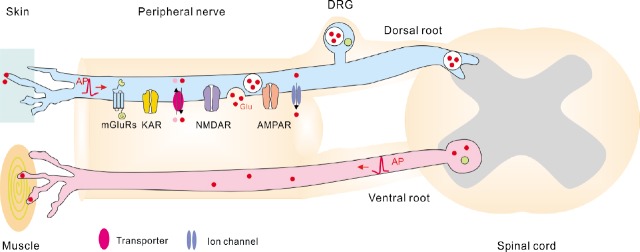
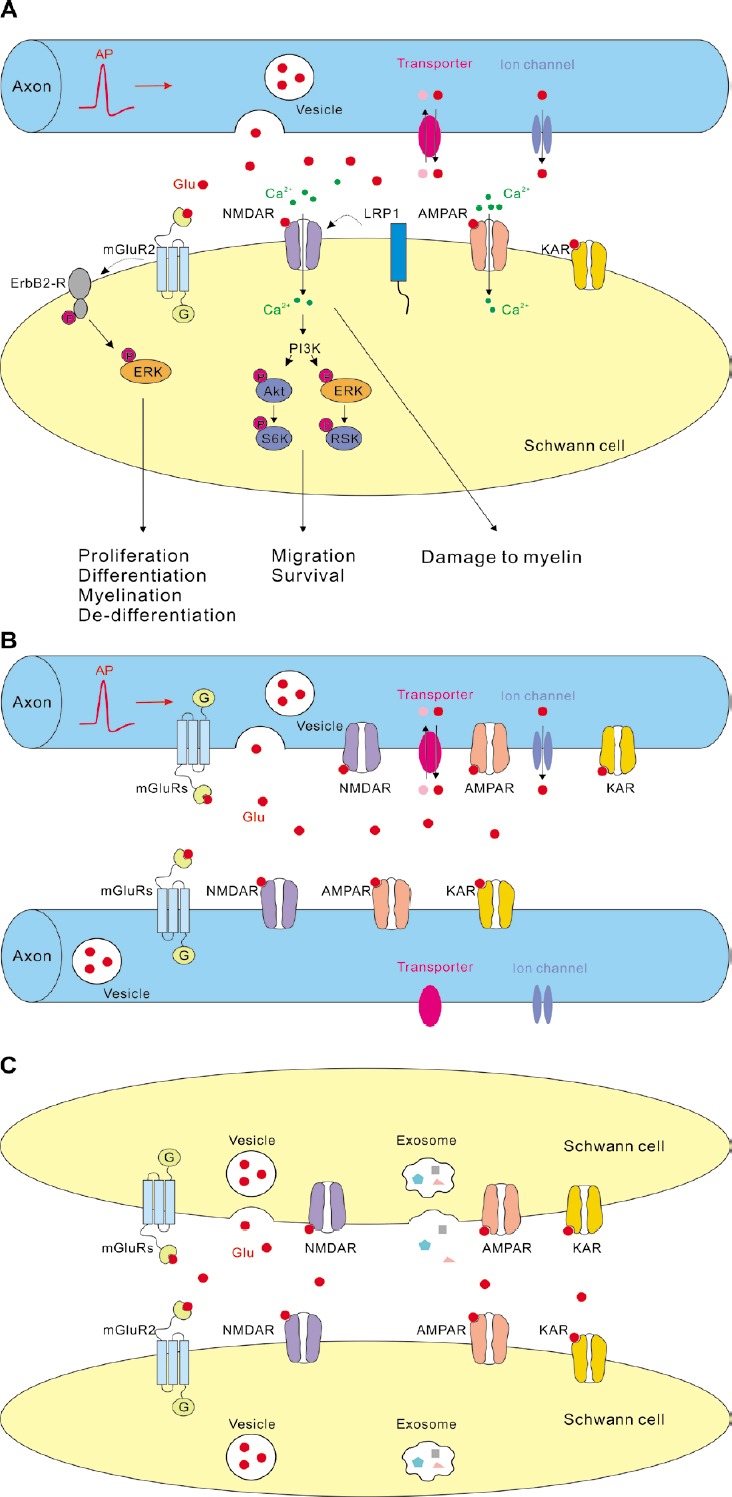
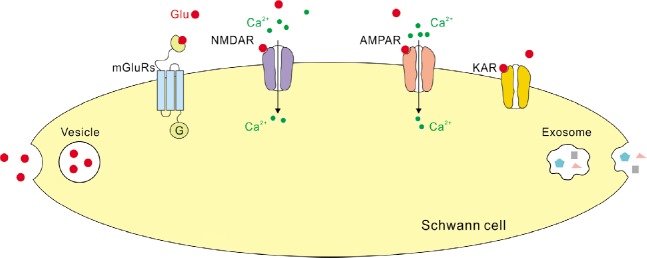
In the peripheral nervous system, the vast majority of axons are accommodated within the fibre bundles that constitute the peripheral nerves. Axons within the nerves are in close contact with myelinating glia, the Schwann cells that are ideally placed to respond to, and possibly shape, axonal activity. The mechanisms of intercellular communication in the peripheral nerves may involve direct contact between the cells, as well as signalling via diffusible substances. Neurotransmitter glutamate has been proposed as a candidate extracellular molecule mediating the cross-talk between cells in the peripheral nerves. Two types of experimental findings support this idea: first, glutamate has been detected in the nerves and can be released upon electrical or chemical stimulation of the nerves; second, axons and Schwann cells in the peripheral nerves express glutamate receptors. Yet, the studies providing direct experimental evidence that intercellular glutamatergic signalling takes place in the peripheral nerves during physiological or pathological conditions are largely missing. Remarkably, in the central nervous system, axons and myelinating glia are involved in glutamatergic signalling. This signalling occurs via different mechanisms, the most intriguing of which is fast synaptic communication between axons and oligodendrocyte precursor cells. Glutamate receptors and/or synaptic axon-glia signalling are involved in regulation of proliferation, migration, and differentiation of oligodendrocyte precursor cells, survival of oligodendrocytes, and re-myelination of axons after damage. Does synaptic signalling exist between axons and Schwann cells in the peripheral nerves? What is the functional role of glutamate receptors in the peripheral nerves? Is activation of glutamate receptors in the nerves beneficial or harmful during diseases? In this review, we summarise the limited information regarding glutamate release and glutamate receptors in the peripheral nerves and speculate about possible mechanisms of glutamatergic signalling in the nerves. We highlight the necessity of further research on this topic because it should help to understand the mechanisms of peripheral nervous system development and nerve regeneration during diseases.
在周围神经系统中,绝大多数轴突容纳在构成周围神经的纤维束内。神经内的轴突与形成髓鞘的神经胶质细胞紧密接触,施万细胞处于理想位置,能够对轴突活动做出反应并可能塑造轴突活动。周围神经中细胞间通讯的机制可能涉及细胞间的直接接触,以及通过可扩散物质进行信号传导。神经递质谷氨酸已被提出作为介导周围神经中细胞间相互作用的细胞外分子候选物。两类实验结果支持这一观点:第一,已在神经中检测到谷氨酸,并且在对神经进行电刺激或化学刺激时可释放谷氨酸;第二,周围神经中的轴突和施万细胞表达谷氨酸受体。然而,在很大程度上缺乏提供直接实验证据表明在生理或病理条件下周围神经中发生细胞间谷氨酸能信号传导的研究。值得注意的是,在中枢神经系统中,轴突和形成髓鞘的神经胶质细胞参与谷氨酸能信号传导。这种信号传导通过不同机制发生,其中最引人入胜的是轴突与少突胶质前体细胞之间的快速突触通讯。谷氨酸受体和/或突触轴突-神经胶质细胞信号传导参与少突胶质前体细胞的增殖、迁移和分化、少突胶质细胞的存活以及损伤后轴突的重新髓鞘化的调节。周围神经中轴突与施万细胞之间是否存在突触信号传导?谷氨酸受体在周围神经中的功能作用是什么?在疾病期间神经中谷氨酸受体的激活是有益还是有害?在本综述中,我们总结了关于周围神经中谷氨酸释放和谷氨酸受体的有限信息,并推测了神经中谷氨酸能信号传导的可能机制。我们强调对该主题进行进一步研究的必要性,因为这将有助于理解疾病期间周围神经系统发育和神经再生的机制。