Cho Taehong, Whalen D H, Docherty Gerard
Hanyang Institute for Phonetics and Cognitive Sciences of Language (HIPCS); Department of English Language and Literature, Hanyang University, 222 Wangsimni-ro, Seongdon-gu, Seoul, 04763, Korea.
Haskins Laboratories, 300 George St., Suite 900, New Haven, CT 06511, United State; Program in Speech-Language-Hearing Sciences, Graduate Center, City University of New York, 365 5th Ave., New York, NY 10016, United States; Department of Linguistics, Yale University, PO Box 208366, New Haven, CT 06520-8366.
J Phon. 2019 Jan;72:52-65. doi: 10.1016/j.wocn.2018.11.002. Epub 2018 Dec 11.
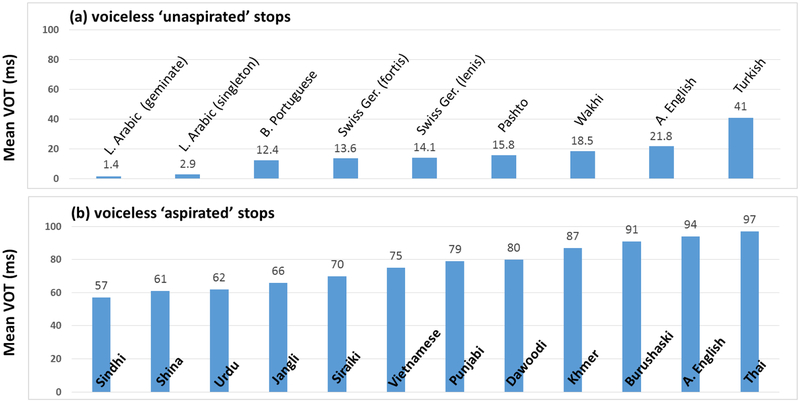
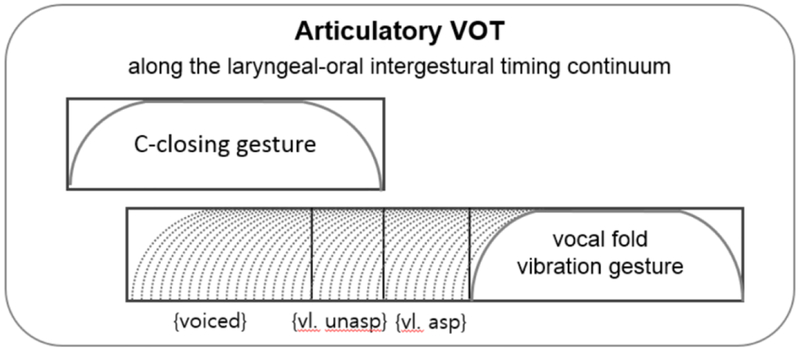
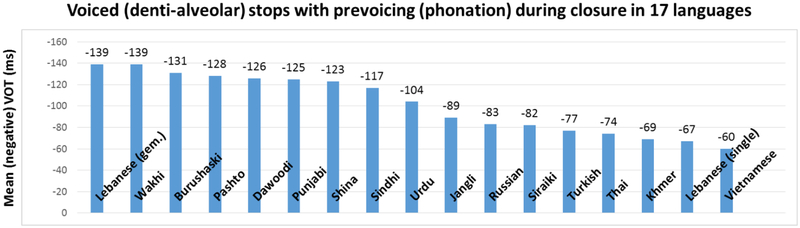
In this special collection entitled , we have compiled eleven studies investigating the voicing contrast in 19 languages. The collection provides extensive data obtained from 270 speakers across those languages, examining VOT and other acoustic, aerodynamic and articulatory measures. The languages studied may be divided into four groups: 'aspirating' languages with a two-way contrast (English, three varieties of German); 'true voicing' languages with a two-way contrast (Russian, Turkish, Brazilian Portuguese, two Iranian languages Pashto and Wakhi); languages with a three-way contrast (Thai, Vietnamese, Khmer, Yerevan Armenia, three Indo-Aryan languages, Dawoodi, Punjabi and Shina, and Burushaki spoken in India); and Indo-Aryan languages with a more than three-way contrast (Jangli and Urdu with a four-way contrast, and Sindhi and Siraiki with a five-way contrast). We discuss the cross-linguistic data, focusing on how much VOT alone tell s us above the voicing contrast in these languages, and what other phonetic dimensions (such as consonant-induced F0 and voice quality) are needed for a complete understanding of laryngeal contrast in these languages. Implications for various issues emerge: universal phonetic feature systems, effects of language contact on linguistic levelling, and the relation between laryngeal contrast and supralaryngeal articulation. The cross-linguistic VOT data also lead us to discuss how the distribution of VOT as measured acoustically may allow us to infer the underlying articulation and how it might be approached in gestural phonologies. The discussion on these multiple issues sparks new questions to be resolved, and provide indications of where the field may be best directed in exploring laryngeal contrast in voicing in the world's languages.
在这个名为《 》的特别专辑中,我们汇编了11项研究,调查19种语言中的浊音对比。该专辑提供了从使用这些语言的270名说话者那里获得的大量数据,研究了嗓音起始时间(VOT)以及其他声学、空气动力学和发音方面的指标。所研究的语言可分为四组:具有双向对比的“送气”语言(英语、三种德语变体);具有双向对比的“真正浊音”语言(俄语、土耳其语、巴西葡萄牙语、两种伊朗语言普什图语和瓦罕语);具有三向对比的语言(泰语、越南语、高棉语、亚美尼亚语埃里温方言、三种印度 - 雅利安语达乌迪语、旁遮普语和希纳语,以及印度的布鲁沙斯基语);以及具有超过三向对比的印度 - 雅利安语(具有四向对比的江利语和乌尔都语,以及具有五向对比的信德语和西拉基语)。我们讨论这些跨语言数据,重点关注仅VOT能在多大程度上告诉我们这些语言中的浊音对比情况,以及为全面理解这些语言中的喉部对比还需要哪些其他语音维度(如辅音引发的基频和嗓音质量)。这引发了对各种问题的思考:通用语音特征系统、语言接触对语言同化的影响,以及喉部对比与喉上发音的关系。跨语言的VOT数据还促使我们讨论从声学上测量的VOT分布如何使我们推断潜在的发音方式,以及在手势音系学中如何处理这一问题。对这些多个问题的讨论引发了有待解决的新问题,并为该领域在探索世界语言中的浊音喉部对比时的最佳研究方向提供了指示。