Zeng Ling-Hui, Wang Qing-Mei, Feng Lin-Yi, Ke Yu-Dun, Xu Qian-Zi, Wei An-Yi, Zhang Chong, Ying Rong-Biao
Department of Pharmacology, Zhejiang University City College, Hangzhou City, Zhejiang Province 310015, People's Republic of China.
Department of Surgical Oncology, Taizhou Cancer Hospital, Wenling City, Zhejiang Province 317500, People's Republic of China.
Onco Targets Ther. 2019 Sep 10;12:7405-7413. doi: 10.2147/OTT.S222702. eCollection 2019.
Vitamin C (VC) is a kind of essential nutrient in the body regarded as a canonical antioxidant during the past hundred years. However, the anti-cancer effect of VC is controversial. Our study is trying to clarify the relationship between VC dosage and breast cancer metastasis.
Human breast cancer cell lines Bcap37 and MDA-MB-453 were treated with VC at three different concentrations (low-dose, 0.01 mM; medium-dose, 0.1 mM; high-dose, 2 mM). Wound healing assays were conducted for migration assay; transwell tests were performed to detect the ability of cell invasion. The protein levels were evaluated by Western blot analysis or immunohistochemistry. Tumor xenografts in nude mice were built to test the effects of VC on breast cancer cell proliferation and metastasis.
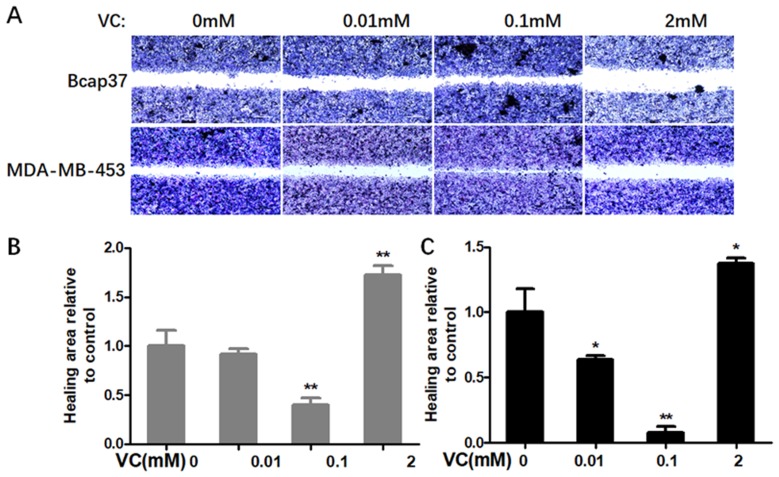
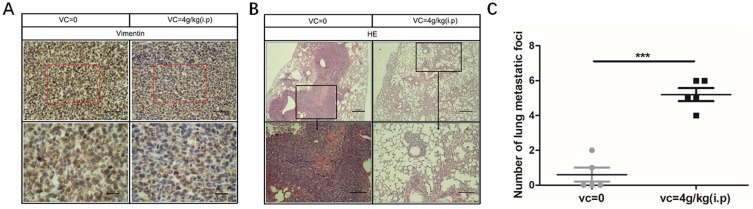
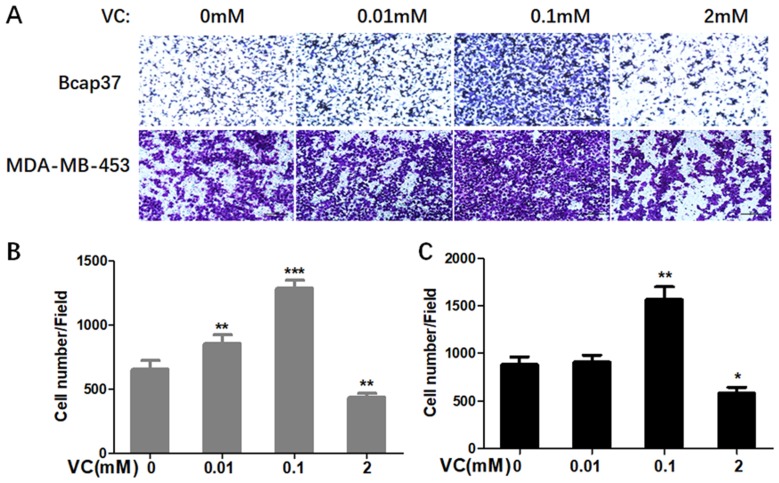
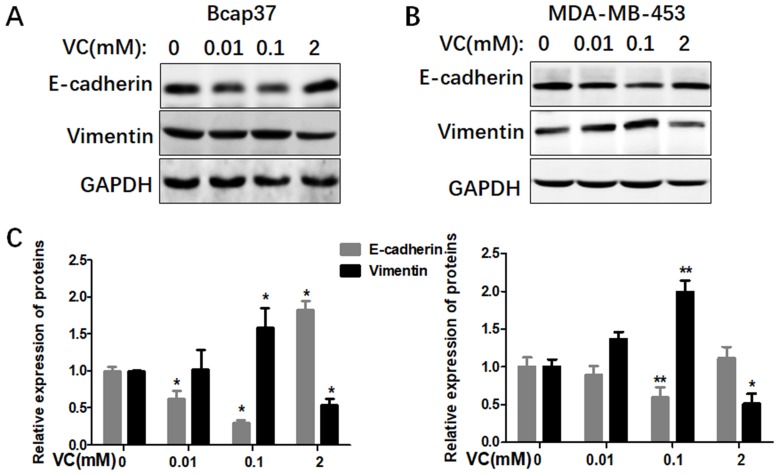
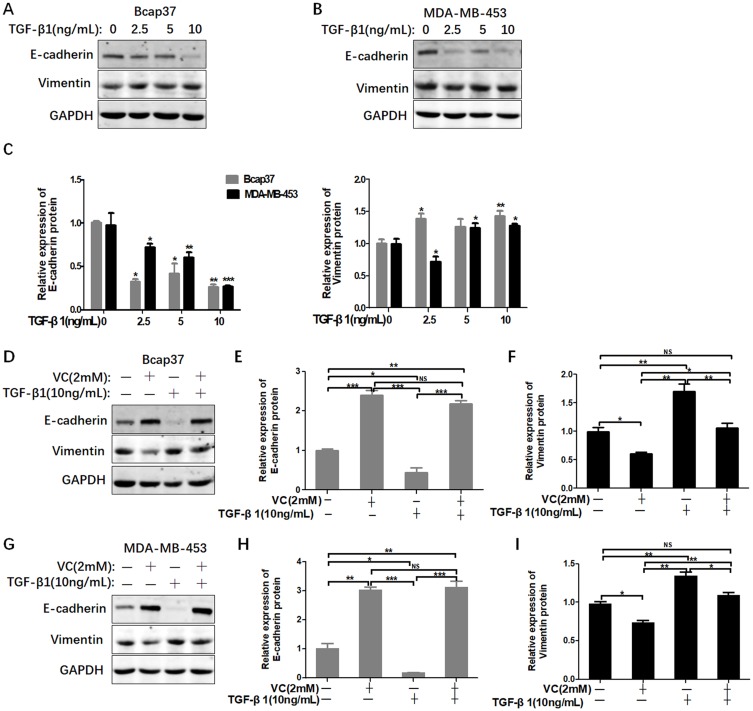
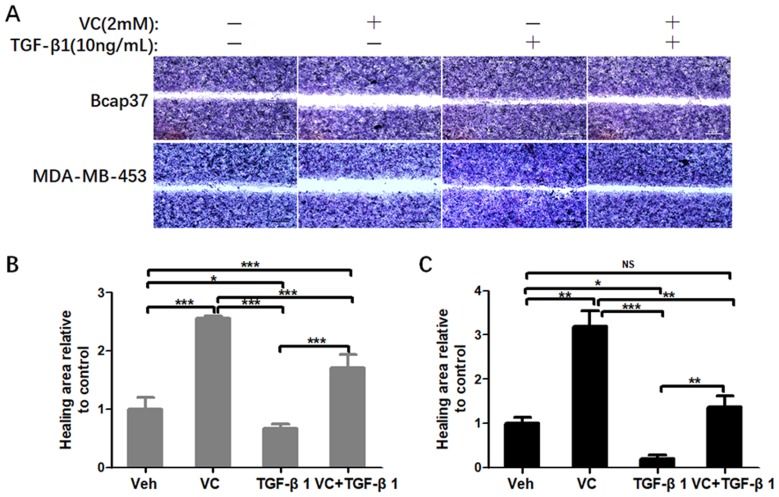
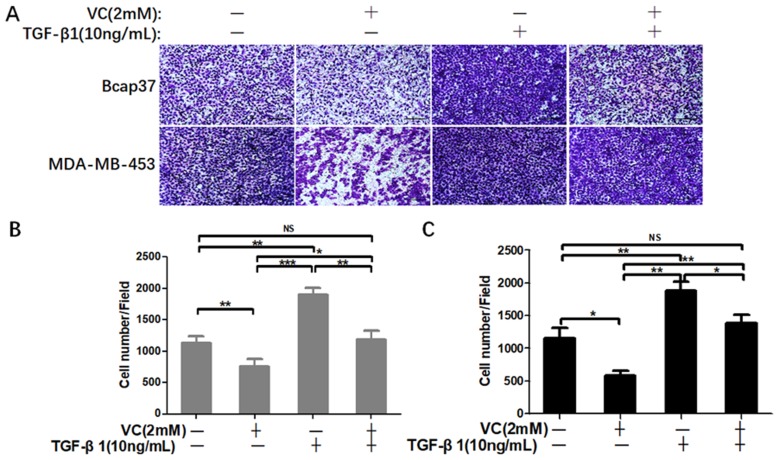
0.01 and 0.1 mM VC promoted cell migration and invasion when compared with the control group, but 2 mM VC significantly suppressed cell migration and invasion of breast cancer cell lines. High-dose VC increased E-cadherin and reduced Vimentin, indicating that high-dose VC suppressed epithelial-mesenchymal transition (EMT) in breast cancer cells. Besides, high-dose VC inhibited cell invasion promoted by TGF-β1 in breast cancer cells. Meanwhile, high-dose VC reversed the suppression of E-cadherin and enhancement of Vimentin induced by TGF-β1 in breast cancer cells. Furthermore, high-dose VC significantly inhibited breast cancer metastasis in vivo.
High-dose VC inhibits cell migration and invasion of breast cancer cell lines through suppressing EMT. Thus, it may be considered as an anticancer drug candidate for breast cancer patients.
维生素C(VC)是人体内一种必需营养素,在过去的一百年里被视为一种典型的抗氧化剂。然而,VC的抗癌作用存在争议。我们的研究旨在阐明VC剂量与乳腺癌转移之间的关系。
用人乳腺癌细胞系Bcap37和MDA-MB-453分别用三种不同浓度的VC(低剂量,0.01 mM;中剂量,0.1 mM;高剂量,2 mM)处理。进行伤口愈合试验以检测细胞迁移能力;进行Transwell试验以检测细胞侵袭能力。通过蛋白质印迹分析或免疫组织化学评估蛋白质水平。构建裸鼠肿瘤异种移植模型以测试VC对乳腺癌细胞增殖和转移的影响。
与对照组相比,0.01 mM和0.1 mM的VC促进了细胞迁移和侵袭,但2 mM的VC显著抑制了乳腺癌细胞系的细胞迁移和侵袭。高剂量VC增加了E-钙黏蛋白并降低了波形蛋白,表明高剂量VC抑制了乳腺癌细胞的上皮-间质转化(EMT)。此外,高剂量VC抑制了TGF-β1促进的乳腺癌细胞侵袭。同时,高剂量VC逆转了TGF-β1诱导的乳腺癌细胞中E-钙黏蛋白的抑制和波形蛋白的增强。此外,高剂量VC在体内显著抑制了乳腺癌转移。
高剂量VC通过抑制EMT抑制乳腺癌细胞系的细胞迁移和侵袭。因此,它可能被认为是乳腺癌患者的一种抗癌药物候选物。