Department of Biomedical Sciences, Faculty of Health and Medical Sciences, University of Copenhagen, Copenhagen, Denmark.
Biotechnology Institute Thurgau (BITg), University of Konstanz, Kreuzlingen, Switzerland.
Front Immunol. 2019 Sep 13;10:2156. doi: 10.3389/fimmu.2019.02156. eCollection 2019.
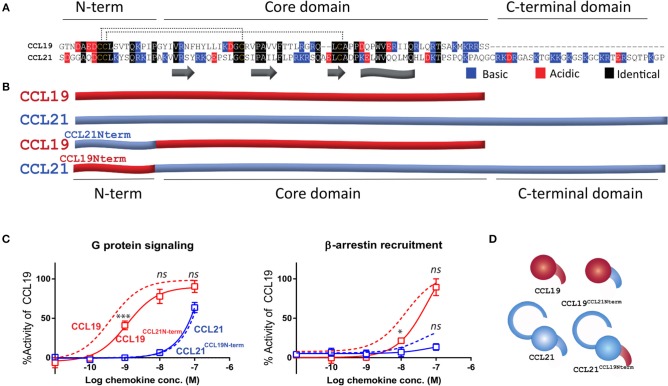
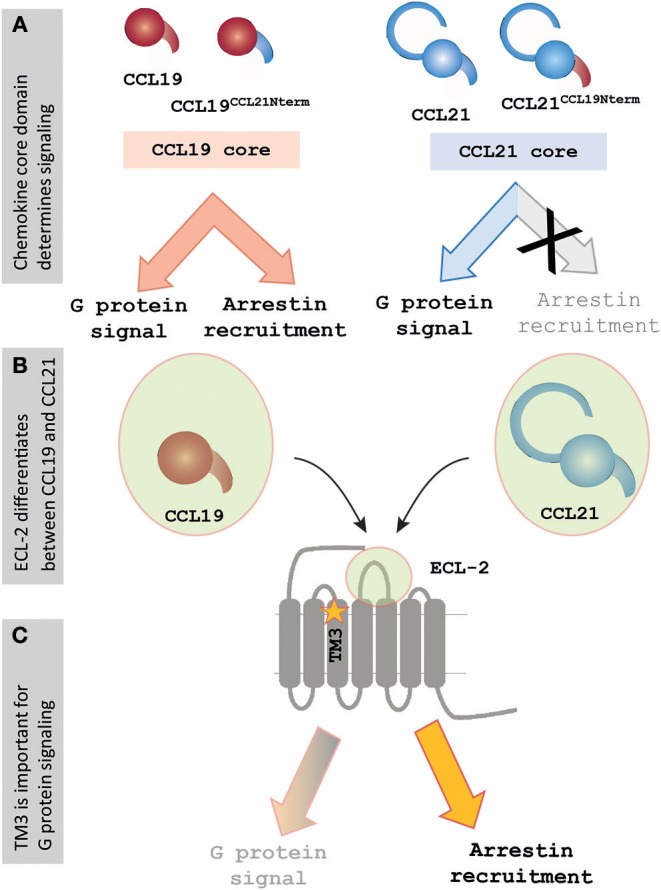
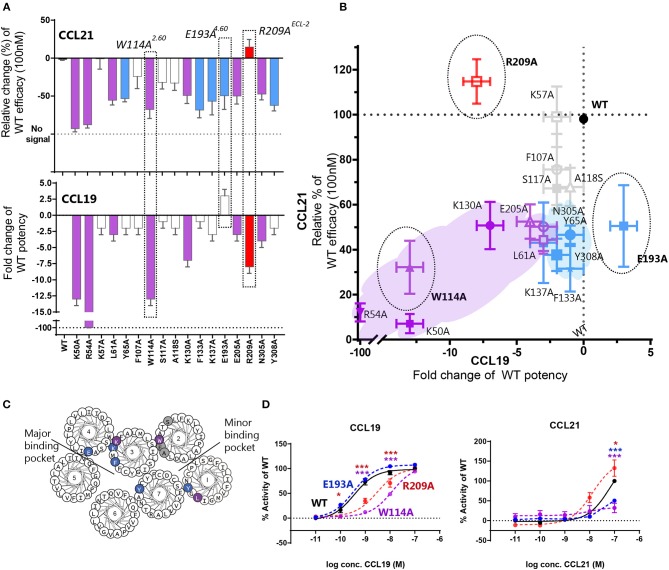
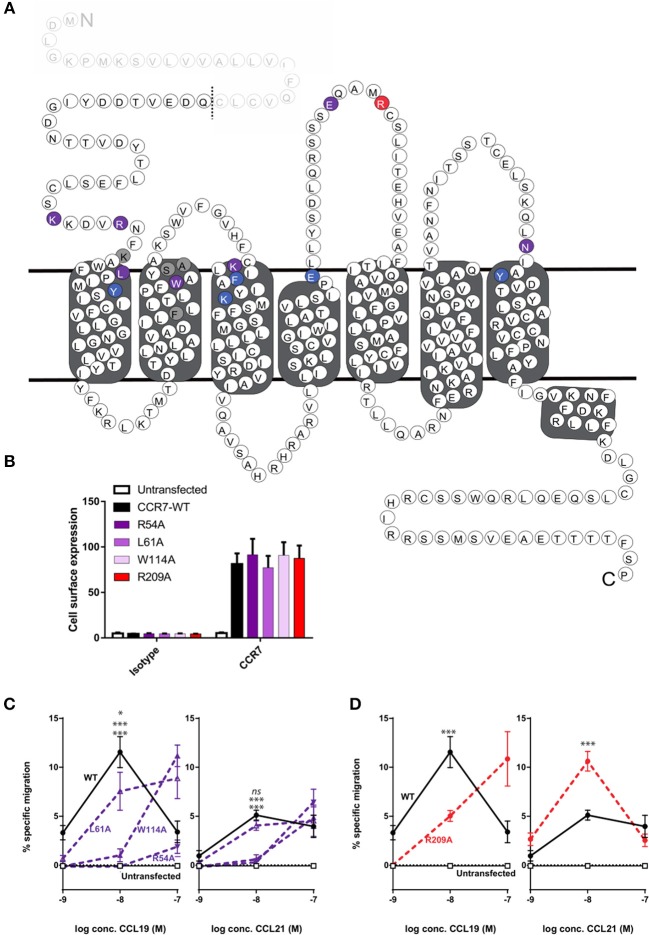
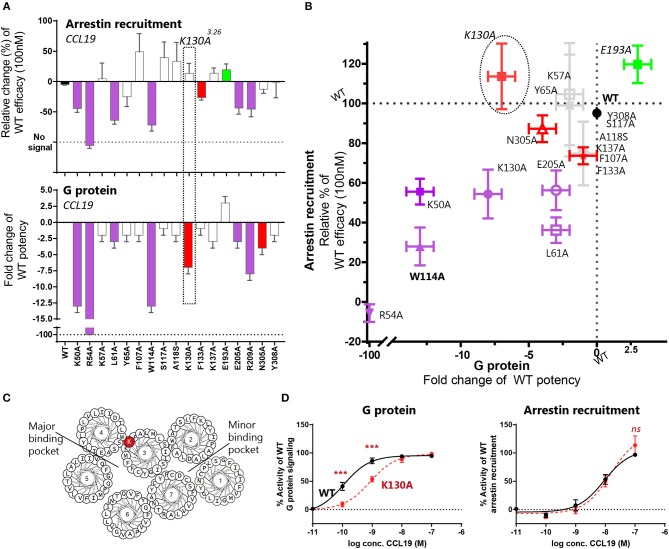
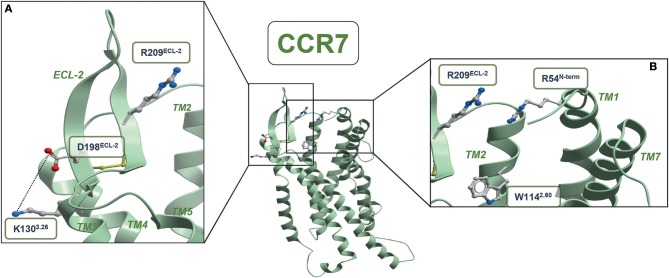
Chemokine receptors play important roles in the immune system and are linked to several human diseases. Targeting chemokine receptors have so far shown very little success owing to, to some extent, the promiscuity of the immune system and the high degree of biased signaling within it. CCR7 and its two endogenous ligands display biased signaling and here we investigate the differences between the two ligands, CCL21 and CCL19, with respect to their biased activation of CCR7. We use (BRET) based signaling assays and Transwell migration assays to determine how swapping of domains between the two ligands affect their signaling patterns and how receptor mutagenesis impacts signaling. Using chimeric ligands we find that the chemokine core domains are central for determining signaling outcome as the lack of β-arrestin-2 recruitment displayed by CCL21 is linked to its core domain and not N-terminus. Through a mutagenesis screen, we identify the extracellular domains of CCR7 to be important for both ligands and show that the two chemokines interact differentially with extracellular loop 2 (ECL-2). By using modeling, we propose a link between ECL-2 interaction and CCR7 signal transduction. Our mutagenesis study also suggests a lysine in the top of TM3, K130, to be important for G protein signaling, but not β-arrestin-2 recruitment. Taken together, the bias in CCR7 between CCL19 and CCL21 relies on the chemokine core domains, where interactions with ECL-2 seem particularly important. Moreover, TM3 selectively regulates G protein signaling as found for other chemokine receptors.
趋化因子受体在免疫系统中发挥着重要作用,与多种人类疾病有关。由于免疫系统的复杂性和高度偏向性信号传递,迄今为止,针对趋化因子受体的靶向治疗效果甚微。CCR7 及其两种内源性配体显示出偏向性信号传递,在此我们研究了两种配体 CCL21 和 CCL19 在激活 CCR7 方面的差异。我们使用基于 BRET 的信号检测和 Transwell 迁移实验来确定配体之间的结构域交换如何影响它们的信号模式,以及受体突变如何影响信号传递。使用嵌合配体,我们发现趋化因子核心结构域对于确定信号传递结果至关重要,因为 CCL21 缺乏β-arrestin-2 募集与其核心结构域而非 N 端有关。通过突变筛选,我们确定 CCR7 的细胞外结构域对于两种配体都很重要,并表明这两种趋化因子与细胞外环 2(ECL-2)相互作用不同。通过建模,我们提出了 ECL-2 相互作用与 CCR7 信号转导之间的联系。我们的突变研究还表明,TM3 顶部的一个赖氨酸 K130 对于 G 蛋白信号传递很重要,但对于β-arrestin-2 募集则不重要。总之,CCR7 在 CCL19 和 CCL21 之间的偏向性依赖于趋化因子核心结构域,其中与 ECL-2 的相互作用似乎尤为重要。此外,正如其他趋化因子受体所发现的那样,TM3 选择性地调节 G 蛋白信号传递。