Department of Pathology and Medical Biology, University Medical Center Groningen, University of Groningen, Groningen, Netherlands.
Department of Internal Medicine, Division of Nephrology, University Medical Center Groningen, Groningen, Netherlands.
Front Immunol. 2019 Sep 12;10:2170. doi: 10.3389/fimmu.2019.02170. eCollection 2019.
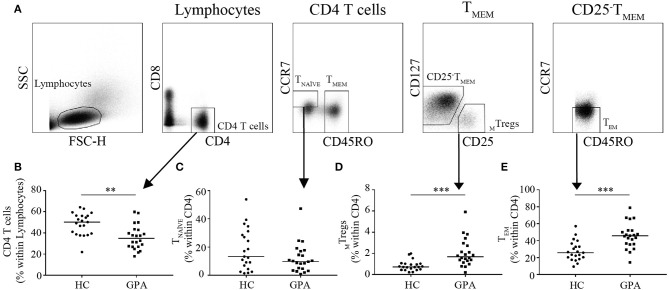
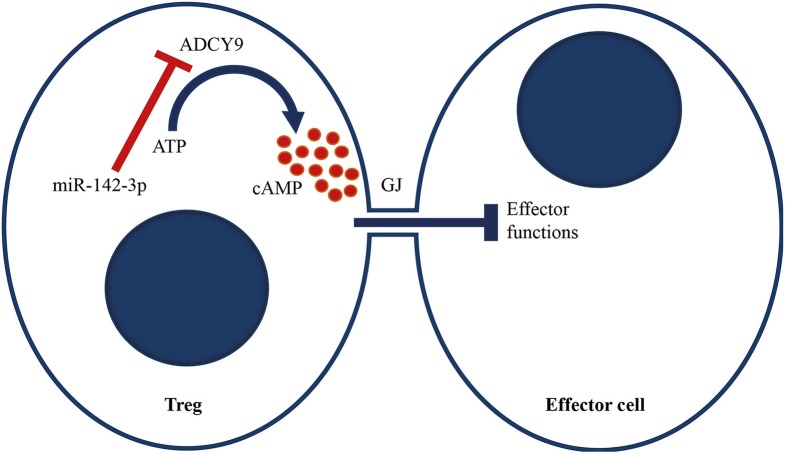
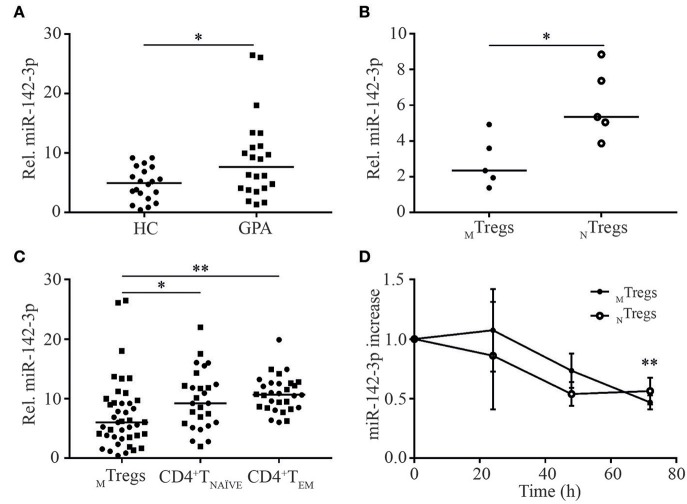
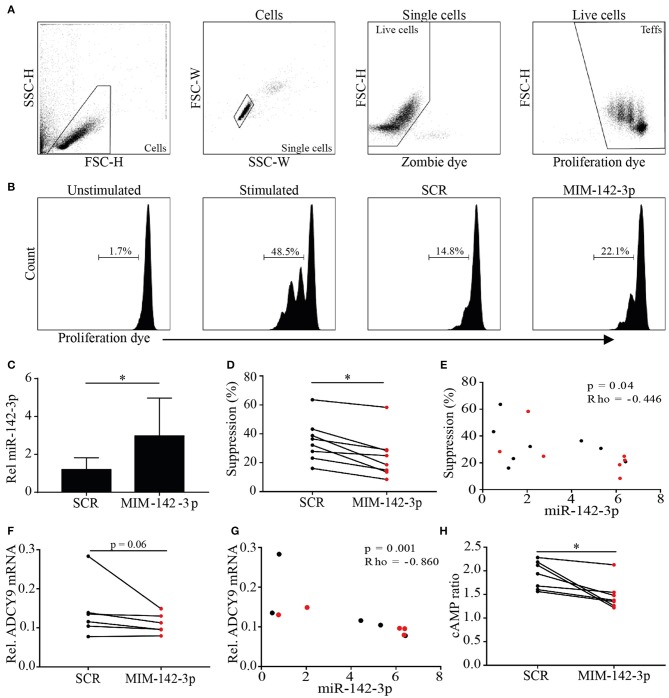
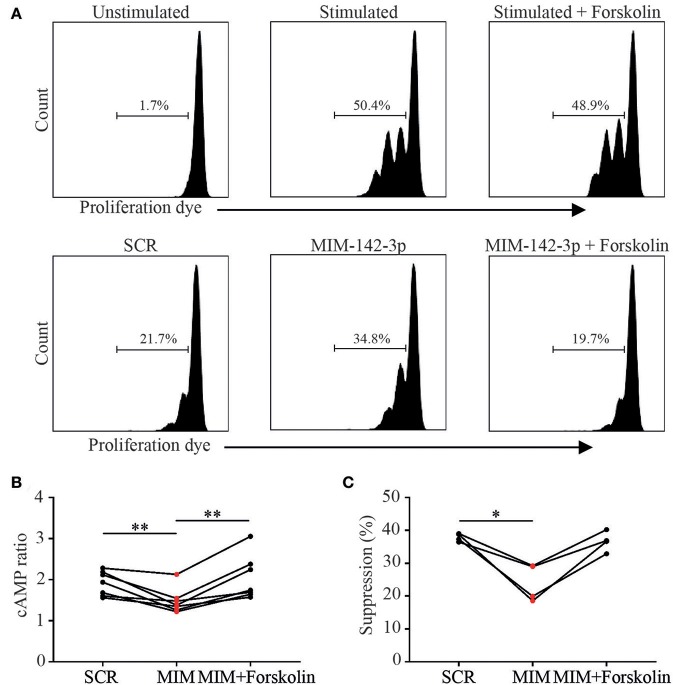
Regulatory T cells (Tregs) are frequently functionally impaired in patients with granulomatosis with polyangiitis (GPA). However, the mechanism underlying their impaired function is unknown. Here, we hypothesized that Treg dysfunction in GPA is due to altered microRNA (miRNA) expression. RNA isolated from FACS-sorted memory () Tregs (CD4CD45ROCD25CD127) of 8 healthy controls (HCs) and 8 GPA patients without treatment was subjected to miRNA microarray analysis. Five differentially expressed miRNAs were validated in a larger cohort by reverse transcriptase quantitative polymerase chain reaction (RT-qPCR). An miRNA target gene database search revealed targets that were tested with RT-qPCR in Tregs from patients and HCs. cAMP levels were measured using flow cytometry. Microarray analysis revealed 19 differentially expressed miRNAs, of which miR-142-3p was confirmed to be significantly upregulated in Tregs from GPA patients compared to those from HCs (1.9-fold, = 0.03). overexpression of miR-142-3p lowered the suppressive capacity of Tregs (2.1-fold, = 0.03), and miR-142-3p expression correlated negatively with the suppressive capacity (rho = -0.446, = 0.04). Overexpression of miR-142-3p significantly decreased cAMP levels ( = 0.02) and tended to decrease the mRNA levels of a predicted target gene, adenylate cyclase 9 (ADCY9; = 0.06). In comparison to those from HCs, Tregs from GPA patients had lower ADCY9 mRNA levels (2-fold, = 0.008) and produced significantly less cAMP after stimulation. Importantly, induction of cAMP production in miR-142-3p overexpressed Tregs by forskolin restored their suppressive function . Overexpression of miR-142-3p in Tregs from GPA patients might cause functional impairment by targeting ADCY9, which leads to the suppression of cAMP production.
调节性 T 细胞(Tregs)在肉芽肿性多血管炎(GPA)患者中经常表现出功能障碍。然而,其功能障碍的机制尚不清楚。在这里,我们假设 GPA 中的 Treg 功能障碍是由于 miRNA(miRNA)表达的改变。
从 8 名健康对照(HC)和 8 名未经治疗的 GPA 患者的 FACS 分选的记忆()Tregs(CD4CD45ROCD25CD127)中分离 RNA,并进行 miRNA 微阵列分析。通过逆转录定量聚合酶链反应(RT-qPCR)在更大的队列中验证了 5 个差异表达的 miRNA。通过 miRNA 靶基因数据库搜索,发现了在患者和 HC 的 Tregs 中通过 RT-qPCR 测试的靶基因。使用流式细胞术测量 cAMP 水平。
微阵列分析显示 19 个差异表达的 miRNA,其中 miR-142-3p 在 GPA 患者的 Tregs 中明显上调,与 HC 相比上调了 1.9 倍( = 0.03)。miR-142-3p 的过表达降低了 Tregs 的抑制能力(2.1 倍, = 0.03),并且 miR-142-3p 的表达与抑制能力呈负相关(rho = -0.446, = 0.04)。miR-142-3p 的过表达显著降低了 cAMP 水平( = 0.02),并倾向于降低预测靶基因腺苷酸环化酶 9(ADCY9)的 mRNA 水平( = 0.06)。与 HC 相比,GPA 患者的 Tregs 中 ADCY9 的 mRNA 水平降低了 2 倍( = 0.008),刺激后产生的 cAMP 明显减少。重要的是,用 forskolin诱导 miR-142-3p 过表达的 Tregs 中 cAMP 的产生恢复了它们的抑制功能。
在 GPA 患者的 Tregs 中转录过表达 miR-142-3p 可能通过靶向 ADCY9 导致功能障碍,从而抑制 cAMP 的产生。