School of Medicine, Institute of Biomedicine, University of Eastern Finland, Kuopio, Finland.
Front Immunol. 2019 Sep 13;10:2211. doi: 10.3389/fimmu.2019.02211. eCollection 2019.
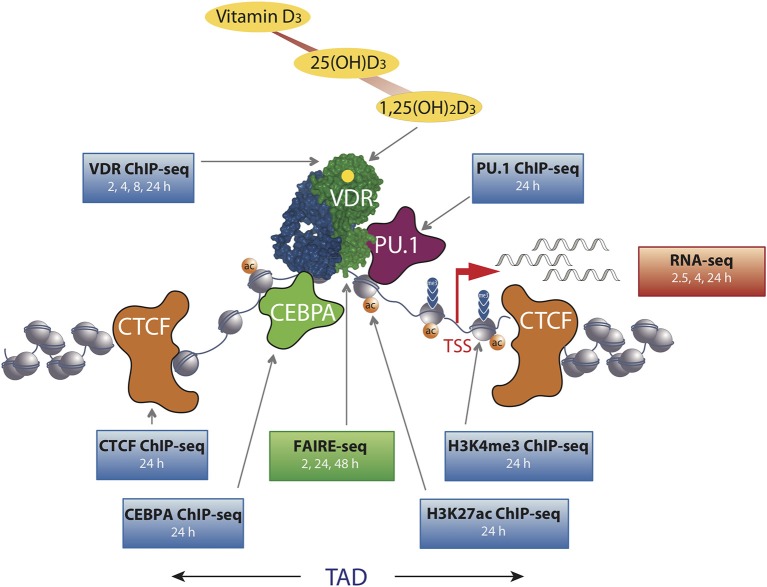
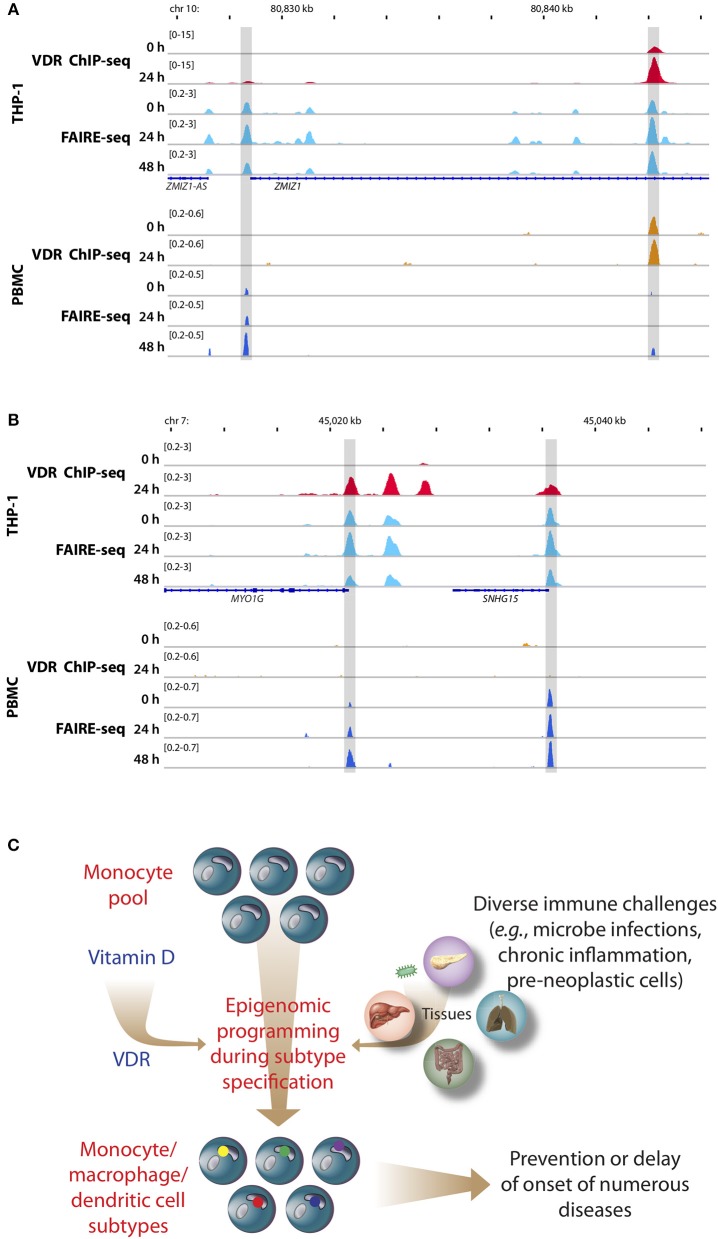
The vitamin D metabolite 1α,25-dihydroxyvitamin D (1,25(OH)D) activates at sub-nanomolar concentrations the transcription factor vitamin D receptor (VDR). VDR is primarily involved in the control of cellular metabolism but in addition modulates processes important for immunity, such as anti-microbial defense and the induction of T cell tolerance. Monocytes and their differentiated phenotypes, macrophages and dendritic cells, are key cell types of the innate immune system, in which vitamin D signaling was most comprehensively investigated the use of next generation sequencing technologies. These investigations provided genome-wide maps illustrating significant effects of 1,25(OH)D on the binding of VDR, the pioneer transcription factors purine-rich box 1 (PU.1) and CCAAT/enhancer binding protein α (CEBPA) and the chromatin modifier CCCTC-binding factor (CTCF) as well as on chromatin accessibility and histone markers of promoter and enhancer regions, H3K4me3 and H3K27ac. Thus, the epigenome of human monocytes is at multiple levels sensitive to vitamin D. These data served as the basis for the chromatin model of vitamin D signaling, which mechanistically explains the activation of a few hundred primary vitamin D target genes. Comparable epigenome- and transcriptome-wide effects of vitamin D were also described in peripheral blood mononuclear cells isolated from individuals before and after supplementation with a vitamin D bolus. This review will conclude with the hypothesis that vitamin D modulates the epigenome of immune cells during perturbations by antigens and other immunological challenges suggesting that an optimal vitamin D status may be essential for an effective epigenetic learning process, in particular of the innate immune system.
维生素 D 代谢物 1α,25-二羟维生素 D(1,25(OH)D)在亚纳摩尔浓度下激活维生素 D 受体(VDR)转录因子。VDR 主要参与细胞代谢的控制,但此外还调节对免疫很重要的过程,如抗微生物防御和 T 细胞耐受的诱导。单核细胞及其分化表型、巨噬细胞和树突状细胞是先天免疫系统的关键细胞类型,在先天免疫系统中,维生素 D 信号转导得到了最全面的研究——使用下一代测序技术。这些研究提供了基因组范围的图谱,说明了 1,25(OH)D 对 VDR、富含嘌呤的框 1(PU.1)和 CCAAT/增强子结合蛋白α(CEBPA)的先驱转录因子以及染色质修饰因子 CCCTC 结合因子(CTCF)的结合、染色质可及性以及启动子和增强子区域的组蛋白标记物 H3K4me3 和 H3K27ac 的显著影响。因此,人单核细胞的表观基因组在多个层面上对维生素 D 敏感。这些数据为维生素 D 信号的染色质模型提供了依据,该模型从机制上解释了几百个主要的维生素 D 靶基因的激活。在个体补充维生素 D 冲击前后分离的外周血单核细胞中,也描述了类似的维生素 D 对表观基因组和转录组的广泛影响。这篇综述将以假设结束,即维生素 D 在抗原和其他免疫挑战引起的免疫细胞表观基因组的改变中进行调节,这表明最佳的维生素 D 状态可能是有效表观遗传学习过程的关键,特别是对先天免疫系统。