Tang Kymeng, Gerling Kathrin, Chen Wei, Geurts Luc
e-Media Research Lab, KU Leuven, Leuven, Belgium.
Center for Intelligent Medical Electronics, Fudan University, Shanghai, China.
J Med Internet Res. 2019 Sep 27;21(9):e13947. doi: 10.2196/13947.
Breastfeeding has many benefits for newborns, mothers, and the wider society. The World Health Organization recommends mothers to feed newborns exclusively with breastmilk for the first 6 months after birth, but breastfeeding rates in many countries fail to align with the recommendations because of various barriers. Breastfeeding success is associated with a number of determinants, such as self-efficacy, intention to breastfeed, and attitudes toward breastfeeding. Information and communication technology (ICT) has been leveraged to support breastfeeding by means of improving knowledge or providing practical supports in different maternal stages. Previous reviews have examined and summarized the effectiveness and credibility of interventions; however, no review has been done from a human-computer interaction perspective that is concerned with novel interaction techniques and the perspective of end users.
The objective of this review was to provide a comprehensive overview of existing digital interventions that support breastfeeding by investigating systems' objective, technology design, validation process, and quality attributes, both in terms of clinical parameters as well as usability and user experience.
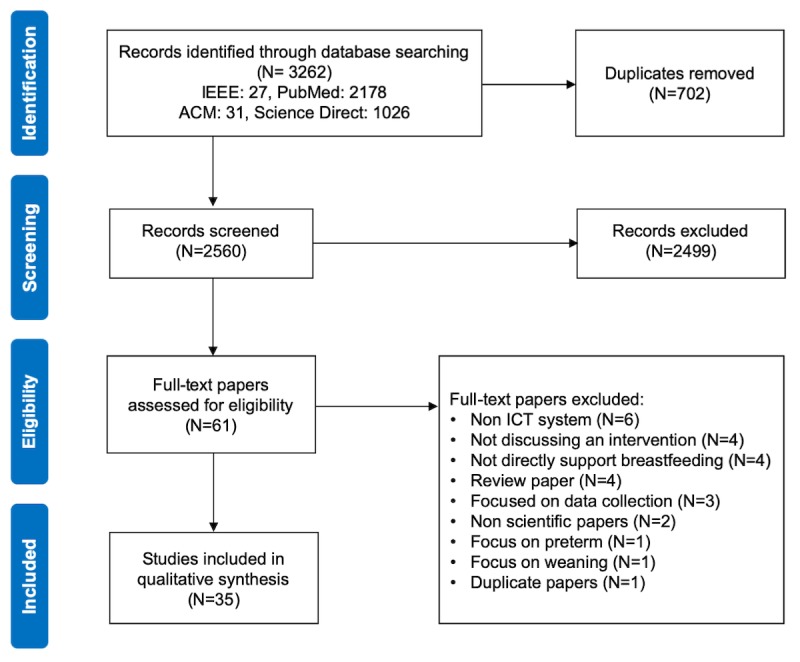
A systematic search was conducted in accordance with Preferred Reporting Items for Systematic Reviews and Meta-Analyses guidelines in the following libraries: PubMed, Science Direct, Association for Computing Machinery Digital Library (ACM Digital Library), and Institute of Electrical and Electronics Engineers Xplore (IEEE Xplore).
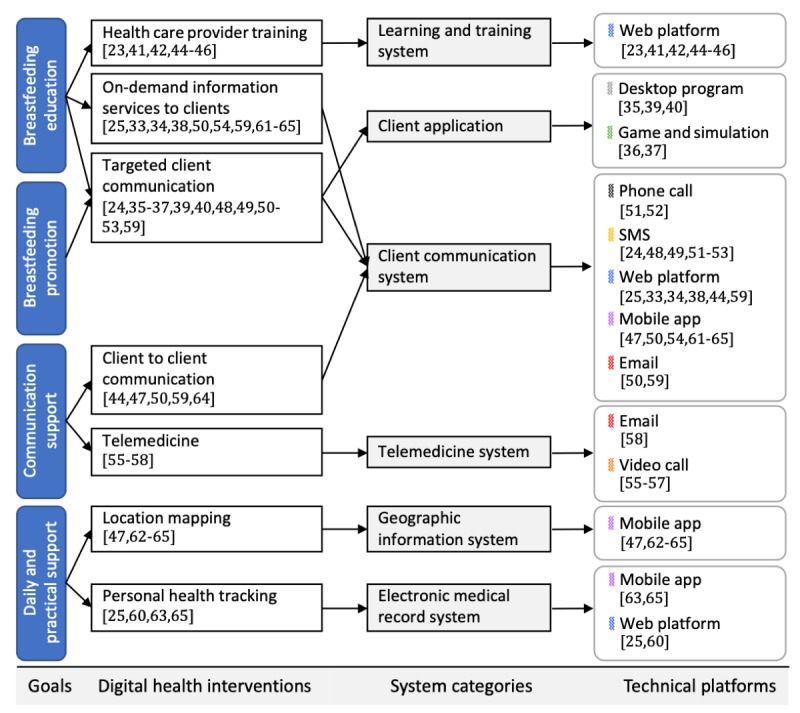
A total of 35 papers discussing 30 interventions were included. The main goals of these interventions were organized into 4 categories: breastfeeding education (n=12), breastfeeding promotion (n=8), communication support (n=6), and daily practical support (n=4). Of the interventions, 13 target mothers in the postnatal period. Most interventions come in forms of client communication systems (n=18), which frequently leverage Web technologies, text message, and mobile apps to provide breastfeeding support. Systems predominantly focus on mothers; validation strategies were rather heterogeneous, with 12 user studies concerning usability and user experience and 18 clinical validation studies focusing on the effects of the interventions on breastfeeding determinants; 5 papers did not report results. Generally, straightforward systems (eg, communication tools or Web-based solutions) seem to be more effective than complex interventions (eg, games).
Existing information and communication systems offer effective means of improving breastfeeding outcomes, but they do not address all relevant periods in parenthood (eg, the antenatal period) and often do not involve important stakeholders, such as partners. There is an opportunity to leverage more complex technical systems to open up avenues for the broader design of ICT to support breastfeeding; however, considering evaluation outcomes of existing support systems of higher complexity, such systems need to be designed with care.
母乳喂养对新生儿、母亲及更广泛的社会都有诸多益处。世界卫生组织建议母亲在婴儿出生后的头6个月纯母乳喂养,但由于各种障碍,许多国家的母乳喂养率未能达到这一建议水平。母乳喂养的成功与多个决定因素相关,如自我效能感、母乳喂养意愿以及对母乳喂养的态度。信息通信技术(ICT)已被用于通过在不同孕产阶段提高知识水平或提供实际支持来促进母乳喂养。以往的综述研究了并总结了干预措施的有效性和可信度;然而,尚未有从人机交互角度进行的综述,该角度关注新颖的交互技术以及终端用户的视角。
本综述的目的是通过调查系统的目标、技术设计、验证过程以及质量属性,从临床参数以及可用性和用户体验方面,全面概述支持母乳喂养的现有数字干预措施。
按照系统评价与Meta分析的首选报告项目(PRISMA)指南,在以下数据库进行系统检索:PubMed、科学Direct、美国计算机协会数字图书馆(ACM Digital Library)以及电气和电子工程师协会(IEEE)Xplore数据库。
共纳入35篇讨论30项干预措施的论文。这些干预措施的主要目标分为4类:母乳喂养教育(12项)、母乳喂养促进(8项)、沟通支持(6项)和日常实际支持(4项)。其中13项干预措施针对产后母亲。大多数干预措施采用客户沟通系统的形式(18项),这些系统经常利用网络技术、短信和移动应用程序来提供母乳喂养支持。系统主要关注母亲;验证策略差异较大,有12项用户研究涉及可用性和用户体验,18项临床验证研究关注干预措施对母乳喂养决定因素的影响;5篇论文未报告结果。总体而言,简单的系统(如沟通工具或基于网络的解决方案)似乎比复杂的干预措施(如游戏)更有效。
现有的信息通信系统提供了改善母乳喂养结果的有效手段,但它们并未涵盖育儿的所有相关阶段(如产前阶段),且通常未涉及重要利益相关者,如伴侣。有机会利用更复杂的技术系统为支持母乳喂养的信息通信技术更广泛设计开辟途径;然而,考虑到现有更高复杂性支持系统的评估结果,此类系统的设计需要谨慎。