Tran Bach Xuan, Latkin Carl A, Sharafeldin Noha, Nguyen Katherina, Vu Giang Thu, Tam Wilson W S, Cheung Ngai-Man, Nguyen Huong Lan Thi, Ho Cyrus S H, Ho Roger C M
Institute for Preventive Medicine and Public Health, Hanoi Medical University, Hanoi, Vietnam.
Bloomberg School of Public Health, Johns Hopkins University, Baltimore, MD, United States.
JMIR Med Inform. 2019 Sep 15;7(4):e14401. doi: 10.2196/14401.
Artificial intelligence (AI)-based therapeutics, devices, and systems are vital innovations in cancer control; particularly, they allow for diagnosis, screening, precise estimation of survival, informing therapy selection, and scaling up treatment services in a timely manner.
The aim of this study was to analyze the global trends, patterns, and development of interdisciplinary landscapes in AI and cancer research.
An exploratory factor analysis was conducted to identify research domains emerging from abstract contents. The Jaccard similarity index was utilized to identify the most frequently co-occurring terms. Latent Dirichlet Allocation was used for classifying papers into corresponding topics.
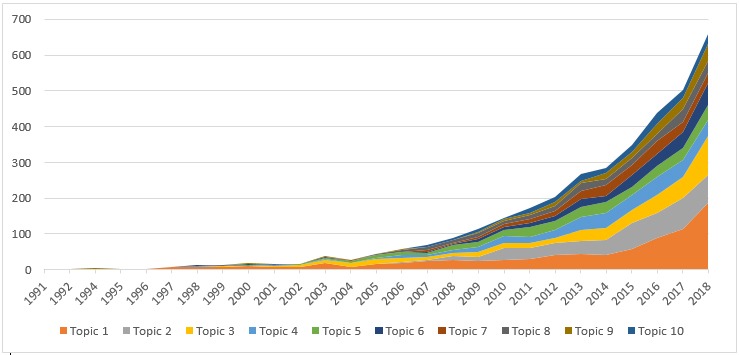
From 1991 to 2018, the number of studies examining the application of AI in cancer care has grown to 3555 papers covering therapeutics, capacities, and factors associated with outcomes. Topics with the highest volume of publications include (1) machine learning, (2) comparative effectiveness evaluation of AI-assisted medical therapies, and (3) AI-based prediction. Noticeably, this classification has revealed topics examining the incremental effectiveness of AI applications, the quality of life, and functioning of patients receiving these innovations. The growing research productivity and expansion of multidisciplinary approaches are largely driven by machine learning, artificial neural networks, and AI in various clinical practices.
The research landscapes show that the development of AI in cancer care is focused on not only improving prediction in cancer screening and AI-assisted therapeutics but also on improving other corresponding areas such as precision and personalized medicine and patient-reported outcomes.
基于人工智能(AI)的治疗方法、设备和系统是癌症控制领域的重要创新;特别是,它们有助于癌症诊断、筛查、精确估计生存期、指导治疗选择以及及时扩大治疗服务规模。
本研究旨在分析人工智能与癌症研究领域跨学科研究的全球趋势、模式及发展情况。
进行探索性因子分析以确定从摘要内容中浮现的研究领域。利用杰卡德相似性指数来识别最常共同出现的术语。使用潜在狄利克雷分配将论文分类到相应主题中。
从1991年到2018年,研究人工智能在癌症治疗中应用的研究数量已增长到3555篇论文,涵盖治疗方法、能力以及与治疗结果相关的因素。发表量最高的主题包括:(1)机器学习;(2)人工智能辅助医学治疗的比较有效性评估;(3)基于人工智能的预测。值得注意的是,这一分类揭示了一些研究主题,涉及人工智能应用的增量有效性、接受这些创新治疗的患者的生活质量和功能状况。研究生产力的不断提高以及多学科方法的扩展在很大程度上是由机器学习、人工神经网络以及人工智能在各种临床实践中的应用所推动的。
研究情况表明,癌症治疗领域人工智能的发展不仅专注于改善癌症筛查和人工智能辅助治疗中的预测,还致力于改善其他相关领域,如精准和个性化医疗以及患者报告的结果。