Department of Neuroscience, Ohio State University, Columbus, Ohio.
Neuroscience Graduate Program, Ohio State University, Columbus, Ohio.
Cytoskeleton (Hoboken). 2019 Jul;76(7-8):423-439. doi: 10.1002/cm.21566. Epub 2019 Nov 6.
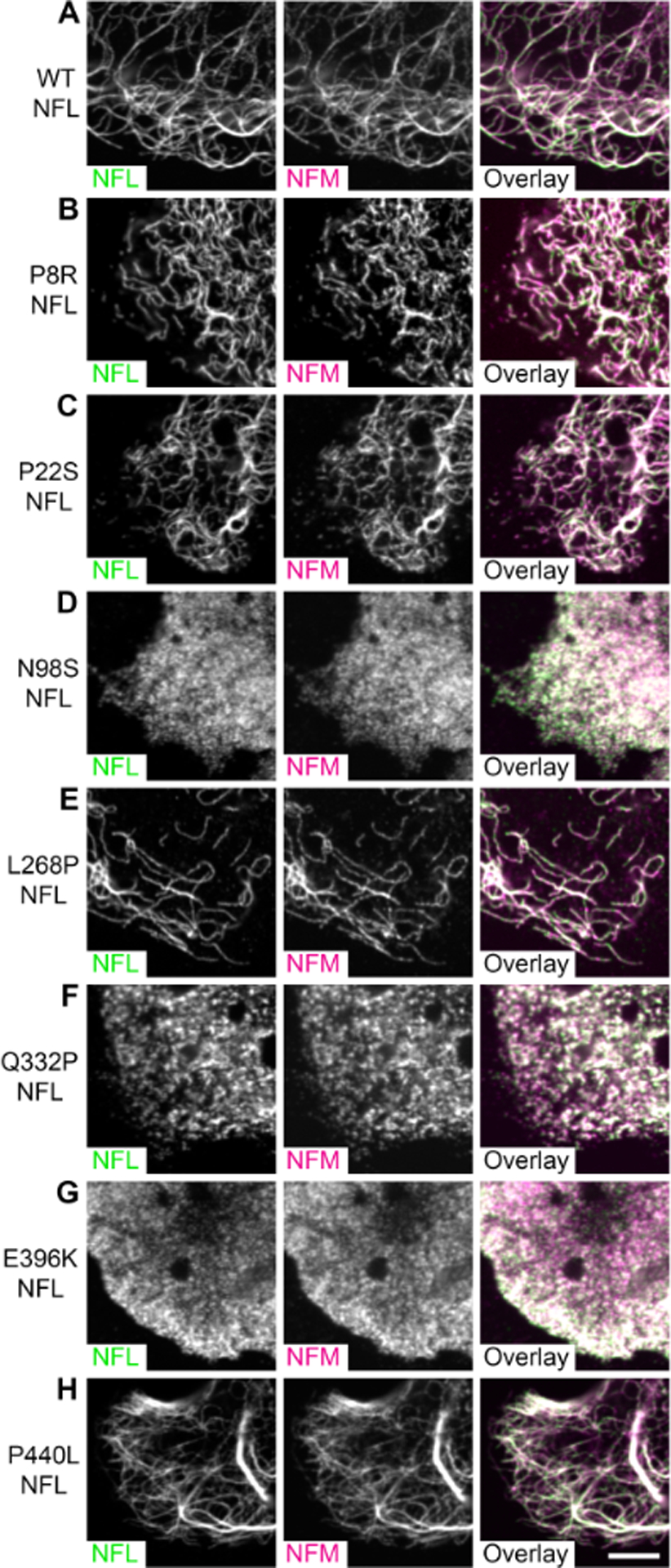
Charcot-Marie-Tooth disease Type 2E/1F (CMT2E/1F) is a peripheral neuropathy caused by mutations in neurofilament protein L (NFL), which is one of five neurofilament subunit proteins that co-assemble to form neurofilaments in vivo. Prior studies on cultured cells have shown that CMT2E/1F mutations disrupt neurofilament assembly and lead to protein aggregation, suggesting a possible disease mechanism. However, electron microscopy of axons in peripheral nerve biopsies from patients has revealed accumulations of neurofilament polymers of normal appearance and no evidence of protein aggregates. To reconcile these observations, we reexamined the assembly of seven CMT2E/1F NFL mutants in cultured cells. None of the mutants assembled into homopolymers in SW13vim- cells, but P8R, P22S, L268/269P, and P440/441L mutant NFL assembled into heteropolymers in the presence of neurofilament protein M (NFM) alone, and N98S, Q332/333P, and E396/397K mutant NFL assembled in the presence of NFM and peripherin. P8R, P22S, N98S, L268/269P, E396/397K, and P440/441L mutant NFL co-assembled into neurofilaments with endogenous NFL, NFM, and α-internexin in cultured neurons, although the N98S and E396/397K mutants showed reduced filament incorporation, and the Q332/333P mutant showed limited incorporation. We conclude that all the mutants are capable of assembling into neurofilaments, but for some of the mutants this was dependent on the identity of the other neurofilament proteins available for co-assembly, and most likely also their relative expression level. Thus, caution should be exercised when drawing conclusions about the assembly capacity of CMT2E/1F mutants based on transient transfections in cultured cells.
腓骨肌萎缩症 2E/1F 型(CMT2E/1F)是一种周围神经病,由神经丝蛋白 L(NFL)突变引起,NFL 是体内共同组装形成神经丝的五种神经丝亚单位蛋白之一。先前在培养细胞中的研究表明,CMT2E/1F 突变破坏神经丝组装并导致蛋白质聚集,提示可能存在疾病机制。然而,对患者周围神经活检中的轴突进行电子显微镜检查显示,正常外观的神经丝聚合物积累,没有蛋白质聚集的证据。为了解决这些观察结果,我们重新检查了在培养细胞中七种 CMT2E/1F NFL 突变体的组装情况。在 SW13vim-细胞中,没有一种突变体能够组装成同源聚合物,但 P8R、P22S、L268/269P 和 P440/441L 突变体 NFL 在单独存在神经丝蛋白 M(NFM)的情况下组装成异源聚合物,而 N98S、Q332/333P 和 E396/397K 突变体 NFL 在存在 NFM 和外周蛋白的情况下组装。P8R、P22S、N98S、L268/269P、E396/397K 和 P440/441L 突变体 NFL 与内源性 NFL、NFM 和 α-中间丝蛋白在培养神经元中共同组装成神经丝,尽管 N98S 和 E396/397K 突变体显示出减少的细丝掺入,而 Q332/333P 突变体显示出有限的掺入。我们得出结论,所有突变体都能够组装成神经丝,但对于一些突变体,这取决于其他神经丝蛋白的身份,它们可用于共同组装,并且很可能还取决于它们的相对表达水平。因此,在基于培养细胞中的瞬时转染来得出关于 CMT2E/1F 突变体的组装能力的结论时,应谨慎行事。