Baars Judith E, Keegan Mathew, Bonnichsen Mark H, Aepli Patrick, Theyventhiran Ruben, Farrell Elizabeth, Kench James G, Saxena Payal, Kaffes Arthur J
AW Morrow Gastroenterology and Liver Centre, Royal Prince Alfred Hospital, Sydney, Australia.
Department of Tissue Pathology and Diagnostic Oncology, Royal Prince Alfred Hospital, Sydney, Australia.
Endosc Int Open. 2019 Oct;7(10):E1241-E1247. doi: 10.1055/a-0950-9554. Epub 2019 Oct 1.
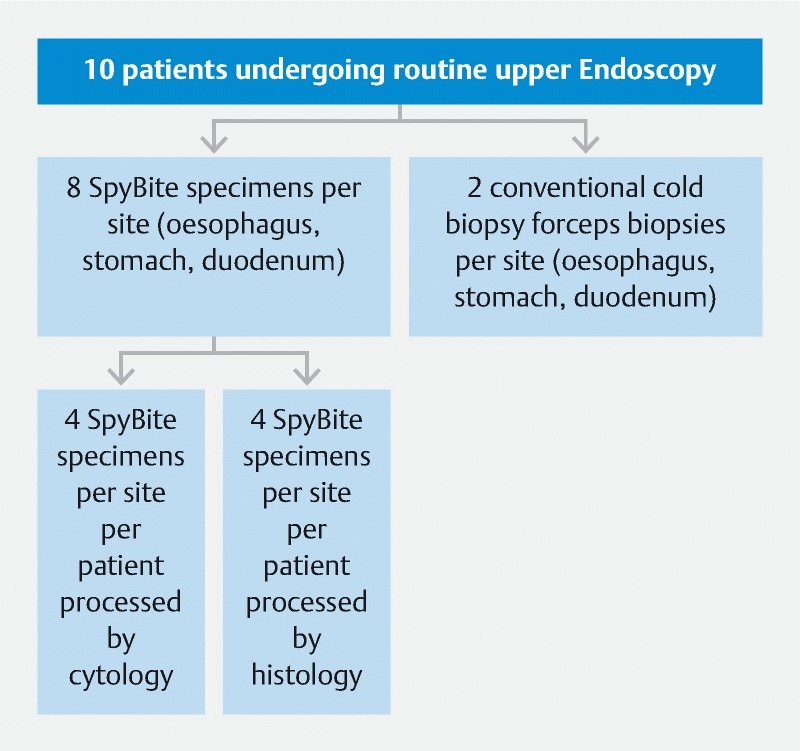
Diagnostic sensitivity for indeterminate biliary lesions remains suboptimal. Cytology techniques may mitigate the impediment of small cholangioscopic specimens. Our primary aim was to compare cell block cytology (CB) with standard histology for foregut SpyBite (SB) specimens. Our secondary aim was to assess CB in biliary SB biopsies. This was a two-phase prospective pilot study. In phase one, a prospective pilot study, foregut SB specimens from three sites (4 per site per patient per processing technique) were allocated to CB or histology, and assessed by a single, blinded pathologist. The gold standard comprised two standard forceps (CFB) histological specimens per site per patient. Specimen ease of processing, size and number, adequacy for diagnosis and artefact were evaluated. In phase two, CB was used for consecutive patients with indeterminate biliary lesions, and compared with phase one CB results. In phase one, 240 SB foregut biopsies were performed in 10 patients, 227 specimens recorded by pathologist. Specimen origin was identified in 100 % and 97 % of histology and CB batches respectively. Specimens were significantly larger in the histology group (2.02 mm vs 1.49 mm, < 0.05). There was a trend to less crush artifact with CB, and no difference in processing difficulty. In phase two, 11 patients (63.0 ±12.7 years, 91 % female) underwent SpyGlass (SG) assessment of suspected indeterminate stricture (n = 8) or mass (n = 3), and six underwent SB. All CB specimens were adequate for diagnosis. Specimen parameters were not significantly different from luminal CB outcomes. In this pilot study, cell block cytology showed similar results as histological analysis of SpyBite specimens in the analysis of biliary stricture.
对于不确定的胆管病变,诊断敏感性仍不理想。细胞学技术可能会减轻小胆管镜标本带来的阻碍。我们的主要目的是比较前肠SpyBite(SB)标本的细胞块细胞学(CB)与标准组织学。我们的次要目的是评估胆管SB活检中的CB。这是一项两阶段的前瞻性试点研究。在第一阶段,即一项前瞻性试点研究中,将来自三个部位(每位患者每种处理技术每个部位4个)的前肠SB标本分配给CB或组织学检查,并由一名单盲病理学家进行评估。金标准是每位患者每个部位两个标准钳取(CFB)组织学标本。评估了标本的处理难易程度、大小和数量、诊断的充分性以及假象。在第二阶段,对连续的胆管病变不确定患者使用CB,并与第一阶段的CB结果进行比较。在第一阶段,对10名患者进行了240次SB前肠活检,病理学家记录了227个标本。分别在100%和97%的组织学和CB批次中确定了标本来源。组织学组的标本明显更大(2.02毫米对1.49毫米,P<0.05)。CB的挤压假象有减少的趋势,处理难度没有差异。在第二阶段,11名患者(63.0±12.7岁,91%为女性)接受了SpyGlass(SG)对疑似不确定狭窄(n=8)或肿块(n=3)的评估,6名患者接受了SB。所有CB标本都足以用于诊断。标本参数与腔内CB结果没有显著差异。在这项试点研究中,在胆管狭窄分析中,细胞块细胞学显示出与SpyBite标本的组织学分析相似的结果。