Signature Science, LLC, Austin, Texas, United States of America.
Center for Human Identification, University of North Texas Health Science Center, Fort Worth, Texas, United States of America.
PLoS One. 2019 Oct 3;14(10):e0223170. doi: 10.1371/journal.pone.0223170. eCollection 2019.
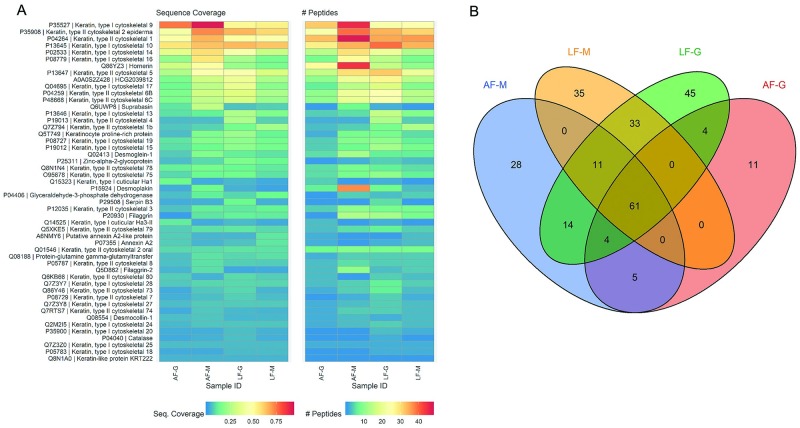
Quantitative genomic and proteomic evaluation of human latent fingerprint depositions represents a challenge within the forensic field, due to the high variability in the amount of DNA and protein initially deposited. To better assess recovery techniques for touch depositions, we present a method to produce simple and customizable artificial fingerprints. These artificial fingerprint samples include the primary components of a typical latent fingerprint, specifically sebaceous fluid, eccrine perspiration, extracellular DNA, and proteinaceous epidermal skin material (i.e., shed skin cells). A commercially available emulsion of sebaceous and eccrine perspiration material provides a chemically-relevant suspension solution for fingerprint deposition, simplifying artificial fingerprint production. Extracted human genomic DNA is added to accurately mimic the extracellular DNA content of a typical latent print and comparable DNA yields are recovered from the artificial prints relative to human prints across surface types. Capitalizing on recent advancements in the use of protein sequence identification for human forensic analysis, these samples also contain a representative quantity of protein, originating from epidermal skin cells collected from the fingers and palms of volunteers. Proteomic sequencing by liquid chromatography-tandem mass spectrometry (LC-MS/MS) analysis indicates a high level of protein overlap between artificial and latent prints. Data are available via ProteomeXchange with identifier PXD015445. By including known quantities of DNA and protein into each artificial print, this method enables total DNA and protein recovery to be quantitatively assessed across different sample collection and extraction methods to better evaluate extraction efficiency. Collectively, these artificial fingerprint samples are simple to make, highly versatile and customizable, and accurately represent the biochemical composition and biological signatures of human fingerprints.
定量基因组学和蛋白质组学评估人类潜在指纹沉积物是法医学领域的一个挑战,因为最初沉积的 DNA 和蛋白质数量变化很大。为了更好地评估触摸沉积物的回收技术,我们提出了一种生产简单且可定制的人工指纹的方法。这些人工指纹样本包括典型潜在指纹的主要成分,特别是皮脂液、汗、细胞外 DNA 和蛋白表皮皮肤物质(即脱落的皮肤细胞)。一种市售的皮脂和汗材料乳液提供了一种与指纹沉积化学相关的悬浮溶液,简化了人工指纹的生产。提取的人类基因组 DNA 被添加以准确模拟典型潜在指纹的细胞外 DNA 含量,并且从人工指纹中回收的 DNA 产量与各种表面类型的人类指纹相当。利用最近在人类法医分析中使用蛋白质序列鉴定的进展,这些样本还包含来自志愿者手指和手掌收集的表皮皮肤细胞的代表性蛋白质量。通过液相色谱-串联质谱 (LC-MS/MS) 分析的蛋白质组学测序表明,人工指纹和潜在指纹之间存在高水平的蛋白质重叠。数据可通过 ProteomeXchange 以标识符 PXD015445 获得。通过在每个人工指纹中包含已知量的 DNA 和蛋白质,该方法能够定量评估不同样品采集和提取方法的总 DNA 和蛋白质回收,以更好地评估提取效率。总之,这些人工指纹样本制作简单,用途广泛且可定制,并准确代表了人类指纹的生物化学组成和生物学特征。