Stanciu Cristina E, Philpott M Katherine, Kwon Ye Jin, Bustamante Eduardo E, Ehrhardt Christopher J
Department of Forensic Science, Virginia Commonwealth University, Richmond, VA, 23284, USA.
F1000Res. 2015 Nov 26;4:1360. doi: 10.12688/f1000research.7385.1. eCollection 2015.
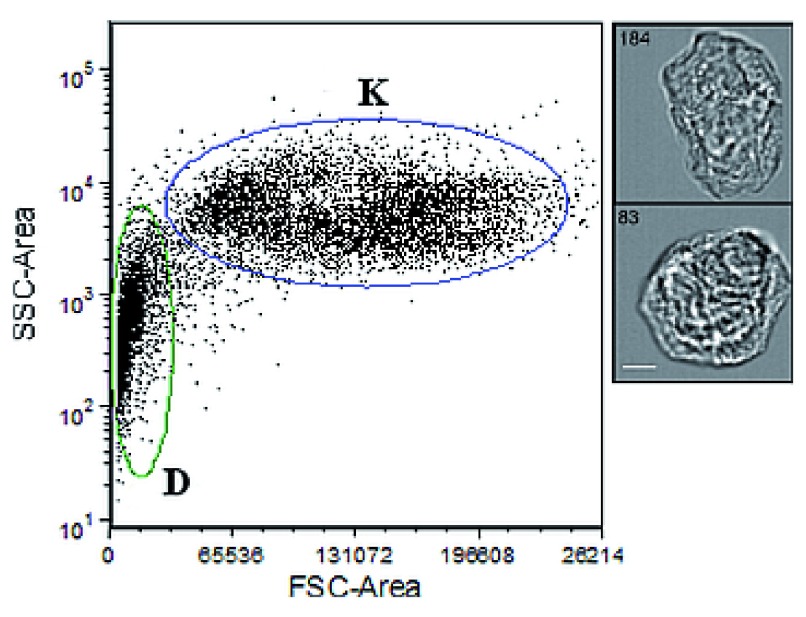
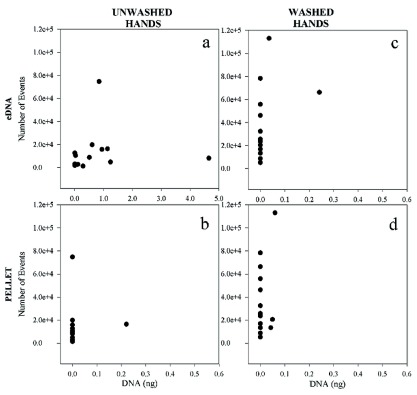
The goal of this study was to investigate the relative contributions of different cellular and genetic components to biological samples created by touch or contact with a surface - one of the most challenging forms of forensic evidence. Touch samples were generated by having individuals hold an object for five minutes and analyzed for quantity of intact epidermal cells, extracellular DNA, and DNA from pelleted cell material after elution from the collection swab. Comparisons were made between samples where individuals had washed their hands immediately prior to handling and those where hand washing was not controlled. The vast majority (84-100%) of DNA detected in these touch samples was extracellular and was uncorrelated to the number of epidermal cells detected. Although little to no extracellular or cell pellet-associated DNA was detected when individuals washed their hands prior to substrate handling, we found that a significant number of epidermal cells (between ~5x10 (3) and ~1x10 (5)) could still be recovered from these samples, suggesting that other types of biological information may be present even when no amplifiable nuclear DNA is present. These results help to elucidate the biological context for touch samples and characterize factors that may contribute to patterns of transfer and persistence of genetic material in forensic evidence.
本研究的目的是调查不同细胞和遗传成分对通过触摸或与表面接触而形成的生物样本的相对贡献,触摸或与表面接触是法医证据中最具挑战性的形式之一。通过让个体手持一个物体五分钟来生成触摸样本,并对洗脱自采集拭子后的完整表皮细胞数量、细胞外DNA以及来自沉淀细胞物质的DNA进行分析。对个体在处理前立即洗手的样本和未控制洗手的样本进行了比较。在这些触摸样本中检测到的绝大多数(84%-100%)DNA是细胞外的,并且与检测到的表皮细胞数量无关。尽管当个体在处理底物前洗手时几乎没有检测到细胞外或与细胞沉淀相关的DNA,但我们发现仍可从这些样本中回收大量表皮细胞(约5×10³至约1×10⁵个),这表明即使不存在可扩增的核DNA,可能仍存在其他类型的生物信息。这些结果有助于阐明触摸样本的生物学背景,并确定可能影响法医证据中遗传物质转移和持久性模式的因素。