Sackl-Pammer Petra, Jahn Rebecca, Özlü-Erkilic Zeliha, Pollak Eva, Ohmann Susanne, Schwarzenberg Julia, Plener Paul, Akkaya-Kalayci Türkan
1Department of Child and Adolescent Psychiatry, Medical University of Vienna, Währinger Gürtel 18-20, 1090 Vienna, Austria.
2Department for Psychiatry and Psychotherapy, Clinical Division of Social Psychiatry, Medical University of Vienna, Währinger Gürtel 18-20, 1090 Vienna, Austria.
Child Adolesc Psychiatry Ment Health. 2019 Sep 30;13:37. doi: 10.1186/s13034-019-0297-9. eCollection 2019.
Social anxiety disorder (SAD) in adolescents may be associated with the use of maladaptive emotion regulation (ER) strategies. The present study examined the use of maladaptive and adaptive ER strategies in adolescents with SAD.
30 adolescents with SAD (CLIN) and 36 healthy adolescents for the control group (CON) aged between 11 and 16 years were assessed with the standardized questionnaires PHOKI () for self-reported fears as well as FEEL-KJ () for different emotion regulation strategies.
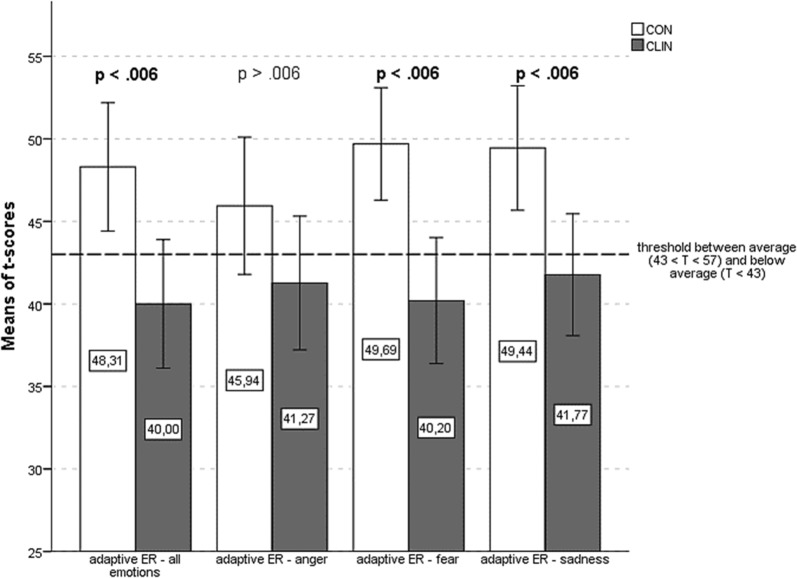
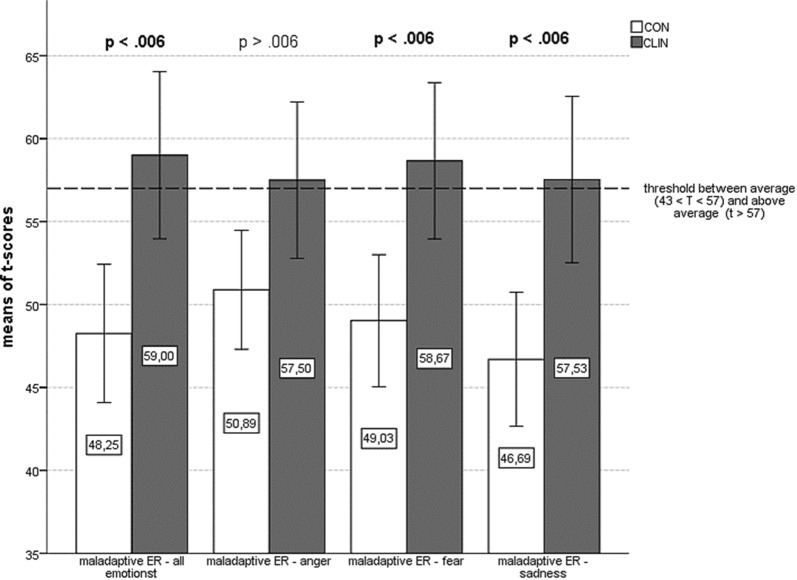
Compared to controls, adolescents with SAD used adaptive ER strategies significantly less often, but made use of maladaptive ER strategies significantly more often. There was a significant positive correlation between maladaptive ER and social anxiety in adolescents. Examining group differences of single ER strategy use, the CLIN and CON differed significantly in the use of the adaptive ER strategy with CLIN reporting less use of than CON. Group differences regarding the maladaptive ER strategies and , as well as the adaptive ER strategy - were found present, with CLIN reporting more use of and and less use of - than CON.
Promoting adaptive emotion regulation should be a central component of psychotherapy (cognitive behavioral therapy-CBT) for social anxiety in adolescents from the beginning of the therapy process. These findings provide rationale for special therapy programs concentrating on the establishment of different adaptive ER strategies (including ). As an increased use of maladaptive ER may be associated with SAD in adolescents, it may be paramount to focus on reduction of maladaptive ER (for example and ) from the beginning of the psychotherapy process. Incorporating more ER components into psychotherapy (CBT) could increase the treatment efficacy. Further investigations of the patterns of emotion regulation in specific anxiety groups like SAD in adolescents is needed to continue to optimize the psychotherapy (CBT) concept.
青少年社交焦虑障碍(SAD)可能与适应不良的情绪调节(ER)策略的使用有关。本研究调查了患有SAD的青少年中适应不良和适应性ER策略的使用情况。
对30名患有SAD的青少年(临床组)和36名年龄在11至16岁之间的健康青少年对照组(CON)进行评估,使用标准化问卷PHOKI()进行自我报告的恐惧评估,以及使用FEEL-KJ()评估不同的情绪调节策略。
与对照组相比,患有SAD的青少年较少使用适应性ER策略,但更多地使用适应不良的ER策略。青少年中适应不良的ER与社交焦虑之间存在显著的正相关。检查单一ER策略使用的组间差异,临床组和对照组在适应性ER策略的使用上存在显著差异,临床组报告的使用量少于对照组。发现临床组和对照组在适应不良的ER策略和以及适应性ER策略上存在组间差异,临床组报告的和的使用量多于对照组,而的使用量少于对照组。
从治疗过程开始,促进适应性情绪调节应成为青少年社交焦虑心理治疗(认知行为疗法 - CBT)的核心组成部分。这些发现为专注于建立不同适应性ER策略(包括)的特殊治疗方案提供了理论依据。由于青少年中适应不良的ER使用增加可能与SAD有关,从心理治疗过程开始就专注于减少适应不良的ER(例如和)可能至关重要。将更多的ER成分纳入心理治疗(CBT)可以提高治疗效果。需要进一步研究特定焦虑群体(如青少年SAD)的情绪调节模式,以继续优化心理治疗(CBT)概念。