Rondanelli Mariangela, Perdoni Federica, Infantino Vittoria, Faliva Milena Anna, Peroni Gabriella, Iannello Giancarlo, Nichetti Mara, Alalwan Tariq A, Perna Simone, Cocuzza Clementina
IRCCS Mondino Foundation, Pavia 27100, Italy.
Department of Public Health, Experimental and Forensic Medicine, University of Pavia, Pavia 27100, Italy.
J Anal Methods Chem. 2019 Sep 10;2019:7247802. doi: 10.1155/2019/7247802. eCollection 2019.
The purpose of this review was to identify the best solution for rapid and noninvasive diagnosis and long-term monitoring of patients affected by inflammatory gastrointestinal diseases, colon and gastric cancer, obesity in correlation to diet, and breast milk to evaluate exposure to VOCs in women and infants.
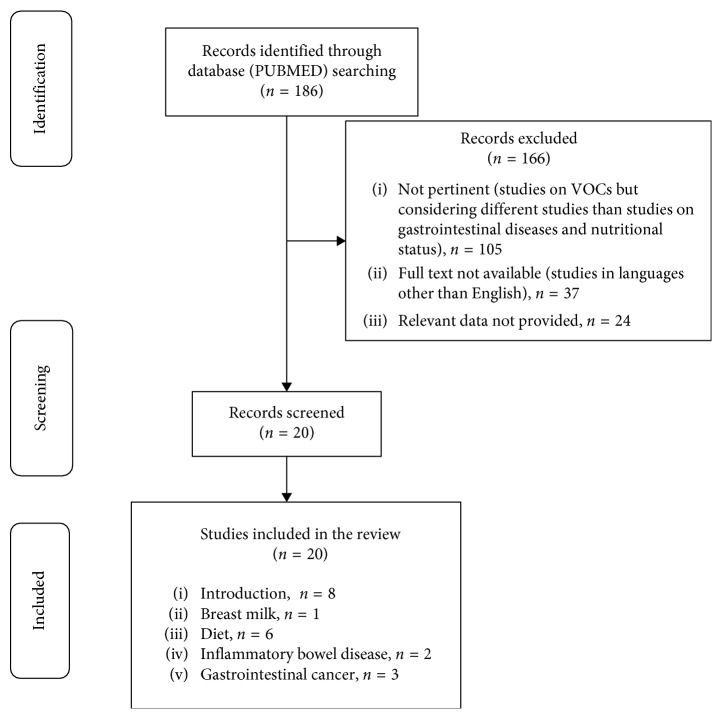
This review included 20 previously published eligible studies. VOC analysis has allowed us to highlight differences in lifestyles, intestinal microbiota, and metabolism. New innovative methods have been described that allow the detection and quantification of a broad spectrum of metabolites present in exhaled breath even at very low levels, some of which have been shown to be indicators of pathological conditions.
Five studies were analyzed that involved VOC analysis in relation to type of diet. All of them showed that the type of diet can have an impact on metabolites excreted and therefore can be a useful tool in the nutritional studies related to metabolism and health and disease status. Two studies concerned VOC analysis in inflammatory bowel diseases, and the results showed that VOCs can distinguish active disease from remission; VOC profile is clearly different in patients. In particular, CH 1-pentadecene, 3-methyl-1-butanal, octane, acetic acid, alpha-pinene, and m-cymene are elevated in active ulcerative colitis. Four studies examined VOCs in gastric and colorectal tumors showing a change in metabolic biomarkers of cancer patients compared to the control group. Finally, the study of VOCs in breast milk has improved the understanding of the potential health risks of exposure of children to chemical pollutants.
VOC analysis allowed to highlight differences in behavior, lifestyle, and metabolism of individuals. Analytical methods are continuously developed to allow for better detection and quantification of metabolites, thus enabling the detection of a broader spectrum of pathophysiology and disease biomarkers.
本综述的目的是确定用于炎症性胃肠疾病、结肠癌和胃癌、与饮食相关的肥胖以及母乳中挥发性有机化合物(VOCs)暴露评估以评价妇女和婴儿健康状况的快速、非侵入性诊断及长期监测的最佳解决方案。
本综述纳入了20项先前发表的符合条件的研究。VOC分析使我们能够突出生活方式、肠道微生物群和代谢方面的差异。已描述了新的创新方法,这些方法能够检测和定量呼出气体中存在的广泛代谢物,即使含量极低,其中一些已被证明是病理状况的指标。
分析了5项涉及饮食类型与VOC分析的研究。所有研究均表明饮食类型可对排泄的代谢物产生影响,因此可成为与代谢、健康和疾病状况相关的营养研究中的有用工具。两项研究涉及炎症性肠病中的VOC分析,结果表明VOCs可区分疾病活动期与缓解期;患者的VOC谱明显不同。特别是,在活动期溃疡性结肠炎中,1-十五碳烯、3-甲基-1-丁醛、辛烷、乙酸、α-蒎烯和间异丙基苯含量升高。四项研究检测了胃癌和结直肠癌中的VOCs,结果显示与对照组相比,癌症患者的代谢生物标志物发生了变化。最后,对母乳中VOCs的研究增进了对儿童接触化学污染物潜在健康风险的理解。
VOC分析能够突出个体在行为、生活方式和代谢方面的差异。分析方法不断发展,以实现对代谢物的更好检测和定量,从而能够检测更广泛的病理生理学和疾病生物标志物。