Advanced Medical and Healthcare Technologies, School of Pharmacy, University of Nottingham, Nottingham, NG7 2RD, UK.
Department of Chemical and Environmental Engineering, Faculty of Engineering, University of Nottingham, Nottingham, NG7 2RD, UK.
Adv Mater. 2019 Dec;31(49):e1903513. doi: 10.1002/adma.201903513. Epub 2019 Oct 3.
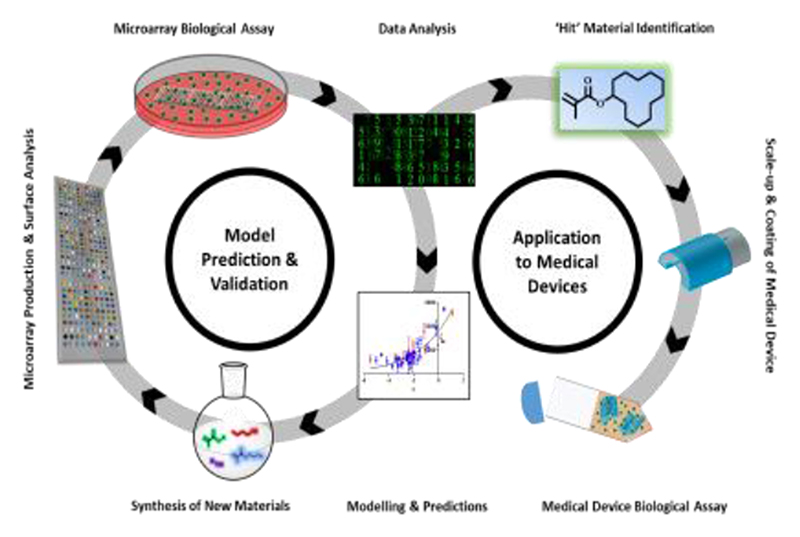
Synthetic materials are an everyday component of modern healthcare yet often fail routinely as a consequence of medical-device-centered infections. The incidence rate for catheter-associated urinary tract infections is between 3% and 7% for each day of use, which means that infection is inevitable when resident for sufficient time. The O'Neill Review on antimicrobial resistance estimates that, left unchecked, ten million people will die annually from drug-resistant infections by 2050. Development of biomaterials resistant to bacterial colonization can play an important role in reducing device-associated infections. However, rational design of new biomaterials is hindered by the lack of quantitative structure-activity relationships (QSARs). Here, the development of a predictive QSAR is reported for bacterial biofilm formation on a range of polymers, using calculated molecular descriptors of monomer units to discover and exemplify novel, biofilm-resistant (meth-)acrylate-based polymers. These predictions are validated successfully by the synthesis of new monomers which are polymerized to create coatings found to be resistant to biofilm formation by six different bacterial pathogens: Pseudomonas aeruginosa, Proteus mirabilis, Enterococcus faecalis, Klebsiella pneumoniae, Escherichia coli, and Staphylococcus aureus.
合成材料是现代医疗保健的日常组成部分,但由于医疗器械为中心的感染,它们经常失效。导管相关尿路感染的发生率为每天使用 3%至 7%,这意味着当留置足够时间时,感染是不可避免的。奥尼尔关于抗菌素耐药性的评论估计,如果不加控制,到 2050 年,每年将有 1000 万人死于耐药感染。开发抗细菌定植的生物材料可以在减少器械相关感染方面发挥重要作用。然而,新生物材料的合理设计受到缺乏定量构效关系(QSAR)的阻碍。在这里,我们报道了一种用于预测一系列聚合物上细菌生物膜形成的预测性 QSAR,使用单体单元的计算分子描述符来发现和举例说明新型、抗生物膜(甲基)丙烯酸酯基聚合物。通过合成新的单体并将其聚合以形成涂层,这些预测得到了成功验证,这些涂层被发现能抵抗六种不同的细菌病原体:铜绿假单胞菌、奇异变形杆菌、粪肠球菌、肺炎克雷伯菌、大肠杆菌和金黄色葡萄球菌的生物膜形成。