• 文献检索
  • 文档翻译
  • 深度研究
  • 学术资讯
  • Suppr Zotero 插件Zotero 插件
  • 邀请有礼
  • 套餐&价格
  • 历史记录
应用&插件
Suppr Zotero 插件Zotero 插件浏览器插件Mac 客户端Windows 客户端微信小程序
定价
高级版会员购买积分包购买API积分包
服务
文献检索文档翻译深度研究API 文档MCP 服务
关于我们
关于 Suppr公司介绍联系我们用户协议隐私条款
关注我们

Suppr 超能文献

核心技术专利:CN118964589B侵权必究
粤ICP备2023148730 号-1Suppr @ 2026

文献检索

告别复杂PubMed语法,用中文像聊天一样搜索,搜遍4000万医学文献。AI智能推荐,让科研检索更轻松。

立即免费搜索

文件翻译

保留排版,准确专业,支持PDF/Word/PPT等文件格式,支持 12+语言互译。

免费翻译文档

深度研究

AI帮你快速写综述,25分钟生成高质量综述,智能提取关键信息,辅助科研写作。

立即免费体验

用于中风患者康复的虚拟现实、增强现实和游戏化外骨骼:系统评价

Exoskeletons With Virtual Reality, Augmented Reality, and Gamification for Stroke Patients' Rehabilitation: Systematic Review.

作者信息

Mubin Omar, Alnajjar Fady, Jishtu Nalini, Alsinglawi Belal, Al Mahmud Abdullah

机构信息

School of Computing, Engineering and Mathematics, Western Sydney University, Rydalmere, Australia.

College of Information Technology, United Arab Emirates University, Al Ain, Abu Dhabi, United Arab Emirates.

出版信息

JMIR Rehabil Assist Technol. 2019 Sep 8;6(2):e12010. doi: 10.2196/12010.

DOI:10.2196/12010
PMID:31586360
原文链接:https://pmc.ncbi.nlm.nih.gov/articles/PMC6779025/
Abstract

BACKGROUND

Robot-assisted therapy has become a promising technology in the field of rehabilitation for poststroke patients with motor disorders. Motivation during the rehabilitation process is a top priority for most stroke survivors. With current advancements in technology there has been the introduction of virtual reality (VR), augmented reality (AR), customizable games, or a combination thereof, that aid robotic therapy in retaining, or increasing the interests of, patients so they keep performing their exercises. However, there are gaps in the evidence regarding the transition from clinical rehabilitation to home-based therapy which calls for an updated synthesis of the literature that showcases this trend. The present review proposes a categorization of these studies according to technologies used, and details research in both upper limb and lower limb applications.

OBJECTIVE

The goal of this work was to review the practices and technologies implemented in the rehabilitation of poststroke patients. It aims to assess the effectiveness of exoskeleton robotics in conjunction with any of the three technologies (VR, AR, or gamification) in improving activity and participation in poststroke survivors.

METHODS

A systematic search of the literature on exoskeleton robotics applied with any of the three technologies of interest (VR, AR, or gamification) was performed in the following databases: MEDLINE, EMBASE, Science Direct & The Cochrane Library. Exoskeleton-based studies that did not include any VR, AR or gamification elements were excluded, but publications from the years 2010 to 2017 were included. Results in the form of improvements in the patients' condition were also recorded and taken into consideration in determining the effectiveness of any of the therapies on the patients.

RESULTS

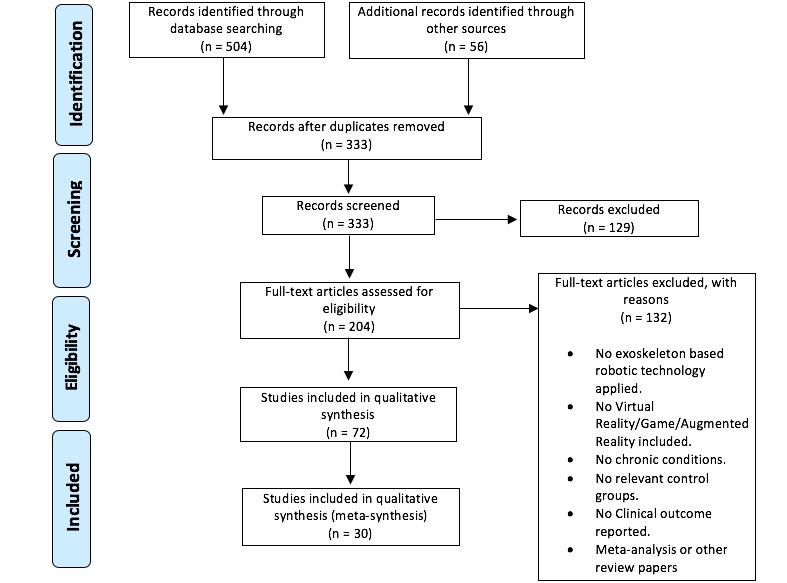
Thirty studies were identified based on the inclusion criteria, and this included randomized controlled trials as well as exploratory research pieces. There were a total of about 385 participants across the various studies. The use of technologies such as VR-, AR-, or gamification-based exoskeletons could fill the transition from the clinic to a home-based setting. Our analysis showed that there were general improvements in the motor function of patients using the novel interfacing techniques with exoskeletons. This categorization of studies helps with understanding the scope of rehabilitation therapies that can be successfully arranged for home-based rehabilitation.

CONCLUSIONS

Future studies are necessary to explore various types of customizable games required to retain or increase the motivation of patients going through the individual therapies.

摘要

背景

机器人辅助治疗已成为中风后运动障碍患者康复领域一项很有前景的技术。康复过程中的积极性是大多数中风幸存者的首要任务。随着当前技术的进步,虚拟现实(VR)、增强现实(AR)、可定制游戏或它们的组合已被引入,以帮助机器人治疗保持或提高患者的兴趣,使他们持续进行锻炼。然而,关于从临床康复过渡到家庭治疗的证据存在空白,这需要对展示这一趋势的文献进行更新综合。本综述根据所使用的技术对这些研究进行分类,并详细介绍上肢和下肢应用方面的研究。

目的

这项工作的目的是回顾中风后患者康复中实施的实践和技术。旨在评估外骨骼机器人与三种技术(VR、AR或游戏化)中的任何一种结合使用在改善中风幸存者的活动和参与度方面的有效性。

方法

在以下数据库中对应用了三种相关技术(VR、AR或游戏化)中任何一种的外骨骼机器人相关文献进行系统检索:MEDLINE、EMBASE、科学Direct和Cochrane图书馆。排除未包括任何VR、AR或游戏化元素的基于外骨骼的研究,但纳入2010年至2017年的出版物。还记录了患者病情改善形式的结果,并在确定任何一种治疗方法对患者的有效性时予以考虑。

结果

根据纳入标准确定了30项研究,包括随机对照试验以及探索性研究。各项研究共有约385名参与者。使用基于VR、AR或游戏化的外骨骼等技术可以填补从诊所到家庭环境的过渡。我们的分析表明,使用与外骨骼的新型接口技术后,患者的运动功能总体上有所改善。这种研究分类有助于理解可以成功安排用于家庭康复的康复治疗范围。

结论

未来有必要开展研究,探索各种可定制游戏,以保持或提高接受个体治疗患者的积极性。
https://cdn.ncbi.nlm.nih.gov/pmc/blobs/241b/6779025/f9892dec3fac/rehab_v6i2e12010_fig1.jpg

相似文献

1
Exoskeletons With Virtual Reality, Augmented Reality, and Gamification for Stroke Patients' Rehabilitation: Systematic Review.用于中风患者康复的虚拟现实、增强现实和游戏化外骨骼:系统评价
JMIR Rehabil Assist Technol. 2019 Sep 8;6(2):e12010. doi: 10.2196/12010.
2
Virtual Reality, Augmented Reality, Gamification, and Telerehabilitation: Psychological Impact on Orthopedic Patients' Rehabilitation.虚拟现实、增强现实、游戏化与远程康复:对骨科患者康复的心理影响
J Clin Med. 2020 Aug 7;9(8):2567. doi: 10.3390/jcm9082567.
3
Virtual and augmented reality in biomedical engineering.虚拟现实和增强现实在生物医学工程中的应用。
Biomed Eng Online. 2023 Jul 31;22(1):76. doi: 10.1186/s12938-023-01138-3.
4
Application of AR and VR in hand rehabilitation: A systematic review.增强现实(AR)和虚拟现实(VR)在手部康复中的应用:系统评价。
J Biomed Inform. 2020 Nov;111:103584. doi: 10.1016/j.jbi.2020.103584. Epub 2020 Oct 2.
5
Combined robot-assisted therapy virtual reality for upper limb rehabilitation in stroke survivors: a systematic review of randomized controlled trials.联合机器人辅助治疗虚拟现实上肢康复脑卒中幸存者:系统评价随机对照试验。
Neurol Sci. 2024 Nov;45(11):5141-5155. doi: 10.1007/s10072-024-07628-z. Epub 2024 Jun 5.
6
Game-Based Virtual Reality System for Upper Limb Rehabilitation After Stroke in a Clinical Environment: Systematic Review and Meta-Analysis.基于游戏的虚拟现实系统在临床环境下用于脑卒中后上肢康复的系统评价和 Meta 分析。
Games Health J. 2022 Oct;11(5):277-297. doi: 10.1089/g4h.2022.0086.
7
Effectiveness of combined robotics and virtual reality on lower limb functional ability in stroke survivors: A systematic review of randomized controlled trials.联合机器人和虚拟现实对脑卒中幸存者下肢功能能力的影响:一项随机对照试验的系统评价。
Neurol Sci. 2024 Oct;45(10):4721-4739. doi: 10.1007/s10072-024-07618-1. Epub 2024 Jun 3.
8
Virtual and Augmented Reality in Post-stroke Rehabilitation: A Narrative Review.虚拟现实与增强现实在中风后康复中的应用:一项叙述性综述
Cureus. 2023 Apr 14;15(4):e37559. doi: 10.7759/cureus.37559. eCollection 2023 Apr.
9
Acceptability of a Mobile Phone-Based Augmented Reality Game for Rehabilitation of Patients With Upper Limb Deficits from Stroke: Case Study.基于手机的增强现实游戏对中风后上肢功能障碍患者康复的可接受性:案例研究
JMIR Rehabil Assist Technol. 2020 Sep 2;7(2):e17822. doi: 10.2196/17822.
10
Movement visualisation in virtual reality rehabilitation of the lower limb: a systematic review.虚拟现实下肢康复中的运动可视化:一项系统综述
Biomed Eng Online. 2016 Dec 19;15(Suppl 3):144. doi: 10.1186/s12938-016-0289-4.

引用本文的文献

1
Upper limb robotic rehabilitation following stroke: a systematic review and meta-analysis investigating efficacy and the influence of device features and program parameters.中风后上肢机器人康复:一项调查疗效以及设备特征和程序参数影响的系统评价和荟萃分析
J Neuroeng Rehabil. 2025 Jul 16;22(1):164. doi: 10.1186/s12984-025-01662-4.
2
A Novel Bilateral Data Fusion Approach for EMG-Driven Deep Learning in Post-Stroke Paretic Gesture Recognition.一种用于中风后偏瘫手势识别中肌电图驱动深度学习的新型双边数据融合方法。
Sensors (Basel). 2025 Jun 11;25(12):3664. doi: 10.3390/s25123664.
3
Five canonical findings from 30 years of psychological experimentation in virtual reality.

本文引用的文献

1
Rehabilitation robots for the treatment of sensorimotor deficits: a neurophysiological perspective.用于治疗感觉运动缺陷的康复机器人:神经生理学视角。
J Neuroeng Rehabil. 2018 Jun 5;15(1):46. doi: 10.1186/s12984-018-0383-x.
2
Virtual reality for stroke rehabilitation.用于中风康复的虚拟现实技术。
Cochrane Database Syst Rev. 2017 Nov 20;11(11):CD008349. doi: 10.1002/14651858.CD008349.pub4.
3
Portable and Reconfigurable Wrist Robot Improves Hand Function for Post-Stroke Subjects.便携式可重构手腕机器人改善脑卒中后手功能
虚拟现实30年心理实验的五项典型发现。
Nat Hum Behav. 2025 May 22. doi: 10.1038/s41562-025-02216-3.
4
Enhancing lower-limb rehabilitation: a scoping review of augmented reality environment.增强下肢康复:对增强现实环境的范围综述
J Neuroeng Rehabil. 2025 May 20;22(1):114. doi: 10.1186/s12984-025-01643-7.
5
Deep Learning-Enhanced Motor Training: A Hybrid VR and Exoskeleton System for Cognitive-Motor Rehabilitation.深度学习增强型运动训练:一种用于认知运动康复的虚拟现实与外骨骼混合系统。
Bioengineering (Basel). 2025 Mar 22;12(4):331. doi: 10.3390/bioengineering12040331.
6
Using 3D and 4D digital human modeling in extended reality-based rehabilitation: a systematic review.在基于扩展现实的康复中使用3D和4D数字人体建模:一项系统综述。
Front Bioeng Biotechnol. 2025 Mar 12;13:1496168. doi: 10.3389/fbioe.2025.1496168. eCollection 2025.
7
Exploring New Tools in Upper Limb Rehabilitation After Stroke Using an Exoskeletal Aid: A Pilot Randomized Control Study.使用外骨骼辅助设备探索中风后上肢康复的新工具:一项试点随机对照研究。
Healthcare (Basel). 2025 Jan 6;13(1):91. doi: 10.3390/healthcare13010091.
8
The Efficacy of a Home-Based, Augmented Reality Dual-Task Platform for Cognitive-Motor Training in Elderly Patients: A Pilot Observational Study.基于家庭的增强现实双任务平台用于老年患者认知运动训练的疗效:一项试点观察性研究。
Psychiatry Investig. 2024 Oct;21(10):1045-1053. doi: 10.30773/pi.2024.0103. Epub 2024 Sep 30.
9
Decoding lower-limb kinematic parameters during pedaling tasks using deep learning approaches and EEG.使用深度学习方法和脑电图解码踏板运动任务期间的下肢运动学参数。
Med Biol Eng Comput. 2024 Dec;62(12):3763-3779. doi: 10.1007/s11517-024-03147-3. Epub 2024 Jul 19.
10
Robotic systems for upper-limb rehabilitation in multiple sclerosis: a SWOT analysis and the synergies with virtual and augmented environments.用于多发性硬化症上肢康复的机器人系统:SWOT分析以及与虚拟和增强环境的协同作用
Front Robot AI. 2024 Feb 27;11:1335147. doi: 10.3389/frobt.2024.1335147. eCollection 2024.
IEEE Trans Neural Syst Rehabil Eng. 2017 Oct;25(10):1864-1873. doi: 10.1109/TNSRE.2017.2692520. Epub 2017 Apr 7.
4
Training with a balance exercise assist robot is more effective than conventional training for frail older adults.与平衡训练辅助机器人一起训练对于体弱的老年人比传统训练更有效。
Geriatr Gerontol Int. 2017 Nov;17(11):1982-1990. doi: 10.1111/ggi.13009. Epub 2017 Mar 10.
5
Heart Disease and Stroke Statistics-2017 Update: A Report From the American Heart Association.《2017年心脏病和中风统计数据更新:美国心脏协会报告》
Circulation. 2017 Mar 7;135(10):e146-e603. doi: 10.1161/CIR.0000000000000485. Epub 2017 Jan 25.
6
Closed-Loop Task Difficulty Adaptation during Virtual Reality Reach-to-Grasp Training Assisted with an Exoskeleton for Stroke Rehabilitation.虚拟现实伸手抓握训练期间闭环任务难度适应,辅以用于中风康复的外骨骼
Front Neurosci. 2016 Nov 15;10:518. doi: 10.3389/fnins.2016.00518. eCollection 2016.
7
Virtual reality gaming in the rehabilitation of the upper extremities post-stroke.虚拟现实游戏在中风后上肢康复中的应用
Brain Inj. 2016;30(7):855-63. doi: 10.3109/02699052.2016.1144146. Epub 2016 Mar 30.
8
Integrative rehabilitation of residents chronic post-stroke in skilled nursing facilities: the design and evaluation of the BrightArm Duo.熟练护理机构中中风后慢性期居民的综合康复:BrightArm Duo的设计与评估
Disabil Rehabil Assist Technol. 2016 Nov;11(8):683-94. doi: 10.3109/17483107.2015.1068384. Epub 2015 Jul 28.
9
Robotic Rehabilitation Game Design for Chronic Stroke.机器人康复游戏设计用于慢性中风。
Games Health J. 2012 Dec;1(6):422-30. doi: 10.1089/g4h.2012.0044.
10
Choice of Human-Computer Interaction Mode in Stroke Rehabilitation.中风康复中人机交互模式的选择
Neurorehabil Neural Repair. 2016 Mar;30(3):258-65. doi: 10.1177/1545968315593805. Epub 2015 Jul 2.