Department of Psychological Sciences.
Department of Psychology.
J Exp Psychol Gen. 2020 May;149(5):914-934. doi: 10.1037/xge0000688. Epub 2019 Oct 7.
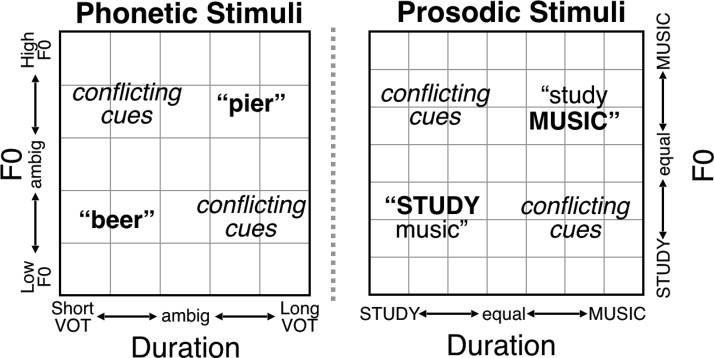
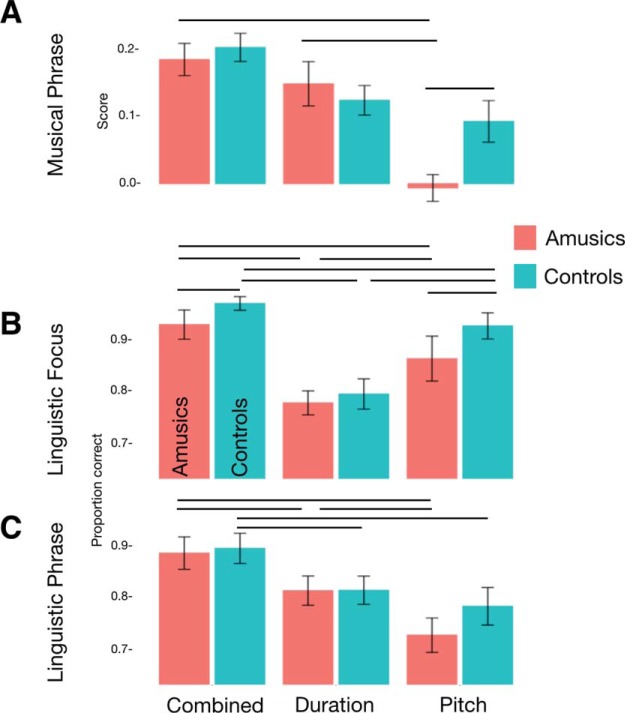
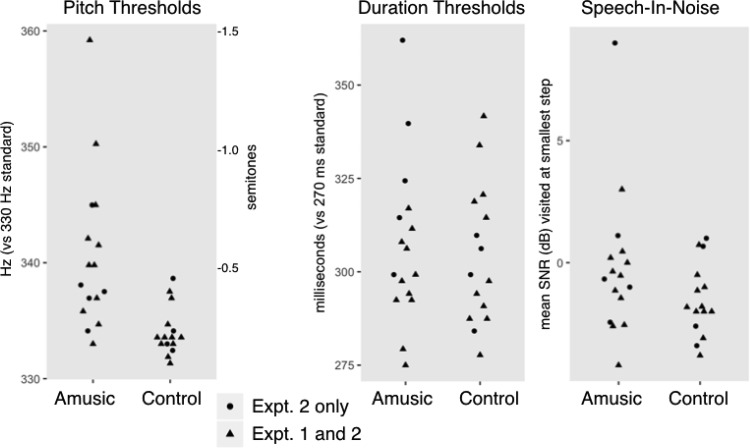
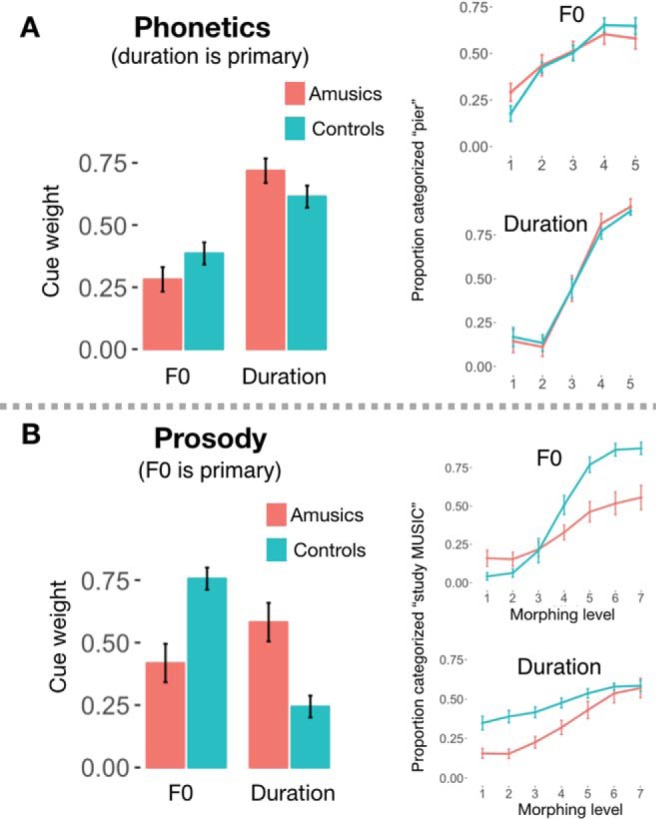
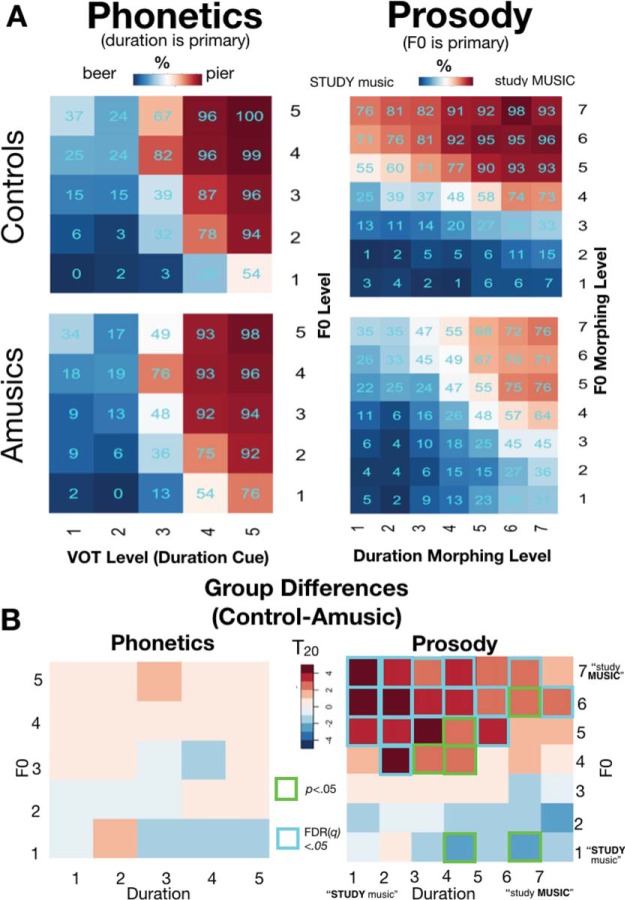
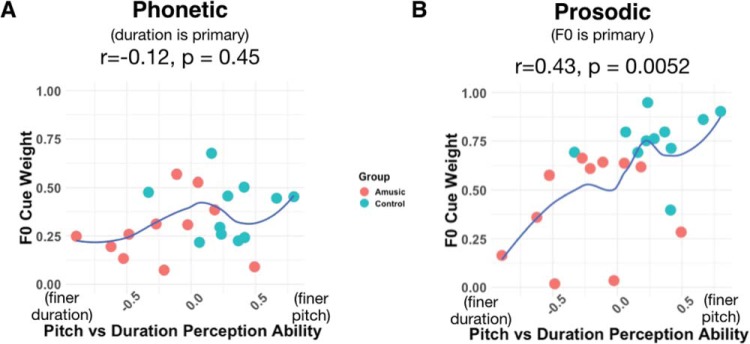
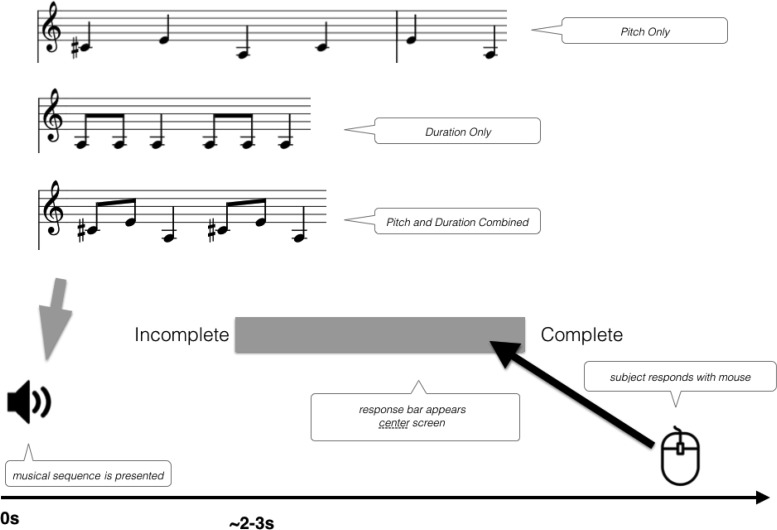
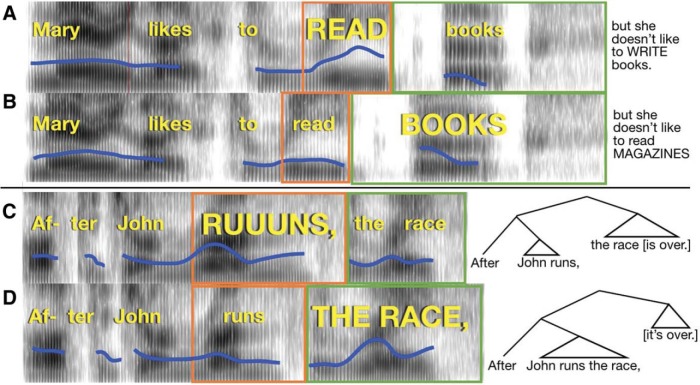
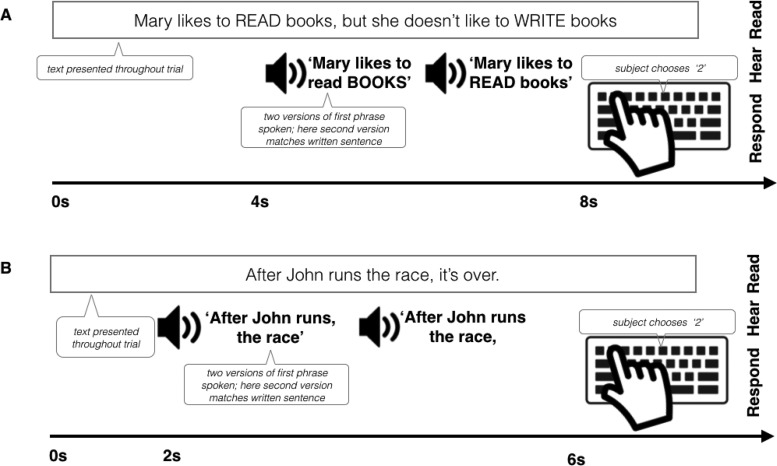
Perception involves integration of multiple dimensions that often serve overlapping, redundant functions, for example, pitch, duration, and amplitude in speech. Individuals tend to prioritize these dimensions differently (stable, individualized perceptual strategies), but the reason for this has remained unclear. Here we show that perceptual strategies relate to perceptual abilities. In a speech cue weighting experiment (trial = 990), we first demonstrate that individuals with a severe deficit for pitch perception (congenital amusics; = 11) categorize linguistic stimuli similarly to controls ( = 11) when the main distinguishing cue is duration, which they perceive normally. In contrast, in a prosodic task where pitch cues are the main distinguishing factor, we show that amusics place less importance on pitch and instead rely more on duration cues-even when pitch differences in the stimuli are large enough for amusics to discern. In a second experiment testing musical and prosodic phrase interpretation ( = 16 amusics; 15 controls), we found that relying on duration allowed amusics to overcome their pitch deficits to perceive speech and music successfully. We conclude that auditory signals, because of their redundant nature, are robust to impairments for specific dimensions, and that optimal speech and music perception strategies depend not only on invariant dimensions (the physical signal), but on dimensions whose precision varies across individuals. Computational models of speech perception (indeed, all types of perception involving redundant cues e.g., vision and touch) should therefore aim to account for the precision of perceptual dimensions and characterize individuals as well as groups. (PsycInfo Database Record (c) 2020 APA, all rights reserved).
感知涉及多个维度的整合,这些维度通常具有重叠和冗余的功能,例如语音中的音高、时长和幅度。个体倾向于以不同的方式优先考虑这些维度(稳定的、个体化的感知策略),但原因尚不清楚。在这里,我们表明感知策略与感知能力有关。在一个语音线索加权实验(trial = 990)中,我们首先证明,在时长是主要区分线索的情况下,具有音高感知严重缺陷的个体(先天性失歌症;n = 11)与对照组(n = 11)对语言刺激的分类方式相似,因为他们正常感知时长。相比之下,在一个主要依赖音高线索的韵律任务中,我们发现失歌症者对音高的重视程度较低,而是更多地依赖时长线索——即使刺激中的音高差足以让失歌症者辨别。在第二个测试音乐和韵律短语解释的实验中(n = 16 名失歌症者;n = 15 名对照组),我们发现依赖时长可以使失歌症者克服音高缺陷,成功感知言语和音乐。我们得出结论,由于听觉信号的冗余性质,它们对特定维度的损伤具有鲁棒性,而最佳的言语和音乐感知策略不仅取决于不变的维度(物理信号),还取决于个体间精度变化的维度。因此,言语感知的计算模型(实际上,所有涉及冗余线索的感知类型,如视觉和触觉)都应该旨在解释感知维度的精度,并对个体和群体进行特征描述。