Department of Biomedical Engineering, The City College of New York, New York, NY, USA.
Department of Biomedical Engineering, The City College of New York, New York, NY, USA.
J Neurosci Methods. 2019 Dec 1;328:108446. doi: 10.1016/j.jneumeth.2019.108446. Epub 2019 Oct 4.
Quasi-uniform assumption is a general theory that postulates local electric field predicts neuronal activation. Computational current flow model of spinal cord stimulation (SCS) of humans and animal models inform how the quasi-uniform assumption can support scaling neuromodulation dose between humans and translational animal.
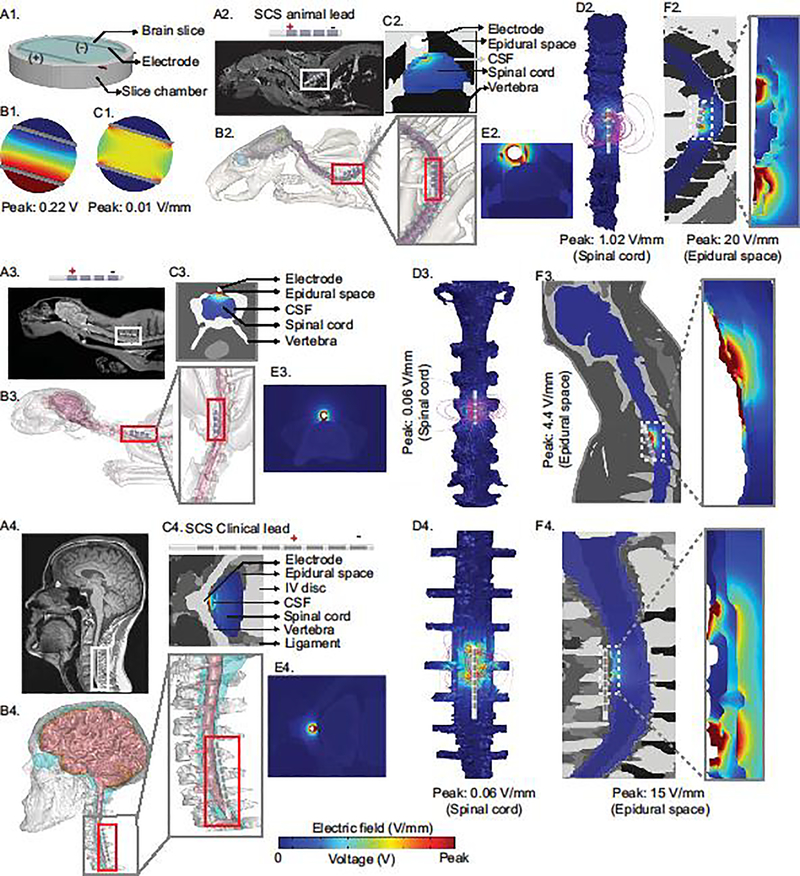
Here we developed finite element models of cat and rat SCS, and brain slice, alongside SCS models. Boundary conditions related to species specific electrode dimensions applied, and electric fields per unit current (mA) predicted.
Clinically and across animal, electric fields change abruptly over small distance compared to the neuronal morphology, such that each neuron is exposed to multiple electric fields. Per unit current, electric fields generally decrease with body mass, but not necessarily and proportionally across tissues. Peak electric field in dorsal column rat and cat were ∼17x and ∼1x of clinical values, for scaled electrodes and equal current. Within the spinal cord, the electric field for rat, cat, and human decreased to 50% of peak value caudo-rostrally (C5-C6) at 0.48 mm, 3.2 mm, and 8 mm, and mediolaterally at 0.14 mm, 2.3 mm, and 3.1 mm. Because these space constants are different, electric field across species cannot be matched without selecting a region of interest (ROI).
This is the first computational model to support scaling neuromodulation dose between humans and translational animal.
Inter-species reproduction of the electric field profile across the entire surface of neuron populations is intractable. Approximating quasi-uniform electric field in a ROI is a rational step to translational scaling.
准均匀假设是一种普遍理论,它假定局部电场可以预测神经元的激活。人类和动物模型的脊髓刺激(SCS)计算电流流模型告知准均匀假设如何支持在人类和转化动物之间缩放神经调节剂量。
在这里,我们开发了猫和鼠 SCS 的有限元模型,以及大脑切片和 SCS 模型。应用了与物种特定电极尺寸相关的边界条件,并预测了每单位电流(mA)的电场。
在临床和整个动物中,与神经元形态相比,电场在小距离内急剧变化,以至于每个神经元都暴露在多个电场中。每单位电流,电场通常随体重而减小,但并非在所有组织中都按比例减小。在大鼠和猫的背柱中,峰值电场分别约为临床值的 17 倍和 1 倍,对于缩放电极和相等电流。在脊髓内,大鼠、猫和人类的电场在 0.48mm、3.2mm 和 8mm 处沿头尾方向(C5-C6)下降到峰值的 50%,在 0.14mm、2.3mm 和 3.1mm 处沿内外侧方向下降。由于这些空间常数不同,不选择感兴趣区域(ROI)就无法匹配跨物种的电场。
这是第一个支持在人类和转化动物之间缩放神经调节剂量的计算模型。
在整个神经元群体表面上重现电场分布的跨物种再现是棘手的。在 ROI 中近似准均匀电场是转化缩放的合理步骤。