Noureen Nuzhat, Khan Saadia, Khursheed Asim, Iqbal Imran, Maryam Moallah, Sharib Syed Muhammad, Maheshwary Neeta
Department of Paediatric Neurology, The Children Hospital and Institute of Child Health Multan, Multan, Pakistan.
Department of Paediatrics, The Children Hospital and Institute of Child Health Multan, Multan, Pakistan.
J Clin Neurol. 2019 Oct;15(4):468-472. doi: 10.3988/jcn.2019.15.4.468.
There is sparsity of quality evidence for the use of drugs after first-line benzodiazepines in convulsive status epilepticus in children. The aim of the study was to compare the clinical efficacy and safety of intravenous levetiracetam versus intravenous phenytoin as second-line drugs in the management of generalized convulsive status epilepticus in children.
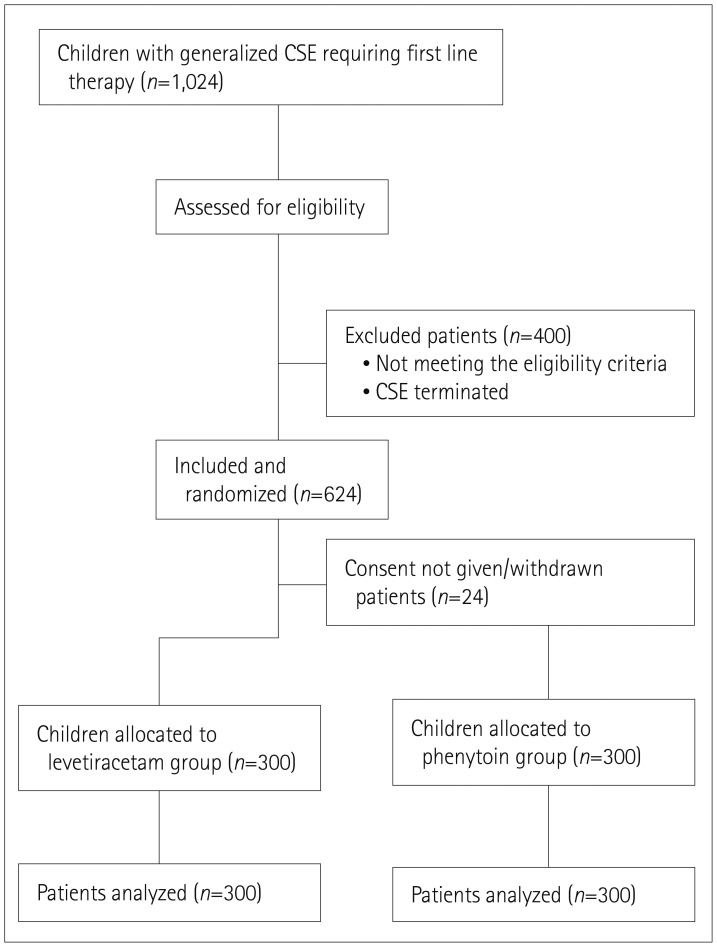
This open-label randomized controlled trial was conducted in the Emergency Department of The Children's Hospital and The Institute of Child Health, Multan, Pakistan over a period of 4 years and 6 months from January 2014 to June 2018. This study included 600 children with generalized convulsive status epilepticus: 300 in the 40 mg/kg levetiracetam group, and 300 in the 20 mg/kg phenytoin group. Cessation of a clinical seizure (seizure cessation rate) within 30 minutes after the end of drug administration was the primary outcome in this study, and the presence or absence of adverse effects was noted as the secondary outcome. Data were analyzed using SPSS (version 20.0).
The children in the levetiracetam and phenytoin were aged 3.5±0.2 and 3.4±0.2 years (mean±SD), respectively, their seizure durations before the start of treatment were 25.1±0.6 and 23.8±0.4 minutes, and their treatment efficacies were 278/300 (92.7%) and 259/300 (83.3%). Levetiracetam was significantly more effective than phenytoin (=0.012), with no significant difference in safety. Adverse events were observed in eight children in the phenytoin group.
Levetiracetam is significantly more effective than phenytoin for the treatment of convulsive status epilepticus in children who have failed to respond to benzodiazepines.
关于儿童惊厥性癫痫持续状态在一线使用苯二氮䓬类药物后使用其他药物的高质量证据较为匮乏。本研究的目的是比较静脉注射左乙拉西坦与静脉注射苯妥英钠作为二线药物治疗儿童全身性惊厥性癫痫持续状态的临床疗效和安全性。
本开放性随机对照试验于2014年1月至2018年6月在巴基斯坦木尔坦儿童医院及儿童健康研究所急诊科进行,为期4年6个月。本研究纳入600例全身性惊厥性癫痫持续状态儿童:左乙拉西坦组300例,剂量为40mg/kg;苯妥英钠组300例,剂量为20mg/kg。给药结束后30分钟内临床癫痫发作停止(癫痫发作停止率)是本研究的主要结局,记录有无不良反应作为次要结局。使用SPSS(版本20.0)进行数据分析。
左乙拉西坦组和苯妥英钠组儿童的年龄分别为3.5±0.2岁和3.4±0.2岁(均值±标准差),治疗开始前癫痫发作持续时间分别为25.1±0.6分钟和23.8±0.4分钟,治疗有效率分别为278/300(92.7%)和259/300(83.3%)。左乙拉西坦的疗效显著优于苯妥英钠(P=0.012),安全性无显著差异。苯妥英钠组有8例儿童出现不良事件。
对于对苯二氮䓬类药物无反应的儿童惊厥性癫痫持续状态,左乙拉西坦的治疗效果显著优于苯妥英钠。