Department of Dermatology, The First Affiliated Hospital of Chongqing Medical University, Yuzhong, Chongqing, China (mainland).
Prescriptions Department, College of Traditional Chinese Medicine, Chongqing Medical University, Yuzhong, Chongqing, China (mainland).
Med Sci Monit. 2019 Oct 8;25:7557-7566. doi: 10.12659/MSM.917164.
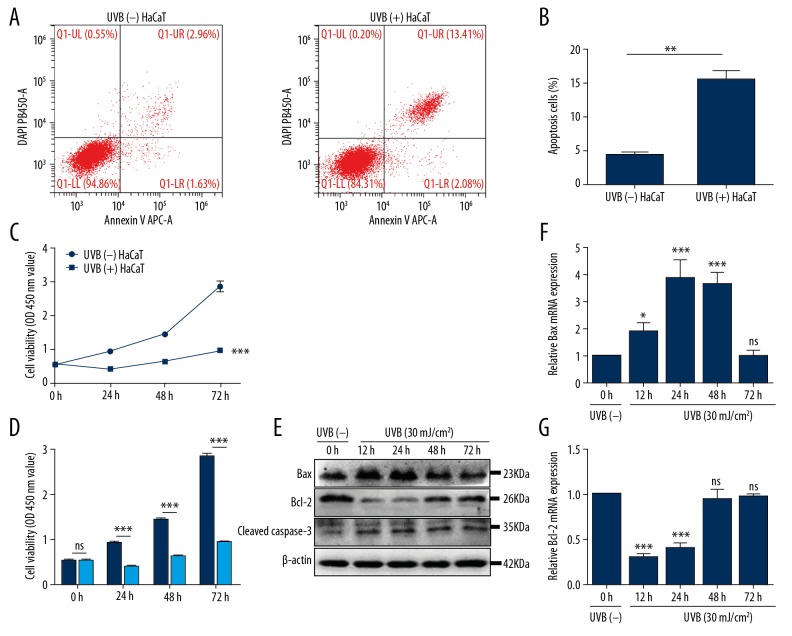
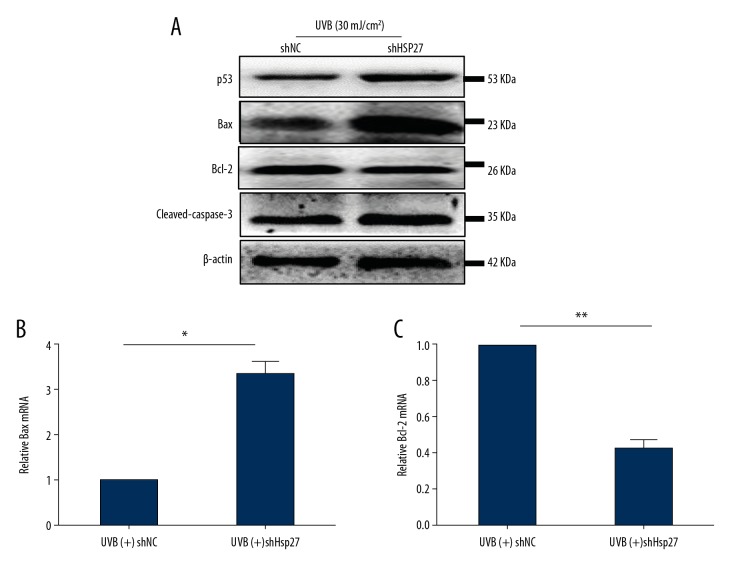
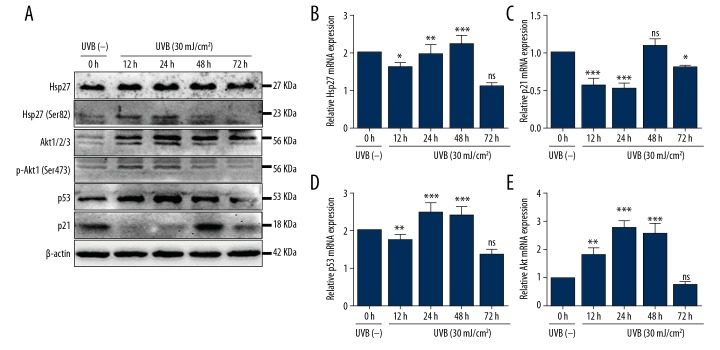
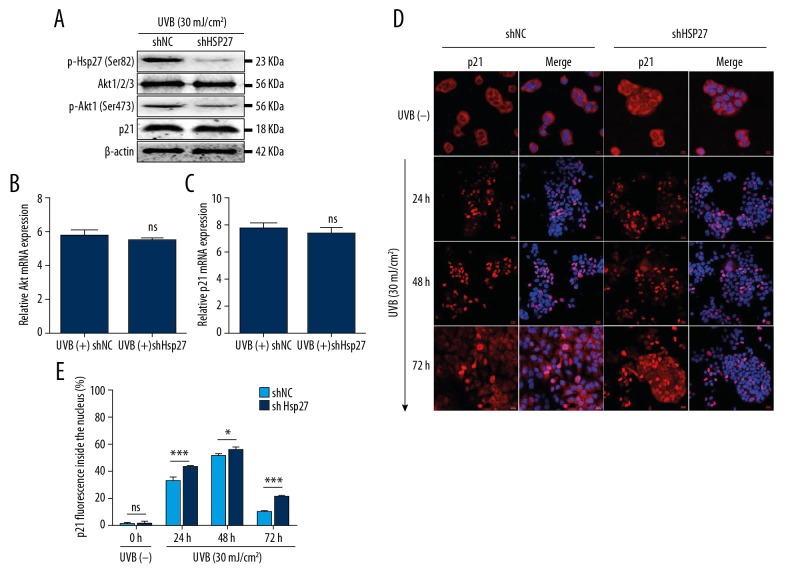
BACKGROUND Owing to the increased incidence of photodermatosis caused by ultraviolet light in recent years, it is necessary to clarify the mechanisms potential photodamage to the skin and reveal possible therapeutic targets. Heat shock protein 27 (Hsp27) is well known for suppressing apoptosis. The aim of present study was to elucidate possible photoprotective mechanism between Hsp27 and p21 on ultraviolet B (UVB)-induced photodamage. MATERIAL AND METHODS The Hsp27 gene was interfered to assess the expression of its downstream effectors, cell apoptosis, and cell proliferation ability. The cell apoptosis was tested using flow cytometry method. The cell proliferation ability was tested using Cell Counting Kit-8 (CCK-8) assay. The expression of protein was tested using western-blotting method. The expression of mRNA was detected using quantitative reverse transcription polymerase chain reaction (qRT-PCR). The subcellular localization was elucidated using immunofluorescence. RESULTS Hsp27 knockdown decreased cell viability and increased the incidence of UVB-induced apoptosis. Compared with control group, activation of phosphorylated-Akt (p-Akt)-dependent pathway resulted in the nuclear accumulation of p21 and suppression of cell proliferation, while promoting apoptosis in Hsp27 knockdown group. In addition, Hsp27 knockdown increased p53 expression and the Bax: Bcl-2 ratio, which further accelerated the apoptotic process. CONCLUSIONS These findings complemented the mechanism of skin photodamage and demonstrated the photoprotective mechanisms of Hsp27 in HaCaT cells, which might implicate a potential therapeutic target of photodamage and photodermatosis.
近年来,由于紫外线引起的光皮肤病发病率增加,有必要阐明皮肤潜在光损伤的机制,并揭示可能的治疗靶点。热休克蛋白 27(Hsp27)以抑制细胞凋亡而闻名。本研究旨在阐明 Hsp27 与 p21 之间在紫外线 B(UVB)诱导的光损伤中的可能光保护机制。
干扰 Hsp27 基因以评估其下游效应物、细胞凋亡和细胞增殖能力的表达。使用流式细胞术检测细胞凋亡。使用 Cell Counting Kit-8(CCK-8)测定法检测细胞增殖能力。使用 Western-blotting 法检测蛋白表达。使用定量逆转录聚合酶链反应(qRT-PCR)检测 mRNA 表达。通过免疫荧光法阐明亚细胞定位。
Hsp27 敲低降低了细胞活力并增加了 UVB 诱导的细胞凋亡的发生率。与对照组相比,磷酸化-Akt(p-Akt)依赖性通路的激活导致 p21 的核积累和细胞增殖的抑制,同时促进 Hsp27 敲低组的细胞凋亡。此外,Hsp27 敲低增加了 p53 表达和 Bax:Bcl-2 比值,这进一步加速了凋亡过程。
这些发现补充了皮肤光损伤的机制,并证明了 Hsp27 在 HaCaT 细胞中的光保护机制,这可能暗示了光损伤和光皮肤病的潜在治疗靶点。