Lizano-Fallas Veronica, Carrasco Del Amor Ana, Cristobal Susana
Department of Biomedical and Clinical Sciences, Cell Biology, Faculty of Medicine, Linköping University, 581 85 Linköping, Sweden.
Ikerbasque, Basque Foundation for Sciences, Department of Physiology, Faculty of Medicine, and Nursing, University of the Basque Country (UPV/EHU), 489 40 Leioa, Spain.
Toxics. 2023 Feb 17;11(2):189. doi: 10.3390/toxics11020189.
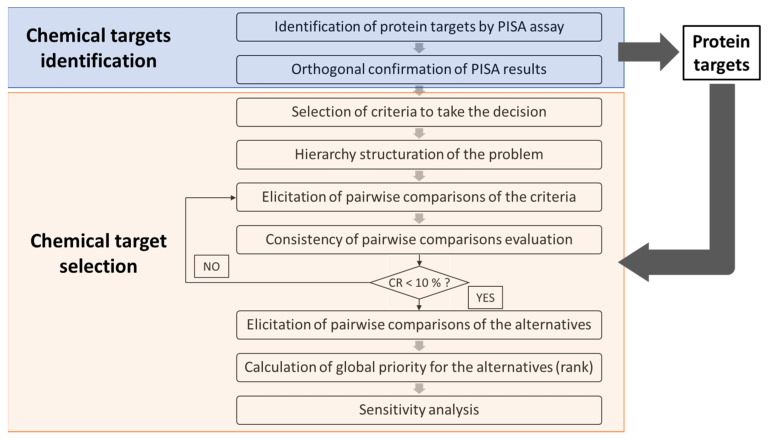
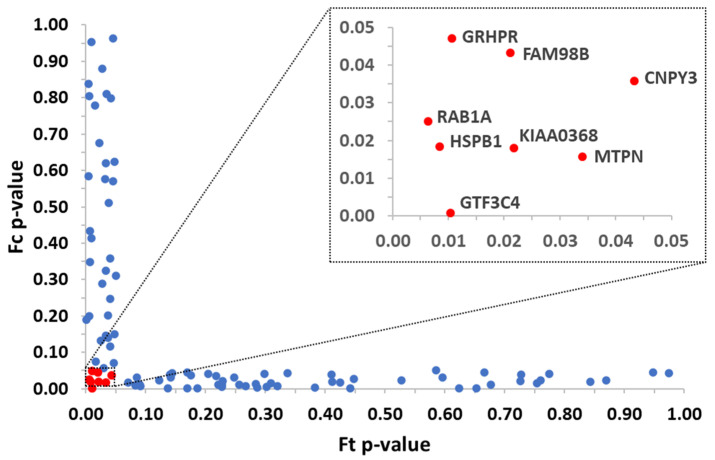
The impact of exposure to multiple chemicals raises concerns for human and environmental health. The adverse outcome pathway method offers a framework to support mechanism-based assessment in environmental health starting by describing which mechanisms are triggered upon interaction with different stressors. The identification of the molecular initiating event and the molecular interaction between a chemical and a protein target is still a challenge for the development of adverse outcome pathways. The cellular response to chemical exposure studied with omics could not directly identify the protein targets. However, recent mass spectrometry-based methods are offering a proteome-wide identification of protein targets interacting with s but unrevealing a molecular initiating event from a set of targets is still dependent on available knowledge. Here, we directly coupled the target identification findings from the proteome integral solubility alteration assay with an analytical hierarchy process for the prediction of a prioritized molecular initiating event. We demonstrate the applicability of this combination of methodologies with a test compound (TCDD), and it could be further studied and integrated into AOPs. From the eight protein targets identified by the proteome integral solubility alteration assay after analyzing 2824 human hepatic proteins, the analytical hierarchy process can select the most suitable protein for an AOP. Our combined method solves the missing links between high-throughput target identification and prediction of the molecular initiating event. We anticipate its utility to decipher new molecular initiating events and support more sustainable methodologies to gain time and resources in chemical assessment.
接触多种化学物质所产生的影响引发了人们对人类和环境健康的担忧。不良结局途径方法提供了一个框架,以支持环境卫生领域基于机制的评估,该评估从描述与不同应激源相互作用时触发的机制开始。确定分子起始事件以及化学物质与蛋白质靶点之间的分子相互作用,对于不良结局途径的发展而言仍然是一项挑战。通过组学研究化学物质暴露后的细胞反应无法直接识别蛋白质靶点。然而,最近基于质谱的方法能够在全蛋白质组范围内识别与化学物质相互作用的蛋白质靶点,但从一组靶点中揭示分子起始事件仍依赖于现有知识。在此,我们将蛋白质组整体溶解度改变分析中的靶点识别结果与层次分析法直接结合,用于预测优先的分子起始事件。我们用一种测试化合物(四氯二苯并二恶英,TCDD)证明了这种方法组合的适用性,并且它可以进一步研究并整合到不良结局途径中。在分析了2824种人类肝脏蛋白质后,通过蛋白质组整体溶解度改变分析确定了8个蛋白质靶点,层次分析法能够为不良结局途径选择最合适的蛋白质。我们的组合方法解决了高通量靶点识别与分子起始事件预测之间缺失的环节。我们预计它在解读新的分子起始事件以及支持更具可持续性的方法以在化学评估中节省时间和资源方面具有实用性。