Jiang Lei, Dong Bao, Yan Yu, Zheng Shuying, Hu Yanan, Zuo Li, Shi Hongxia
Electron Microscope Laboratory.
Department of Nephrology, Peking University People's Hospital, Beijing, China.
Medicine (Baltimore). 2019 Oct;98(41):e17388. doi: 10.1097/MD.0000000000017388.
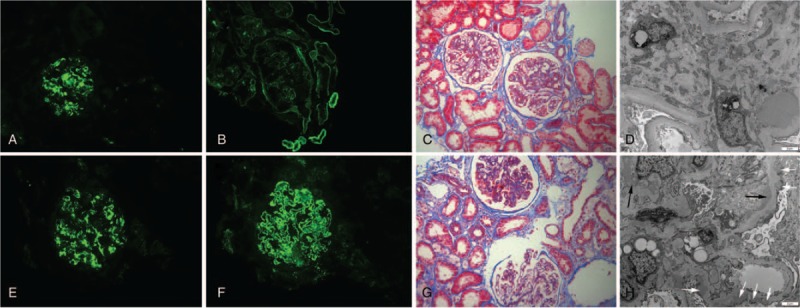
It is not rare to find Immunoglobulin A (IgA) nephropathy (IgAN) combined with other glomerular diseases, which can be called compound IgAN (cIgAN). Till now, clinical-pathological investigation of cIgAN was lacking, especially the severity of "background IgAN lesions." This research aimed to investigate the incidence, clinical and pathological characteristics of cIgAN, and thus improve the understanding of the clinical significance of this combination.Patients with cIgAN diagnosed in Peking University People's Hospital from November 2012 to April 2018 were retrospectively analyzed. Patients with IgAN without compound glomerular diseases (sIgAN) were enrolled as a control group.Among 1407 patients diagnosed with IgAN, 80 (5.69%) were cIgAN patients. Compared with sIgAN, cIgAN patients had a significantly lower prevalence of microscopic hematuria and more urine protein. There were 10 pathological types of glomerular diseases combined with IgAN, led by diabetic nephropathy 37 (46.25%) and membranous nephropathy 14 (17.5%). Histologically, although the mesangial hypercellularity was comparable in 2 groups, cIgAN patients had a lower prevalence of endocapillary proliferation, segmental glomerulosclerosis, and cellular or fibrocellular crescents formation, as well as weaker immunofluorescence intensity for IgA and C3 (all P < .05). Eight out of 27 (29.63%) cIgAN patients with follow-up data (5-48 months) developed irreversible end-stage renal disease requiring dialysis.The order of incidence of concomitant diseases was similar to that of the pure diseases. The "background IgAN associated lesions" except mesangial hypercellularity were relatively mild in cIgAN group. Those might suggest that in some cases, IgAN seems to be a chance finding, and the combined diseases may play a more important role in the clinicopathological features of the patients than the nephritis caused by IgA deposition. While diagnosing IgAN, other combined glomerular diseases need to be carefully considered by nephrologists and pathologists.
免疫球蛋白A(IgA)肾病(IgAN)合并其他肾小球疾病并不罕见,这种情况可称为复合型IgA肾病(cIgAN)。到目前为止,缺乏对cIgAN的临床病理研究,尤其是“背景IgAN病变”的严重程度。本研究旨在调查cIgAN的发病率、临床和病理特征,从而提高对这种合并情况临床意义的认识。对2012年11月至2018年4月在北京大学人民医院诊断为cIgAN的患者进行回顾性分析。将无合并肾小球疾病的IgAN患者(sIgAN)纳入对照组。在1407例诊断为IgAN的患者中,80例(5.69%)为cIgAN患者。与sIgAN相比,cIgAN患者镜下血尿的患病率显著较低,蛋白尿较多。有10种肾小球疾病类型与IgAN合并,以糖尿病肾病37例(46.25%)和膜性肾病14例(17.5%)为主。组织学上,虽然两组的系膜细胞增多情况相当,但cIgAN患者毛细血管内增生、节段性肾小球硬化以及细胞性或纤维细胞性新月体形成的患病率较低,IgA和C3的免疫荧光强度也较弱(均P<0.05)。27例有随访数据(5 - 48个月)的cIgAN患者中有8例(29.63%)发展为需要透析的不可逆终末期肾病。伴随疾病的发病率顺序与单纯疾病相似。cIgAN组除系膜细胞增生外的“背景IgAN相关病变”相对较轻。这可能表明在某些情况下,IgAN似乎是偶然发现的,合并疾病在患者的临床病理特征中可能比IgA沉积引起的肾炎起更重要的作用。在诊断IgAN时,肾病学家和病理学家需要仔细考虑其他合并的肾小球疾病。