Division of Intramural Research, National Institute on Minority Health and Health Disparities, National Institutes of Health, Bethesda, MD, United States.
ICF, Rockville, MD, United States.
JMIR Mhealth Uhealth. 2019 Oct 7;7(10):e14699. doi: 10.2196/14699.
Population-level text messaging smoking cessation interventions may reduce racial and ethnic differences in smoking among pregnant women.
Our objective was to examine racial and ethnic differences in dropout, response, and abstinence rates among users of a US national, publicly available text messaging cessation intervention targeting pregnant women, SmokefreeMOM.
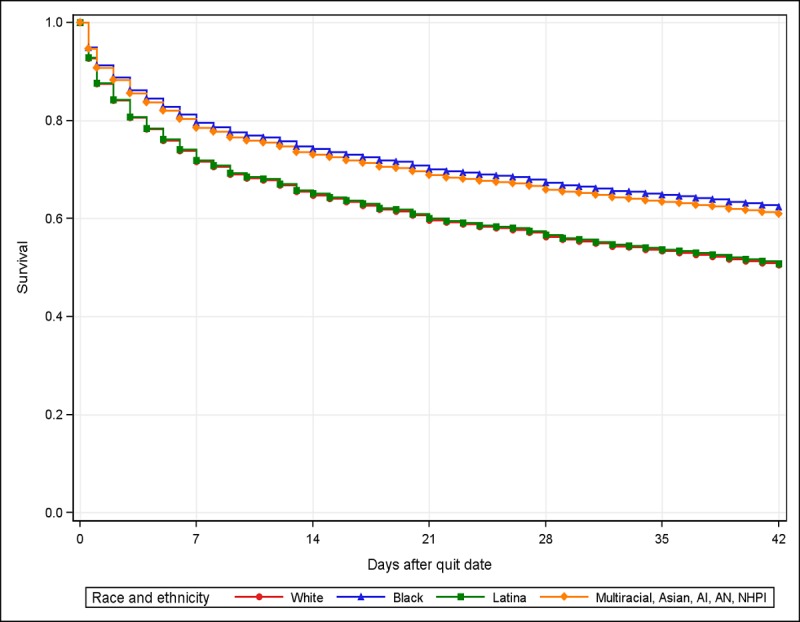
Participants were online subscribers to SmokefreeMOM who set a prospective quit date within the 9 months before their due date. We examined demographics, smoking frequency, number of cigarettes smoked per day, and prequit time (up to 14 days of preparation time before quit date) as correlates of response rate and abstinence at 8 time points: quit date, day 7, day 14, day 21, day 28, day 35, day 42 (intervention end), and day 72 (1-month follow-up). We conducted survival analysis of time from quit date to dropout by race and ethnicity.
The mean age of the analytic sample of 1288 users was 29.46 (SD 7.11) years. Of these, 65.81% (848/1288) were white, 16.04% (207/1288) were black, 8.86% (114/1288) were Latina, and 9.29% (120/1288) were multiracial, American Indian/Alaska Native, Native Hawaiian Pacific Islander, or other; 82.68% (1065/1288) had some college education or less. Point-prevalence abstinence was 14.51% (157/1082) on quit day, 3.51% (38/1082) at intervention end, and 1.99% (21/1053) at 1-month follow-up. Black users (hazard ratio 0.68, 95% CI 0.51-0.91) and those with a high school degree or less (hazard ratio 0.66, 95% CI 0.49-0.89) or some college education (hazard ratio 0.75, 95% CI 0.57-0.99) were less likely to drop out than whites or users with a bachelor's degree or higher. Response and abstinence rates were similar across race, ethnicity, and education.
Enrollment was low among racial and ethnic minority women but high among less-educated women. Abstinence at intervention end and 1-month follow-up was lower than that in controlled trials of text messaging cessation interventions for pregnant women (range 7%-20%). Increasing the reach, engagement, and effectiveness of SmokefreeMOM, especially among women with high rates of smoking during pregnancy, must be prioritized.
人群层面的短信戒烟干预措施可能会减少孕妇吸烟的种族和民族差异。
我们的目的是检查美国全国范围内、公开可用的针对孕妇的短信戒烟干预措施 SmokefreeMOM 的使用者中,在辍学、反应和戒烟率方面的种族和民族差异。
参与者是 SmokefreeMOM 的在线订阅者,他们在预产期前的 9 个月内设定了预期的戒烟日期。我们检查了人口统计学特征、吸烟频率、每天吸烟的数量以及戒烟前的时间(最多 14 天的准备时间),作为反应率和 8 个时间点(戒烟日期、第 7 天、第 14 天、第 21 天、第 28 天、第 35 天、第 42 天(干预结束)和第 72 天(1 个月随访)的戒烟率的相关性。我们根据种族和民族对从戒烟日期到辍学的时间进行了生存分析。
分析样本的平均年龄为 29.46 岁(SD 7.11)。其中,65.81%(848/1288)为白人,16.04%(207/1288)为黑人,8.86%(114/1288)为拉丁裔,9.29%(120/1288)为多种族、美洲印第安人/阿拉斯加原住民、夏威夷原住民或太平洋岛民或其他;82.68%(1065/1288)接受过大学教育或以下教育。戒烟日的点患病率为 14.51%(157/1082),干预结束时为 3.51%(38/1082),1 个月随访时为 1.99%(21/1053)。黑人用户(风险比 0.68,95%CI 0.51-0.91)和高中及以下学历用户(风险比 0.66,95%CI 0.49-0.89)或接受过一些大学教育的用户(风险比 0.75,95%CI 0.57-0.99)辍学的可能性低于白人或具有学士学位或更高学历的用户。反应和戒烟率在种族、民族和教育程度方面相似。
少数民族和教育程度较低的女性的参与率较低,但教育程度较低的女性的参与率较高。干预结束时和 1 个月随访时的戒烟率低于孕妇短信戒烟干预试验中的戒烟率(范围为 7%-20%)。必须优先考虑提高 SmokefreeMOM 的覆盖面、参与度和有效性,特别是针对吸烟率较高的孕妇。