Beinke Jan Heinrich, Fitte Christian, Teuteberg Frank
Accounting and Information Systems, University of Osnabrueck, Osnabrueck, Germany.
J Med Internet Res. 2019 Oct 7;21(10):e13585. doi: 10.2196/13585.
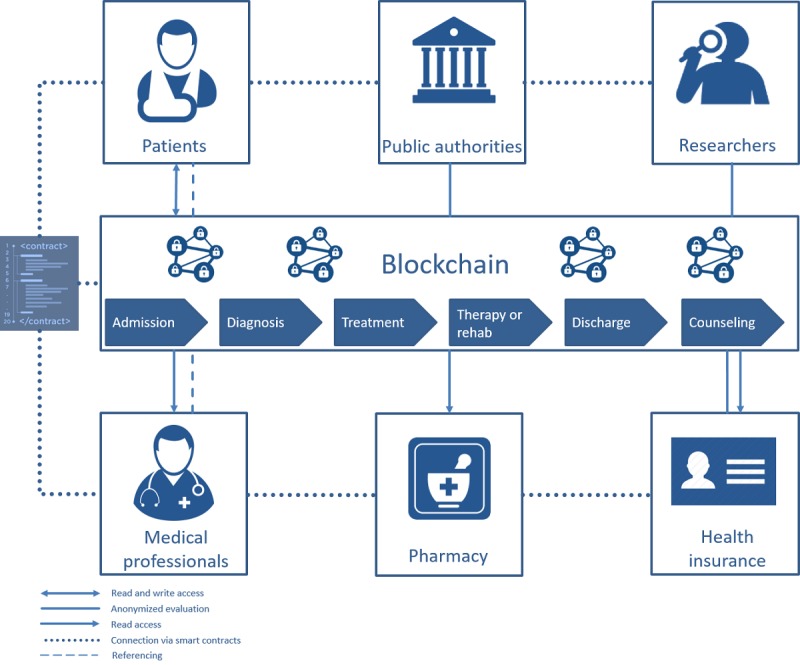
Data security issues still constitute the main reason for the sluggish dissemination of electronic health records (EHRs). Given that blockchain technology offers the possibility to verify transactions through a decentralized network, it may serve as a solution to secure health-related data. Therefore, we have identified stakeholder-specific requirements and propose a blockchain-based architecture for EHRs, while referring to the already existing scientific discussions on the potential of blockchain for use in EHRs.
This study aimed to introduce blockchain technology for EHRs, based on identifying stakeholders and systematically eliciting their requirements, and to discuss the key benefits (KBs) and key challenges (KCs) of blockchain technology in the context of EHRs.
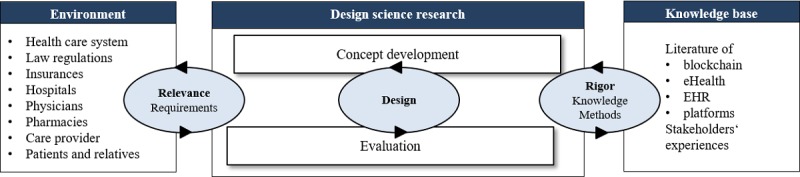
The blockchain-based architecture was developed in the framework of the design science research paradigm. The requirements were identified using a structured literature review and interviews with nine health care experts. Subsequently, the proposed architecture was evaluated using 4 workshops with 15 participants.
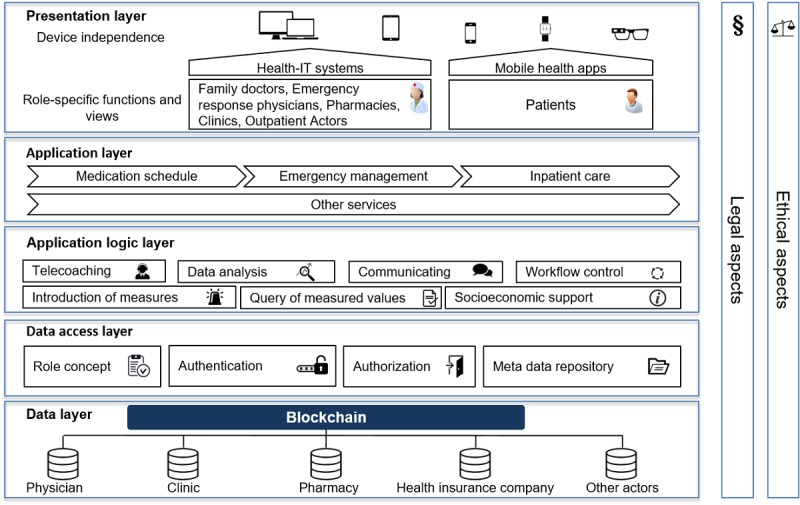
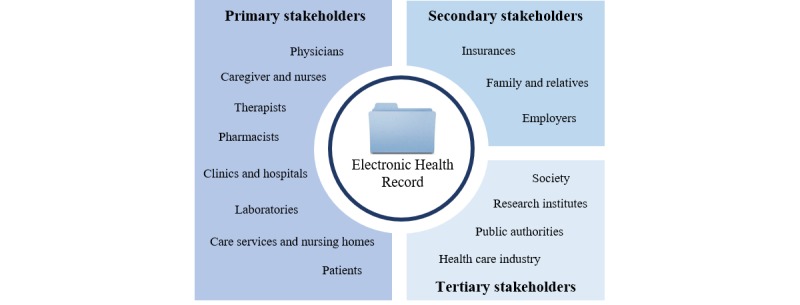
We identified three major EHR stakeholder groups and 34 respective requirements. On this basis, we developed a five-layer architecture. The subsequent evaluation of the artifact was followed by the discussion of 12 KBs and 12 KCs of a blockchain-based architecture for EHRs. To address the KCs, we derived five recommendations for action for science and practice.
Our findings indicate that blockchain technology offers considerable potential to advance EHRs. Improvements to currently available EHR solutions are expected, for instance, in the areas of data security, traceability, and automation by smart contracts. Future research could examine the patient's acceptance of blockchain-based EHRs and cost-benefit analyses.
数据安全问题仍是电子健康记录(EHR)传播缓慢的主要原因。鉴于区块链技术提供了通过去中心化网络验证交易的可能性,它可能成为保护健康相关数据的一种解决方案。因此,我们确定了利益相关者的特定需求,并参考了关于区块链在EHR中应用潜力的现有科学讨论,提出了一种基于区块链的EHR架构。
本研究旨在基于识别利益相关者并系统地引出他们的需求,将区块链技术引入EHR,并在EHR背景下讨论区块链技术的关键益处(KB)和关键挑战(KC)。
基于区块链的架构是在设计科学研究范式的框架内开发的。通过结构化文献综述和对九位医疗保健专家的访谈来确定需求。随后,使用有15名参与者的4个研讨会对所提出的架构进行评估。
我们确定了三个主要的EHR利益相关者群体和34项相应需求。在此基础上,我们开发了一个五层架构。对该工件的后续评估之后,讨论了基于区块链的EHR架构的1十二条KB和十二条KC。为解决这些KC,我们为科学和实践得出了五项行动建议。
我们的研究结果表明,区块链技术在推进EHR方面具有巨大潜力。预计当前可用的EHR解决方案将有所改进,例如在数据安全、可追溯性和智能合约自动化等领域。未来的研究可以考察患者对基于区块链的EHR的接受度以及成本效益分析。