Experimental Psychology, Helmholtz Institute, Utrecht University, Utrecht, The Netherlands; Developmental Psychology, Utrecht University, Utrecht, The Netherlands.
Experimental Psychology, Helmholtz Institute, Utrecht University, Utrecht, The Netherlands.
Dev Cogn Neurosci. 2019 Dec;40:100710. doi: 10.1016/j.dcn.2019.100710. Epub 2019 Sep 27.
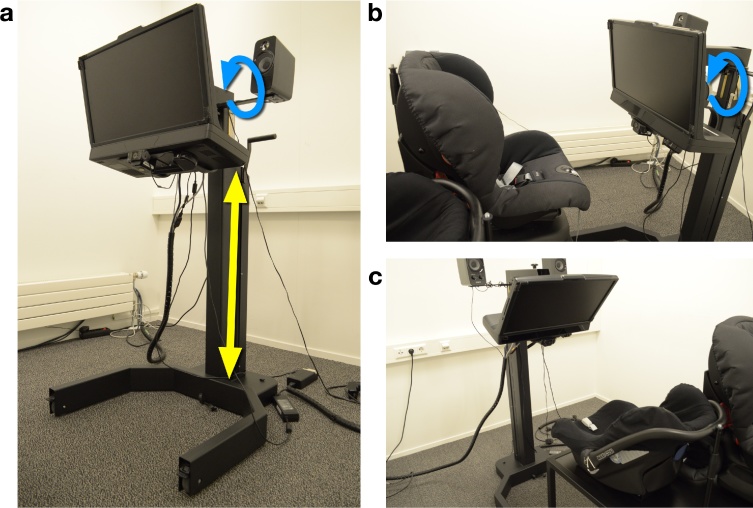
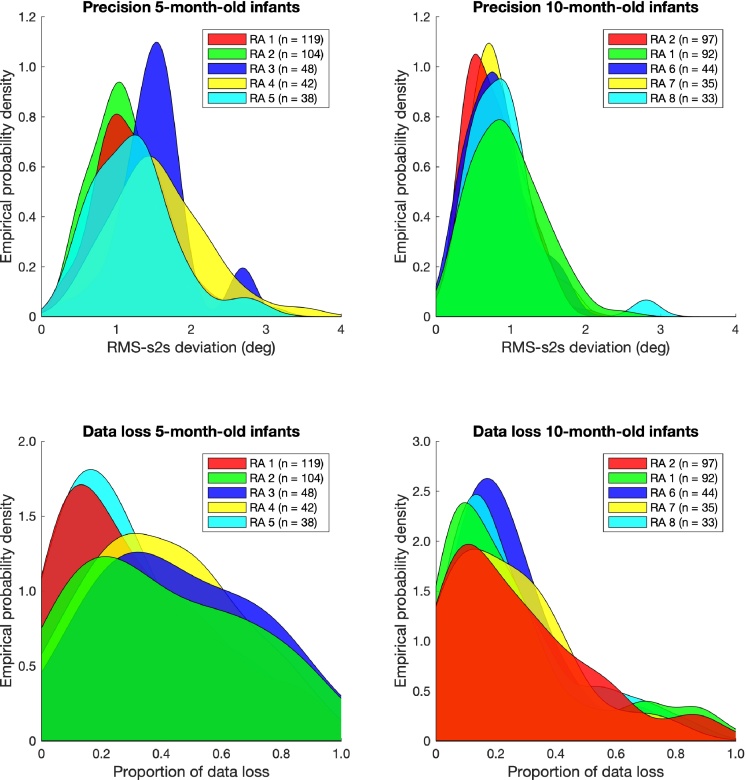
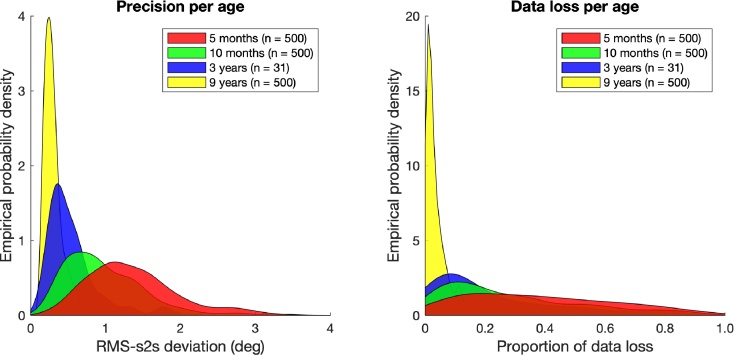
Eye tracking is a popular research tool in developmental cognitive neuroscience for studying the development of perceptual and cognitive processes. However, eye tracking in the context of development is also challenging. In this paper, we ask how knowledge on eye-tracking data quality can be used to improve eye-tracking recordings and analyses in longitudinal research so that valid conclusions about child development may be drawn. We answer this question by adopting the data-quality perspective and surveying the eye-tracking setup, training protocols, and data analysis of the YOUth study (investigating neurocognitive development of 6000 children). We first show how our eye-tracking setup has been optimized for recording high-quality eye-tracking data. Second, we show that eye-tracking data quality can be operator-dependent even after a thorough training protocol. Finally, we report distributions of eye-tracking data quality measures for four age groups (5 months, 10 months, 3 years, and 9 years), based on 1531 recordings. We end with advice for (prospective) developmental eye-tracking researchers and generalizations to other methodologies.
眼动追踪是发展认知神经科学中用于研究感知和认知过程发展的一种流行研究工具。然而,发展中的眼动追踪也具有挑战性。在本文中,我们探讨了如何利用眼动追踪数据质量知识来改进纵向研究中的眼动追踪记录和分析,以便能够得出关于儿童发展的有效结论。我们通过采用数据质量的视角,调查了 YOUth 研究(调查 6000 名儿童的神经认知发展)的眼动追踪设置、训练方案和数据分析,回答了这个问题。我们首先展示了我们的眼动追踪设置如何针对高质量眼动追踪数据的记录进行了优化。其次,我们展示了即使经过彻底的训练方案,眼动追踪数据质量也可能依赖于操作人员。最后,我们基于 1531 次记录,报告了四个年龄组(5 个月、10 个月、3 岁和 9 岁)的眼动追踪数据质量指标的分布情况。我们最后为(未来的)发展眼动追踪研究人员提供了建议,并对其他方法进行了概括。