Scripps Institution of Oceanography, University of California, San Diego, CA, 92093-0218, USA.
Nat Commun. 2019 Oct 8;10(1):4564. doi: 10.1038/s41467-019-12600-z.
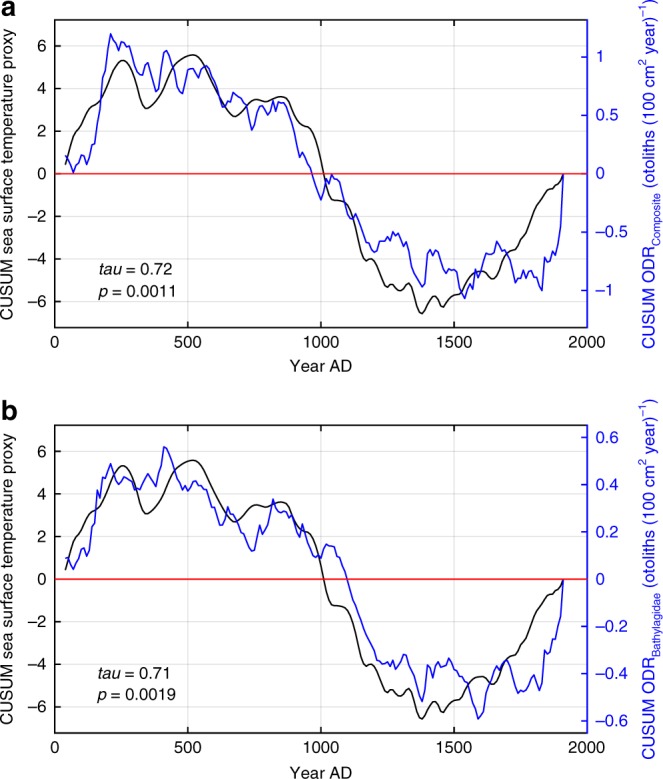
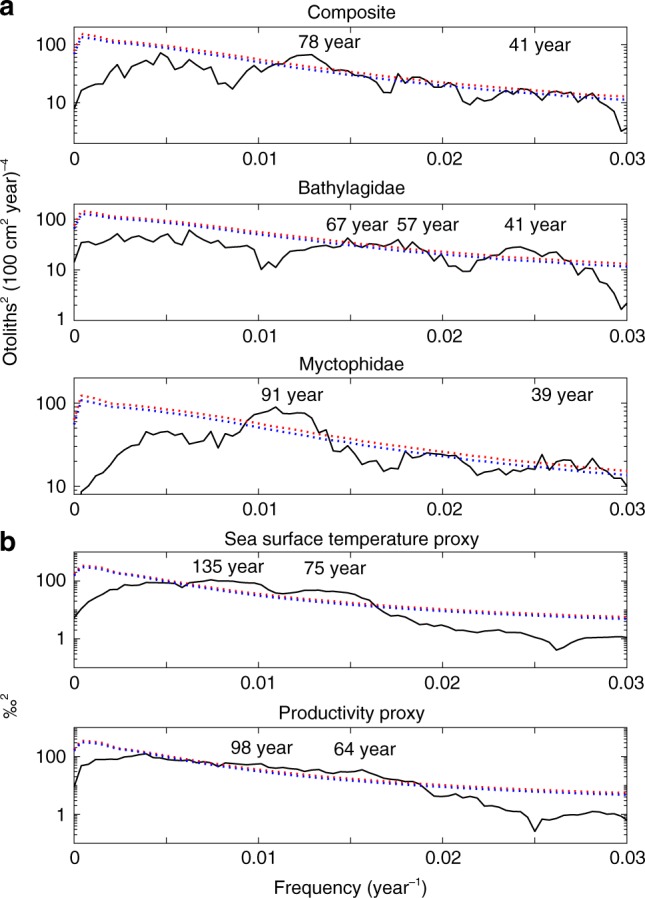
The mesopelagic (200-1000 m) separates the productive upper ocean from the deep ocean, yet little is known of its long-term dynamics despite recent research that suggests fishes of this zone likely dominate global fish biomass and contribute to the downward flux of carbon. Here we show that mesopelagic fishes dominate the otolith (ear bone) record in anoxic sediment layers of the Santa Barbara Basin over the past two millennia. Among these mesopelagic fishes, otoliths from families Bathylagidae (deep-sea smelts) and Myctophidae (lanternfish) are most abundant. Otolith deposition rate fluctuates at decadal to centennial time scales and covaries with proxies for upper ocean temperature, consistent with climate forcing. Moreover, otolith deposition rate and proxies for temperature and primary productivity show contemporaneous discontinuities during the Medieval Climate Anomaly and Little Ice Age. Mesopelagic fishes may serve as proxies for future climatic influence at those depths including effects on the carbon cycle.
中层水(200-1000 米)将生产力高的上层海洋与深海分隔开来,但尽管最近的研究表明,该区域的鱼类可能主导着全球鱼类生物量,并有助于向下输送碳,但人们对其长期动态仍知之甚少。在这里,我们表明中层鱼类在过去两千年中主导着圣巴巴拉盆地缺氧沉积物层中的耳石(耳骨)记录。在这些中层鱼类中,来自 Bathylagidae(深海胡瓜鱼)和 Myctophidae(灯笼鱼)科的耳石最为丰富。耳石沉积速率在数十年到百年的时间尺度上波动,并与上层海洋温度的代用指标相关,这与气候强迫一致。此外,耳石沉积速率和温度及初级生产力的代用指标在中世纪气候异常和小冰期期间同时出现不连续。中层鱼类可能成为未来气候对这些深度影响的指标,包括对碳循环的影响。