Istituto Italiano di Tecnologia (IIT), Department of Robotics, Brain and Cognitive Sciences (RBCS), Genova, Italy.
Department of Computer Science, University of Milan, Milan, Italy.
Sci Rep. 2019 Oct 8;9(1):14430. doi: 10.1038/s41598-019-50609-y.
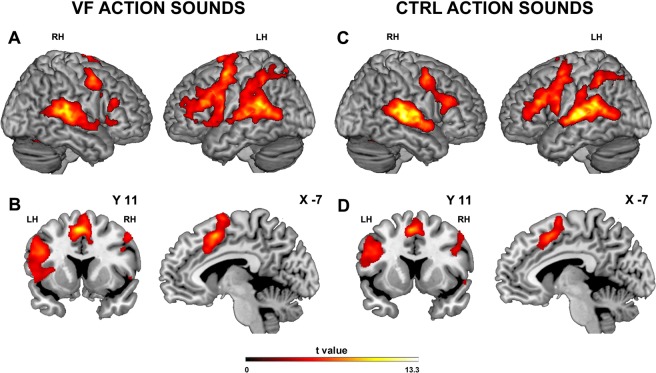
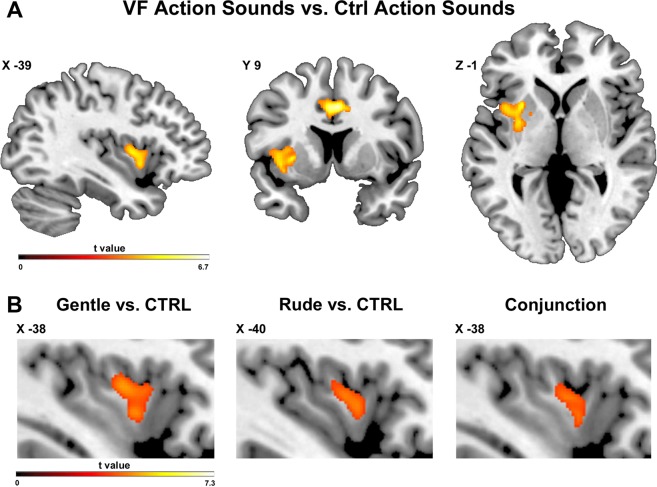
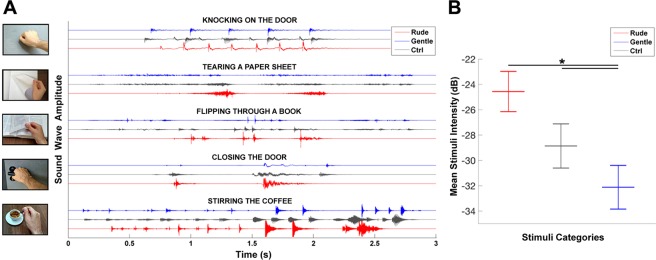
During social interactions, actions and words can be expressed in different ways, for example gently, vigorously or rudely communicating the positive or negative attitude of the agent. These forms of communication are called vitality forms and play a crucial role in social relations. While the neural bases of speech and actions vitality forms have been investigated, there is no information on how we recognize others' mood/attitude by hearing the sound of their actions. In the present fMRI study we investigated the neural basis of vitality forms while participants heard action sounds in two different conditions: sounds resulting from gentle and rude actions, sounds communicating the same actions without vitality forms (control stimuli). Results showed that hearing action sounds conveying rude and gentle vitality forms respect to the control stimuli produced a specific activation of the dorso-central insula. In addition, hearing both vitality forms action sounds and control stimuli produced the activation of the parieto-frontal circuit typically involved in the observation and the execution of arm actions. In conclusion, our data indicate that, the dorso-central insula is a key region involved in the processing of vitality forms regardless of the modality by which they are conveyed.
在社交互动中,动作和语言可以以不同的方式表达,例如温和、有力或粗鲁地传达主体的积极或消极态度。这些交流形式被称为活力形式,在社交关系中起着至关重要的作用。虽然已经研究了言语和动作活力形式的神经基础,但关于我们如何通过听到动作的声音来识别他人的情绪/态度,还没有信息。在本 fMRI 研究中,当参与者在两种不同条件下听到动作声音时,我们研究了活力形式的神经基础:一种是温和的动作声音,另一种是粗鲁的动作声音,这两种声音传达了相同的动作但没有活力形式(控制刺激)。结果表明,听到传达粗鲁和温和活力形式的动作声音相对于控制刺激会特异性地激活背侧中央脑岛。此外,听到活力形式的动作声音和控制刺激都会激活通常涉及手臂动作观察和执行的顶-额回路。总之,我们的数据表明,背侧中央脑岛是一个关键区域,无论其传递方式如何,都参与处理活力形式。