Tan Yuan, Ke Minjing, Huang Zhijian, Chong Cheong-Meng, Cen Xiaotong, Lu Jia-Hong, Yao Xiaoli, Qin Dajiang, Su Huanxing
1State Key Laboratory of Quality Research in Chinese Medicine, Institute of Chinese Medical Sciences, University of Macau, Macao, China.
2South China Institute for Stem Cell Biology and Regenerative Medicine, Guangzhou Institutes of Biomedicine and Health, Chinese Academy of Sciences, Guangzhou, China.
Aging Dis. 2019 Oct 1;10(5):1037-1048. doi: 10.14336/AD.2018.1216. eCollection 2019 Oct.
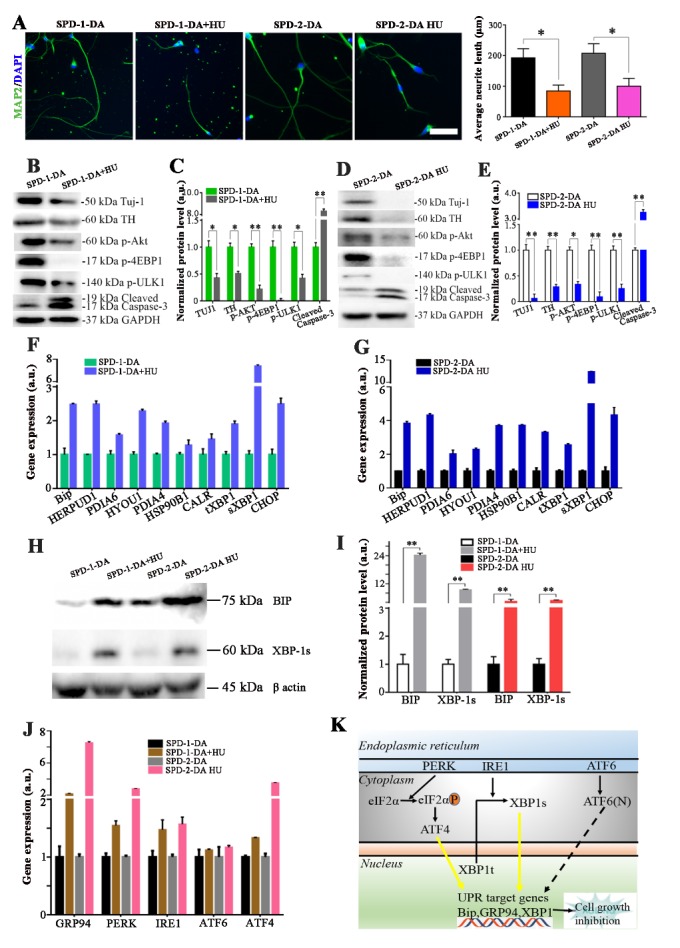
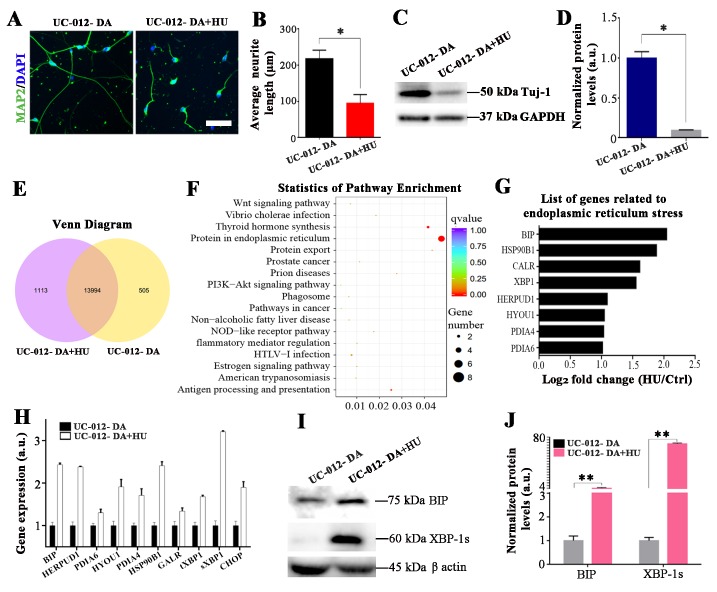
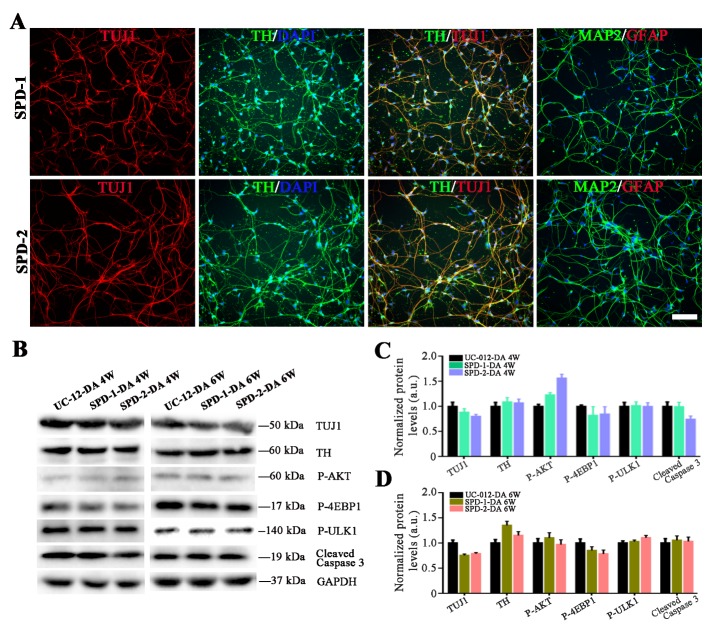
Induced pluripotent stem cells (iPSCs)-derived dopaminergic neurons might be reset back to the fetal state due to reprogramming. Thus, it is a compelling challenge to reliably and efficiently induce disease phenotypes of iPSCs-derived dopaminergic neurons to model late-onset Parkinson's disease (PD). Here, we applied a small molecule, hydroxyurea (HU), to promote the manifestation of disease relevant phenotypes in iPSCs-based modeling of PD. We established two iPS cell lines derived from two sporadic PD patients. Both patients-iPSCs-derived dopaminergic neurons did not display PD relevant phenotypes after 6 weeks culture. HU treatment remarkably induced ER stress on patients-iPSCs-derived dopaminergic neurons. Moreover, HU treatment significantly reduced neurite outgrowth, decreased the expression of p-AKT and its downstream targets (p-4EBP1 and p-ULK1), and increased the expression level of cleaved-Caspase 3 in patients-iPSCs-derived dopaminergic neurons. The findings of the present study suggest that HU administration could be a convenient and reliable approach to induce disease relevant phenotypes in PD-iPSCs-based models, facilitating to study disease mechanisms and test drug effects.
诱导多能干细胞(iPSC)来源的多巴胺能神经元可能由于重编程而恢复到胎儿状态。因此,在可靠且高效地诱导iPSC来源的多巴胺能神经元出现疾病表型以模拟迟发性帕金森病(PD)方面,这是一项极具挑战性的任务。在此,我们应用一种小分子——羟基脲(HU),以促进在基于iPSC的PD模型中与疾病相关表型的显现。我们建立了源自两名散发性PD患者的两条iPS细胞系。在培养6周后,这两名患者的iPSC来源的多巴胺能神经元均未表现出与PD相关的表型。HU处理显著诱导了患者iPSC来源的多巴胺能神经元的内质网应激。此外,HU处理显著减少了神经突生长,降低了p-AKT及其下游靶点(p-4EBP1和p-ULK1)的表达,并增加了患者iPSC来源的多巴胺能神经元中裂解的半胱天冬酶3的表达水平。本研究结果表明,给予HU可能是在基于PD-iPSC的模型中诱导与疾病相关表型的一种便捷且可靠的方法,有助于研究疾病机制和测试药物效果。