Doctorado en Ciencias Biologicas y de la Salud, Universidad Autonoma Metropolitana-Xochimilco, Ciudad de México, México.
Departamento de Neuroquímica, Instituto Nacional de Neurología "Dr Manuel Velasco Suarez", Ave. Insurgentes Sur No. 3877, 14269, Ciudad de México, D.F, México.
BMC Psychiatry. 2019 Oct 9;19(1):295. doi: 10.1186/s12888-019-2286-1.
The aim of present study is to measure plasma clozapine (CLZ) and N-desmethyl clozapine (DMC) as biomarkers to correlate drug concentrations with the appearance of preclinical adverse hematic effects.
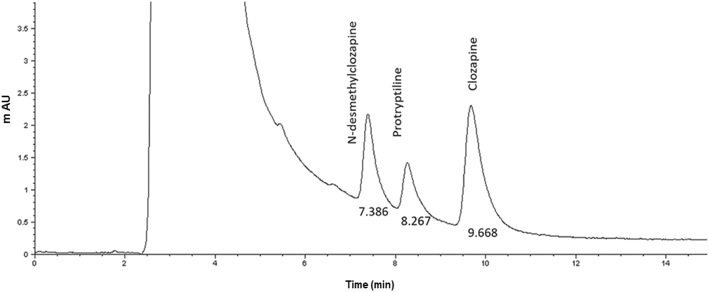
A high-performance liquid chromatographic method, using a diode-array (ultraviolet) detector, was validated to obtain reliable concentrations of CLZ and DMC, its main metabolite, in plasma of 41 schizophrenic patients taking CLZ. Blood neutrophils and leucocytes counting were concurrently assessed as a proxy to subclinical adverse reactions.
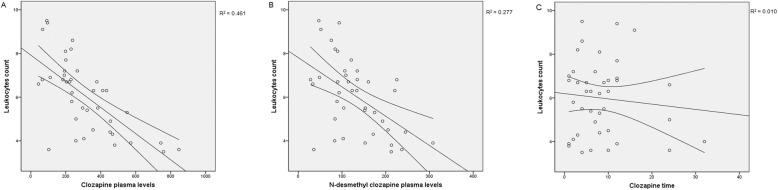
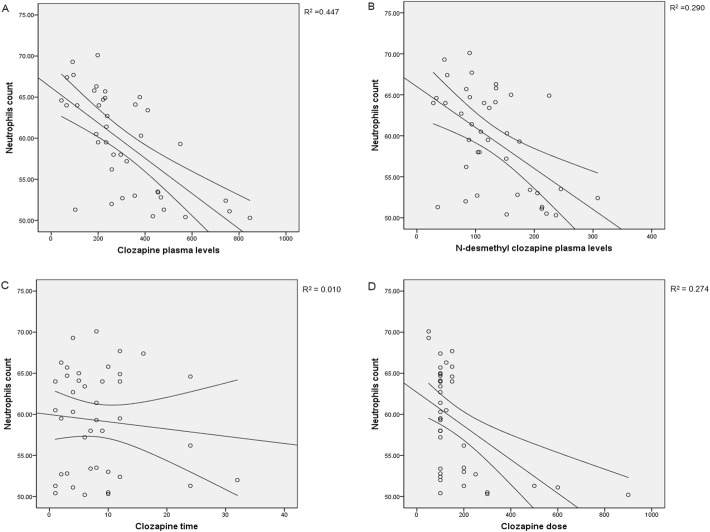
The analytical method employed was linear, reproducible, and stable to measure concentrations of CLZ between 30 and 1000 ng/mL, while 12.5-560 ng/mL of the metabolite. The method allowed us to correlate CLZ plasma concentrations, the time taking CLZ and CLZ dose as determinants of neutrophils' counting with a R = 0.447, using a multiple regression analysis model. Likewise, the correlation of leucocyte counting vs CLZ plasma levels and CLZ time, showed a R = 0.461. DMC correlated significantly with both neutrophils and leucocytes counting, but was excluded from the regression when CLZ concentration was included in the model. Finally, no other hematological adverse reactions were recorded. One patient presented a cardiovascular complication. The negative correlation between clozapine and neutrophil count observed in patients, suggest that CLZ itself, but not DMC, could be related to hematologic side-effects.
The findings of this study, demonstrate for the first time, that plasma levels of CLZ and time taking the drug are independent determinants of blood neutrophils and leucocytes, so the monitoring of plasma CLZ may be useful in the clinic practice to determine safe dosing of the drug.
本研究旨在测量血浆氯氮平(CLZ)和 N-去甲基氯氮平(DMC)作为生物标志物,将药物浓度与临床前不良血液效应的出现相关联。
采用二极管阵列(紫外)检测器的高效液相色谱法对 41 名服用氯氮平的精神分裂症患者的血浆进行了验证,以获得 CLZ 和其主要代谢物 DMC 的可靠浓度。同时评估血液中性粒细胞和白细胞计数作为亚临床不良反应的替代指标。
所采用的分析方法线性、可重现且稳定,可测量 30 至 1000ng/mL 范围内的 CLZ 浓度,以及 12.5-560ng/mL 的代谢物。该方法允许我们使用多元回归分析模型将 CLZ 血浆浓度、服用 CLZ 的时间和 CLZ 剂量作为中性粒细胞计数的决定因素进行相关分析,相关系数为 0.447。同样,白细胞计数与 CLZ 血浆水平和 CLZ 时间的相关性,显示相关系数为 0.461。DMC 与中性粒细胞和白细胞计数显著相关,但当 CLZ 浓度包含在模型中时,它被排除在回归之外。最后,没有记录到其他血液学不良反应。一名患者出现心血管并发症。患者中观察到的氯氮平和中性粒细胞计数之间的负相关表明,CLZ 本身而不是 DMC,可能与血液学副作用有关。
本研究首次证明,CLZ 血浆水平和服用药物的时间是血液中性粒细胞和白细胞的独立决定因素,因此监测 CLZ 血浆水平可能有助于临床实践确定药物的安全剂量。