Department of Neurosurgery, School of Medicine, West Virginia University, Morgantown, West Virginia.
Department of Radiation Oncology, School of Medicine, West Virginia University, Morgantown, West Virginia.
Neurosurgery. 2020 Sep 15;87(4):664-671. doi: 10.1093/neuros/nyz428.
Despite a high incidence of brain metastases in patients with small-cell lung cancer (SCLC), limited data exist on the use of stereotactic radiosurgery (SRS), specifically Gamma Knife™ radiosurgery (Elekta AB), for SCLC brain metastases.
To provide a detailed analysis of SCLC patients treated with SRS, focusing on local failure, distant brain failure, and overall survival (OS).
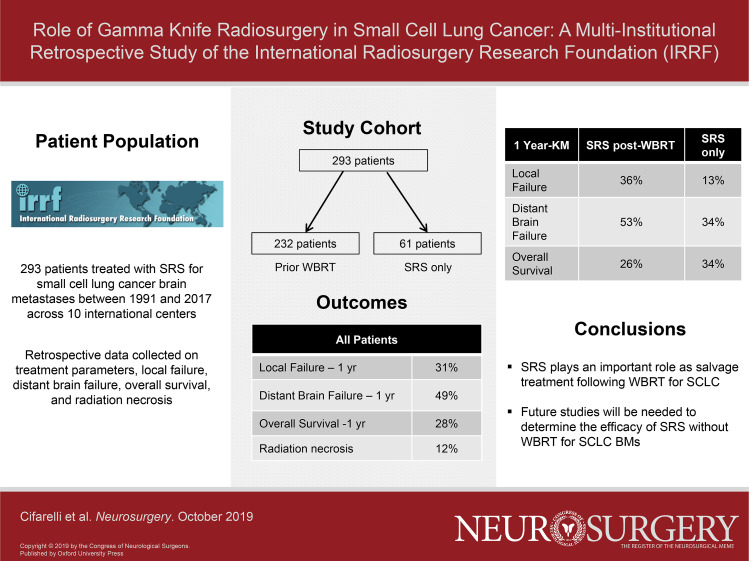
A multi-institutional retrospective review was performed on 293 patients undergoing SRS for SCLC brain metastases at 10 medical centers from 1991 to 2017. Data collection was performed according to individual institutional review boards, and analyses were performed using binary logistic regression, Cox-proportional hazard models, Kaplan-Meier survival analysis, and competing risks analysis.
Two hundred thirty-two (79%) patients received SRS as salvage following prior whole-brain irradiation (WBRT) or prophylactic cranial irradiation, with a median marginal dose of 18 Gy. At median follow-up after SRS of 6.4 and 18.0 mo for surviving patients, the 1-yr local failure, distant brain failure, and OS were 31%, 49%, and 28%. The interval between WBRT and SRS was predictive of improved OS for patients receiving SRS more than 1 yr after initial treatment (21%, <1 yr vs 36%, >1 yr, P = .01). On multivariate analysis, older age was the only significant predictor for OS (hazard ratio 1.63, 95% CI 1.16-2.29, P = .005).
SRS plays an important role in the management of brain metastases from SCLC, especially in salvage therapy following WBRT. Ongoing prospective trials will better assess the value of radiosurgery in the primary management of SCLC brain metastases and potentially challenge the standard application of WBRT in SCLC patients.
尽管小细胞肺癌(SCLC)患者的脑转移发生率很高,但关于立体定向放射外科(SRS),特别是伽玛刀放射外科(Elekta AB)在 SCLC 脑转移中的应用的数据有限。
提供接受 SRS 治疗的 SCLC 患者的详细分析,重点关注局部失败、远处脑失败和总生存(OS)。
对 1991 年至 2017 年间 10 家医疗中心的 293 例 SCLC 脑转移患者进行了多机构回顾性研究。根据各个机构的审查委员会进行数据收集,并使用二项逻辑回归、Cox 比例风险模型、Kaplan-Meier 生存分析和竞争风险分析进行分析。
232 例(79%)患者在全脑放疗(WBRT)或预防性颅照射后接受 SRS 作为挽救性治疗,中位边缘剂量为 18 Gy。在 SRS 后中位随访 6.4 和 18.0 个月时,存活患者的 1 年局部失败、远处脑失败和 OS 分别为 31%、49%和 28%。WBRT 与 SRS 之间的间隔时间是影响接受 SRS 治疗患者 OS 的重要因素,与初始治疗后 1 年以上接受 SRS 治疗的患者相比(21%,<1 年 vs 36%,>1 年,P=.01)。多变量分析显示,年龄较大是 OS 的唯一显著预测因素(风险比 1.63,95%CI 1.16-2.29,P=.005)。
SRS 在 SCLC 脑转移的治疗中起着重要作用,特别是在 WBRT 后挽救性治疗中。正在进行的前瞻性试验将更好地评估放射外科在 SCLC 脑转移的初始治疗中的价值,并可能对 WBRT 在 SCLC 患者中的标准应用提出挑战。