Department of Physical Medicine and Rehabilitation, University of Texas Southwestern Medical Center, Dallas.
JAMA Netw Open. 2019 Oct 2;2(10):e1913054. doi: 10.1001/jamanetworkopen.2019.13054.
With the substantial increase in the proportion of women graduating from medical school, factors surrounding family leave require careful attention. Although many circumstances and experiences are unique to the training setting and specialty, a nationwide representation of physician mothers across all disciplines and all levels of training may reveal common themes and experiences among them, enable comparison across training setting and subspecialties, and identify best practices for supporting physician mothers throughout their careers.
To characterize family leave and return-to-work experiences of physician mothers across subspecialties.
DESIGN, SETTING, AND PARTICIPANTS: This cross-sectional US nationwide survey study evaluating the experiences of 844 physician mothers was administered electronically via REDCap from September 2 to December 20, 2018.
A survey was developed using a modified Delphi process with a panel of experts to characterize physician mothers' family leave and return-to-work experiences. The survey covered both negative and positive experiences of physician mothers for each child they conceived or adopted after medical school to identify areas for change and strategies for successfully supporting physician parents.
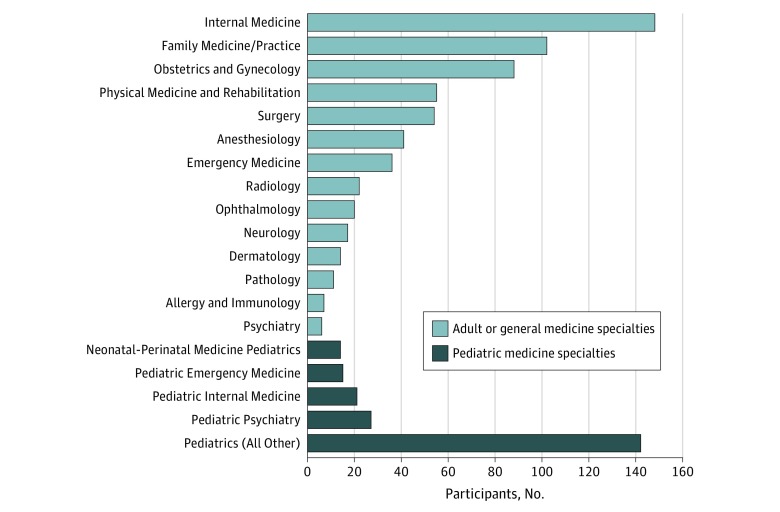
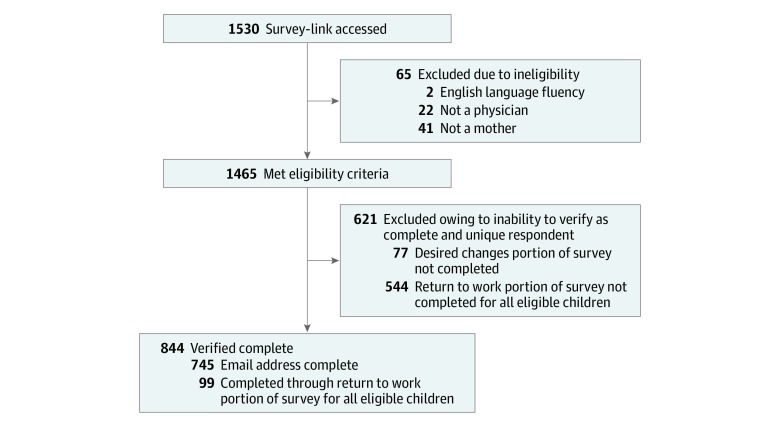
Of 1465 potentially eligible survey respondents, 844 (57.6%) were verified as unique respondents with complete surveys. Their mean (SD) age was 35.8 (5.2) years (range, 27-67 years), with most women (826 [97.9%]) currently practicing and 138 women (16.4%) currently in a residency program. Participants were included from 19 subspecialty groups. Of the women surveyed, 619 (73.3%) felt that leave time was insufficient. The majority (751 [89.0%]) would have preferred 11 weeks to 6 months of leave vs the 5 to 12 weeks (often not paid) most commonly available. The most frequently reported negative experiences when returning to work were associated with lack of facilities for breast pumping (range, 12 of 78 [15.4%] for the third child to 272 of 844 [32.2%] for the first child) and time for breast pumping (range, 27 of 78 [34.6%] for the third child to 407 of 844 [48.2%] for the first child), difficulty obtaining childcare (eg, for the first child, 298 of 844 [35.3%]), and discrimination (eg, for the first child, 152 of 844 [18.0%]). The most common positive experience was emotional support (eg, for the first child, 504 of 844 [59.7%]), primarily from colleagues.
The present study, capturing one of the largest and most heterogeneous samples of physician mothers, showed that a substantial number of women physicians working in a variety of specialties at all levels of training across the United States needed and wanted more support for maternity leave and return to work. Support at the institutional level, such as paid leave, adequate breast pumping time without penalty, on-site childcare, and schedule flexibility, would likely provide the greatest direct assistance to help physician mothers thrive in their careers.
随着越来越多的女性从医学院毕业,围绕产假的各种因素需要引起我们的关注。虽然许多情况和经验是培训环境和专业特有的,但对所有学科和各个培训阶段的医生母亲进行全国性的代表性研究可能会揭示出她们之间的共同主题和经验,使我们能够对培训环境和亚专业进行比较,并确定在整个职业生涯中支持医生母亲的最佳实践。
描述各个亚专业的医生母亲的产假和重返工作岗位的经历。
设计、设置和参与者:本横断面研究使用改良 Delphi 方法对 844 名医生母亲的经验进行了评估,调查于 2018 年 9 月 2 日至 12 月 2 日通过 REDCap 在线进行。
使用专家小组制定的调查问卷来描述医生母亲的产假和重返工作岗位的经历。该调查涵盖了医生母亲在医学院毕业后每生育或收养一个孩子的消极和积极经历,以确定需要改变的领域和成功支持医生父母的策略。
在 1465 名可能符合条件的调查对象中,有 844 名(57.6%)被确认为有完整调查问卷的独特调查对象。她们的平均(SD)年龄为 35.8(5.2)岁(范围,27-67 岁),大多数女性(826 [97.9%])目前正在行医,138 名女性(16.4%)目前在接受住院医师培训。参与者来自 19 个亚专业群体。在接受调查的女性中,619 名(73.3%)认为休假时间不足。大多数(751 [89.0%])希望有 11 周到 6 个月的休假时间,而不是最常见的 5 周到 12 周(通常不带薪)。返回工作岗位时最常报告的负面经历与缺乏挤奶设施有关(范围,第三胎的 12 例(15.4%)至第一胎的 272 例(32.2%))和挤奶时间(范围,第三胎的 27 例(34.6%)至第一胎的 407 例(48.2%))、难以获得儿童保育(例如,第一胎有 298 例(35.3%))和歧视(例如,第一胎有 152 例(18.0%))。最常见的积极体验是情感支持(例如,第一胎有 504 例(59.7%)),主要来自同事。
本研究是对医生母亲的一项调查,样本量在美国是最大和最多样化的之一,结果表明,相当数量的女性医生在各个专业领域工作,她们在各级培训中都需要和希望得到更多的产假和重返工作岗位的支持。机构层面的支持,如带薪休假、充足的挤奶时间而不受处罚、现场儿童保育和灵活的时间表,可能会为帮助医生母亲在职业生涯中茁壮成长提供最大的直接帮助。