Losada Isabel, Barbeito Gema, García-Garrote Fernando, Fernández-Pérez Begoña, Malvar Alberto, Hervada Xurxo
Dirección Xeral de Saúde Pública, Consellería de Sanidade, Xunta de Galicia, Santiago de Compostela, España.
Complexo Hospitalario Universitario de Santiago, Santiago de Compostela, España.
Aten Primaria. 2020 Aug-Sep;52(7):462-468. doi: 10.1016/j.aprim.2019.06.007. Epub 2019 Oct 11.
Escherichia coli (E. coli) is responsible for the majority of community urinary tract infections. The objective of the study is to know the sensitivity spectrum of E. coli in urinary tract infections to be able to recommend the appropriate empirical antibiotic treatment.
Cross-sectional, multicentric, retrospective study.
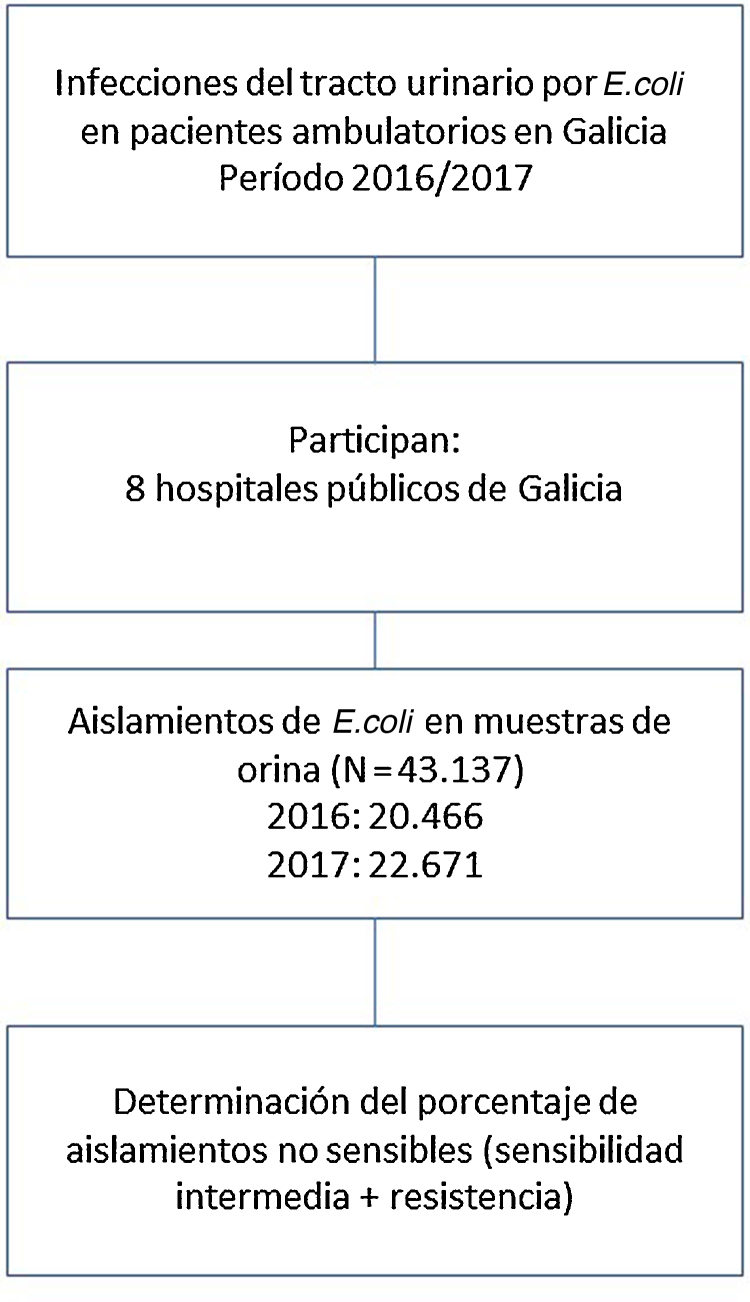
Galician 8 public hospitals, practically the entire population of Galicia (Spain).
43,137 outpatients with urinary tract infection due to E. coli isolated in urine in 2016/2017.
Analyzed variables: demographic, minimum inhibitory concentration and interpretation of sensitivity according to CLSI criteria and resistance mechanisms. The antibiotics studied were: ampicillin, amoxicillin-clavulanic acid, ciprofloxacin, cefotaxime, cefepime, gentamicin, nitrofurantoin, fosfomycin, cotrimoxazole, imipenem and ertapenem. The identification and sensitivity were made mainly by automated methods.
The percentages of non-sensitivity of E. coli isolates were: ampicillin 49.2%, amoxicillin-clavulanic acid 17.8%, cefotaxime 6.7%, cefepime 5.7%, ertapenem 0.04%, imipenem 0.05%, gentamicin 9,1%, ciprofloxacin 26.2%, fosfomycin 3.3%, nitrofurantoin 2.4% and cotrimoxazole 23.9%. The non-sensitivities were higher in men and as age increases. Six percent of E. coli were producers of extended-spectrum beta-lactamases.
The empirical treatment in Galicia for uncomplicated cystitis produced by E. coli in women continues to be nitrofurantoin and fosfomycin. In men under 15 years of age, fosfomycin is indicated and in men older than 15 years, treatment in our environment should include culture and administer a 3rd generation oral cephalosporin empirically. Cotrimoxazole and ciprofloxacin are not recommended as empirical treatment because of their high resistance rates.
大肠埃希菌是社区获得性尿路感染的主要致病菌。本研究旨在了解尿路感染中大肠埃希菌的药敏谱,以便推荐合适的经验性抗生素治疗方案。
横断面、多中心、回顾性研究。
加利西亚地区的8家公立医院,几乎涵盖了加利西亚(西班牙)的全部人口。
2016/2017年尿液中分离出大肠埃希菌的43137例门诊尿路感染患者。
分析的变量包括:人口统计学数据、最低抑菌浓度、根据CLSI标准的药敏结果及耐药机制。研究的抗生素有:氨苄西林、阿莫西林-克拉维酸、环丙沙星、头孢噻肟、头孢吡肟、庆大霉素、呋喃妥因、磷霉素、复方新诺明、亚胺培南和厄他培南。鉴定和药敏试验主要采用自动化方法。
大肠埃希菌分离株的不敏感率分别为:氨苄西林49.2%、阿莫西林-克拉维酸17.8%、头孢噻肟6.7%、头孢吡肟5.7%、厄他培南0.04%、亚胺培南0.05%、庆大霉素9.1%、环丙沙星26.2%、磷霉素3.3%、呋喃妥因2.4%、复方新诺明23.9%。男性和随着年龄增长,不敏感率更高。6%的大肠埃希菌产超广谱β-内酰胺酶。
在加利西亚地区,女性由大肠埃希菌引起的非复杂性膀胱炎的经验性治疗仍为呋喃妥因和磷霉素。15岁以下男性,推荐使用磷霉素;15岁以上男性,在我们的环境中治疗应包括进行培养并经验性给予第三代口服头孢菌素。由于复方新诺明和环丙沙星的耐药率较高,不推荐作为经验性治疗药物。