Unit of Regenerative Therapy, Service of Plastic, Reconstructive and Hand Surgery, Department of Musculoskeletal Medicine, Lausanne University Hospital, Lausanne, Switzerland.
Laboratory of Biomechanical Orthopedics, Institute of Bioengineering, EPFL, Lausanne, Switzerland.
Artif Organs. 2020 Apr;44(4):E161-E171. doi: 10.1111/aor.13581. Epub 2019 Nov 14.
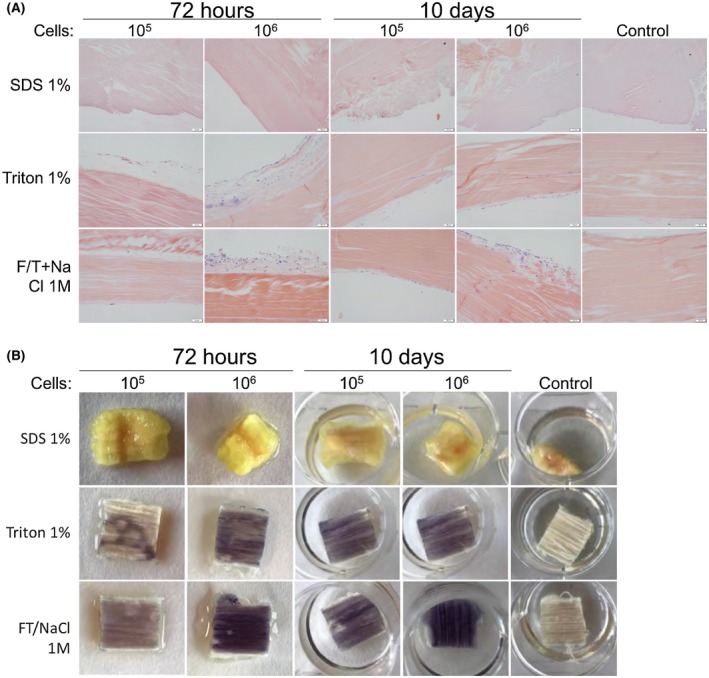
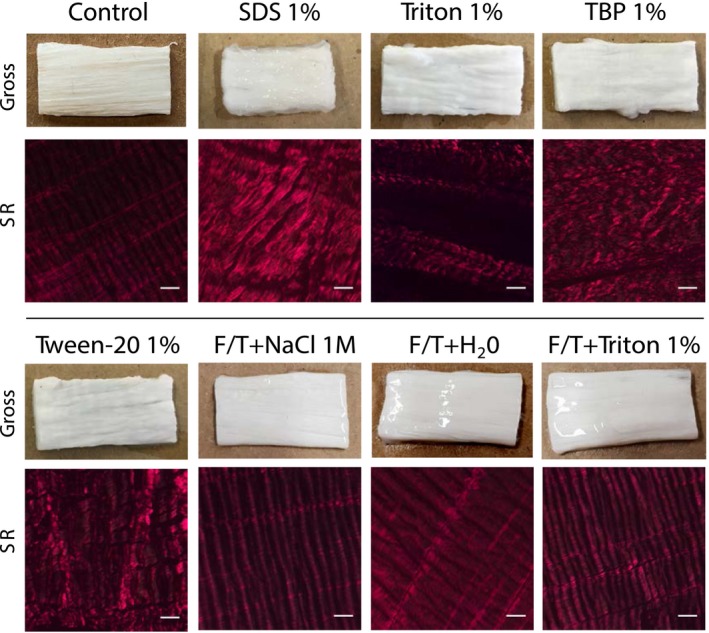
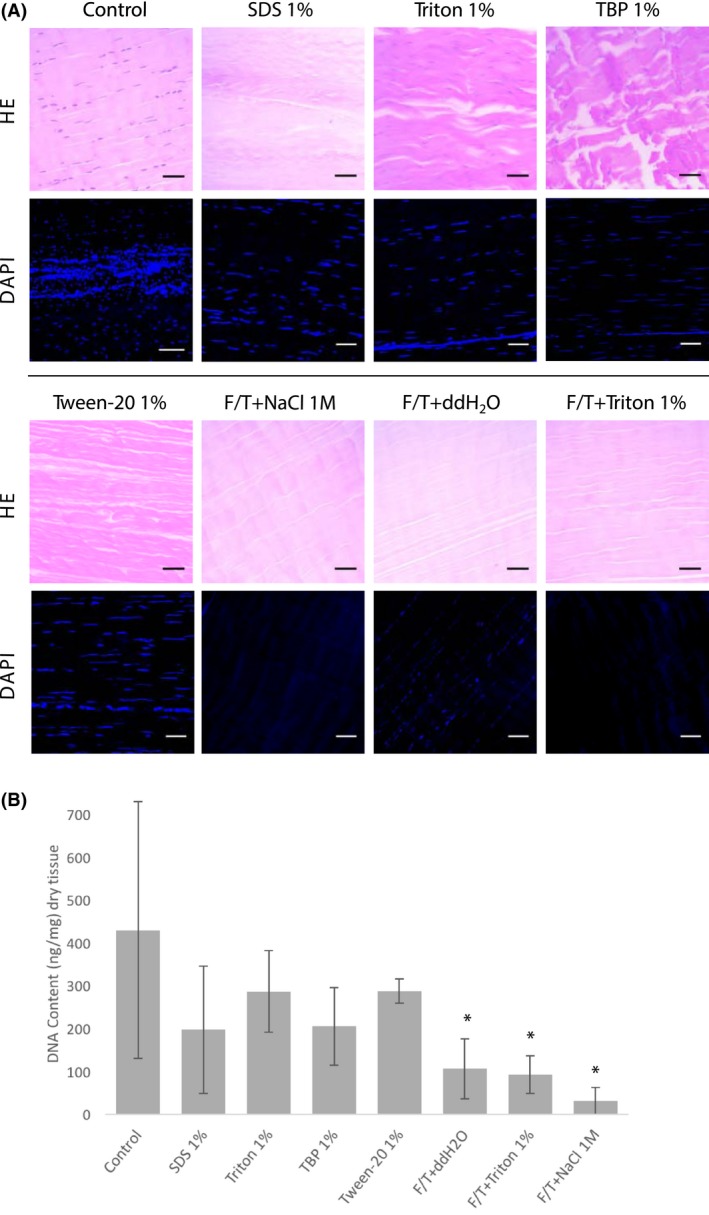
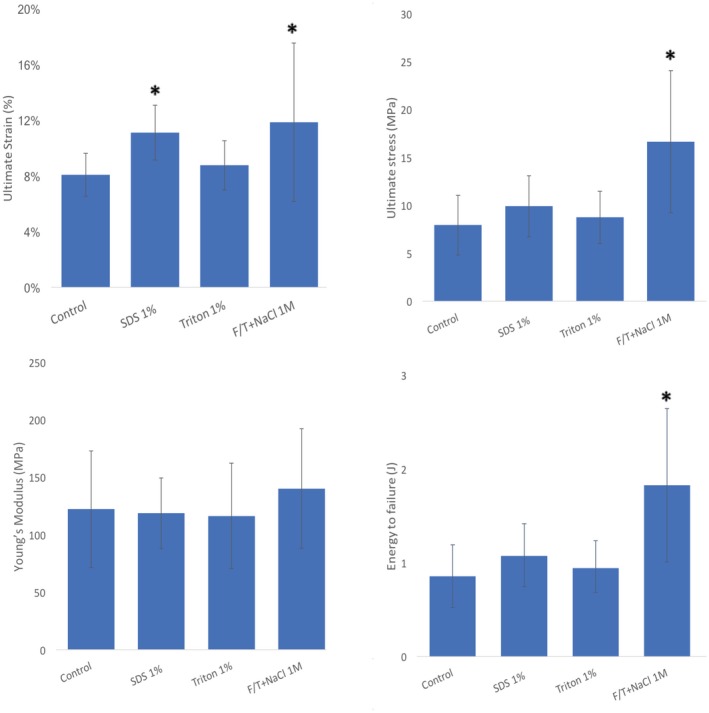
Chronic and acute tendon injuries are frequent afflictions, for which treatment is often long and unsatisfactory. When facing extended injuries, matrices and scaffolds with sufficient biomechanical properties are required for surgical repair and could additionally serve as supports for cellular therapies to improve healing. In this study, protocols of either commonly used detergents only (SDS 1%, Triton 1%, TBP 1%, and Tween-20 1%) or a combination of freeze/thaw (F/T) cycles with decellularization agents (NaCl 1M, ddH O) were evaluated for the decellularization of horse equine superficial digital flexor tendon (SDFT) for hand flexor or extensor tendon reconstruction. Decellularization efficiency was assessed microscopically by histological staining (HE, DAPI) and DNA quantification. Macroscopical structure and biomechanical integrity of the tendon matrices were further assessed by gross observation, histological staining (SR), and mechanical testing (ultimate strain and stress, Young's modulus, energy to failure) for select protocols. Decellularization with hypertonic NaCl 1M in association with F/T cycles produced the most robust tendon matrices, which were nontoxic after 10 days for subsequent recellularization with human fetal progenitor tendon cells (hFPTs). This standardized protocol uses a less aggressive decellularization agent than current practice, which allows subsequent reseeding with allogenic cells, therefore making them very suitable and bioengineered tendon matrices for human tendon reconstruction in the clinic.
慢性和急性肌腱损伤是常见的疾病,其治疗往往漫长而不尽如人意。在面对长期损伤时,手术修复需要具有足够生物力学性能的基质和支架,并且还可以作为细胞治疗的支持物,以改善愈合。在这项研究中,评估了仅使用常用去污剂的方案(SDS1%、Triton1%、TBP1%和 Tween-201%)或与脱细胞剂(NaCl1M、ddH2O)联合使用冻融(F/T)循环的方案,用于马的浅指深屈肌腱(SDFT)的脱细胞化,以用于手部屈肌腱或伸肌腱重建。通过组织学染色(HE、DAPI)和 DNA 定量显微镜评估脱细胞效率。通过大体观察、组织学染色(SR)和机械测试(极限应变和应力、杨氏模量、失效能)进一步评估选择方案的肌腱基质的宏观结构和生物力学完整性。高渗 NaCl1M 与 F/T 循环联合脱细胞化产生了最坚固的肌腱基质,在与人类胎儿祖细胞肌腱细胞(hFPT)进行后续再细胞化后 10 天无毒性。该标准化方案使用的脱细胞剂比当前实践更具侵略性,这允许随后用同种异体细胞进行再播种,因此非常适合用于临床中的人类肌腱重建的生物工程化肌腱基质。