Górnicki Tomasz, Lambrinow Jakub, Golkar-Narenji Afsaneh, Data Krzysztof, Domagała Dominika, Niebora Julia, Farzaneh Maryam, Mozdziak Paul, Zabel Maciej, Antosik Paweł, Bukowska Dorota, Ratajczak Kornel, Podhorska-Okołów Marzenna, Dzięgiel Piotr, Kempisty Bartosz
Division of Histology and Embryology, Department of Human Morphology and Embryology, Wroclaw Medical University, 50-368 Wroclaw, Poland.
Prestage Department of Poultry Science, North Carolina State University, Raleigh, NC 27607, USA.
Nanomaterials (Basel). 2024 Mar 16;14(6):531. doi: 10.3390/nano14060531.
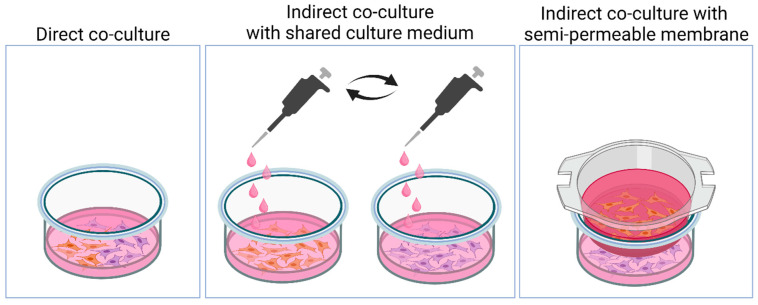
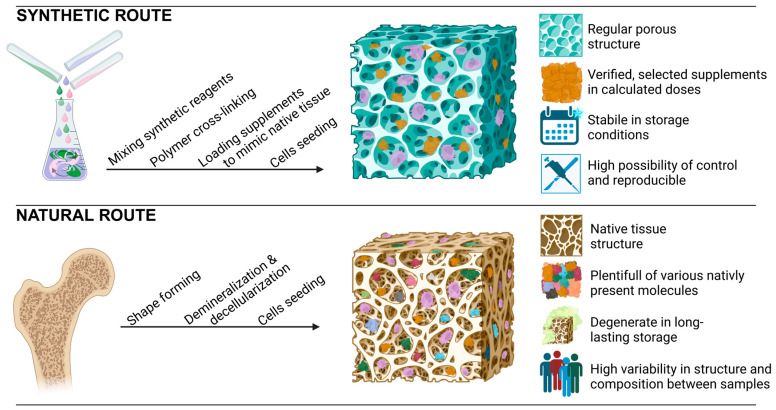
Biomimetic scaffolds imitate native tissue and can take a multidimensional form. They are biocompatible and can influence cellular metabolism, making them attractive bioengineering platforms. The use of biomimetic scaffolds adds complexity to traditional cell cultivation methods. The most commonly used technique involves cultivating cells on a flat surface in a two-dimensional format due to its simplicity. A three-dimensional (3D) format can provide a microenvironment for surrounding cells. There are two main techniques for obtaining 3D structures based on the presence of scaffolding. Scaffold-free techniques consist of spheroid technologies. Meanwhile, scaffold techniques contain organoids and all constructs that use various types of scaffolds, ranging from decellularized extracellular matrix (dECM) through hydrogels that are one of the most extensively studied forms of potential scaffolds for 3D culture up to 4D bioprinted biomaterials. 3D bioprinting is one of the most important techniques used to create biomimetic scaffolds. The versatility of this technique allows the use of many different types of inks, mainly hydrogels, as well as cells and inorganic substances. Increasing amounts of data provide evidence of vast potential of biomimetic scaffolds usage in tissue engineering and personalized medicine, with the main area of potential application being the regeneration of skin and musculoskeletal systems. Recent papers also indicate increasing amounts of in vivo tests of products based on biomimetic scaffolds, which further strengthen the importance of this branch of tissue engineering and emphasize the need for extensive research to provide safe for humansbiomimetic tissues and organs. In this review article, we provide a review of the recent advancements in the field of biomimetic scaffolds preceded by an overview of cell culture technologies that led to the development of biomimetic scaffold techniques as the most complex type of cell culture.
仿生支架模仿天然组织,可呈现多维形态。它们具有生物相容性,能够影响细胞代谢,使其成为颇具吸引力的生物工程平台。仿生支架的应用增加了传统细胞培养方法的复杂性。最常用的技术是在二维平面上培养细胞,因其操作简单。三维(3D)形式可为周围细胞提供微环境。基于支架的存在,有两种主要技术可用于获得3D结构。无支架技术包括球体技术。同时,支架技术包含类器官以及所有使用各种类型支架的构建体,范围从脱细胞细胞外基质(dECM)到水凝胶,水凝胶是3D培养中研究最广泛的潜在支架形式之一,直至4D生物打印生物材料。3D生物打印是用于制造仿生支架的最重要技术之一。该技术的多功能性允许使用许多不同类型的墨水,主要是水凝胶,以及细胞和无机物质。越来越多的数据证明了仿生支架在组织工程和个性化医学中的巨大应用潜力,其主要潜在应用领域是皮肤和肌肉骨骼系统的再生。最近的论文还表明,基于仿生支架的产品的体内测试数量不断增加,这进一步强化了这一组织工程分支的重要性,并强调需要进行广泛研究以提供对人类安全的仿生组织和器官。在这篇综述文章中,我们先概述了导致仿生支架技术发展的细胞培养技术,这是最复杂的细胞培养类型,然后对仿生支架领域的最新进展进行了综述。