Castillo Nidia, Pastor Victoria, Chávez Ángel, Arró Montserrat, Boronat Albert, Flors Victor, Ferrer Albert, Altabella Teresa
Plant Metabolism and Metabolic Engineering Program, Centre for Research in Agricultural Genomics (CRAG), CSIC-IRTA-UAB-UB, Barcelona, Spain.
Metabolic Integration and Cell Signalling Group, Plant Physiology Section, Department of Ciencias Agrarias y del Medio Natural, Universitat Jaume I, Castelló, Spain.
Front Plant Sci. 2019 Sep 27;10:1162. doi: 10.3389/fpls.2019.01162. eCollection 2019.
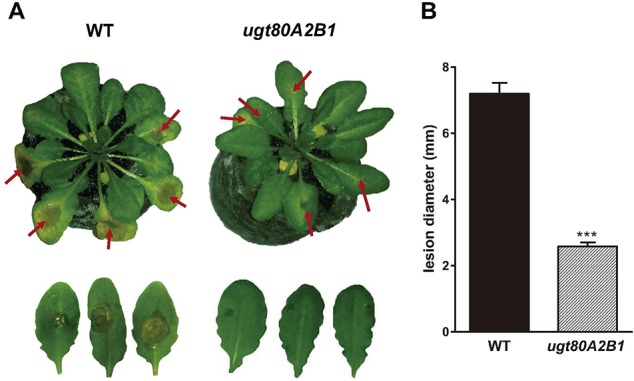
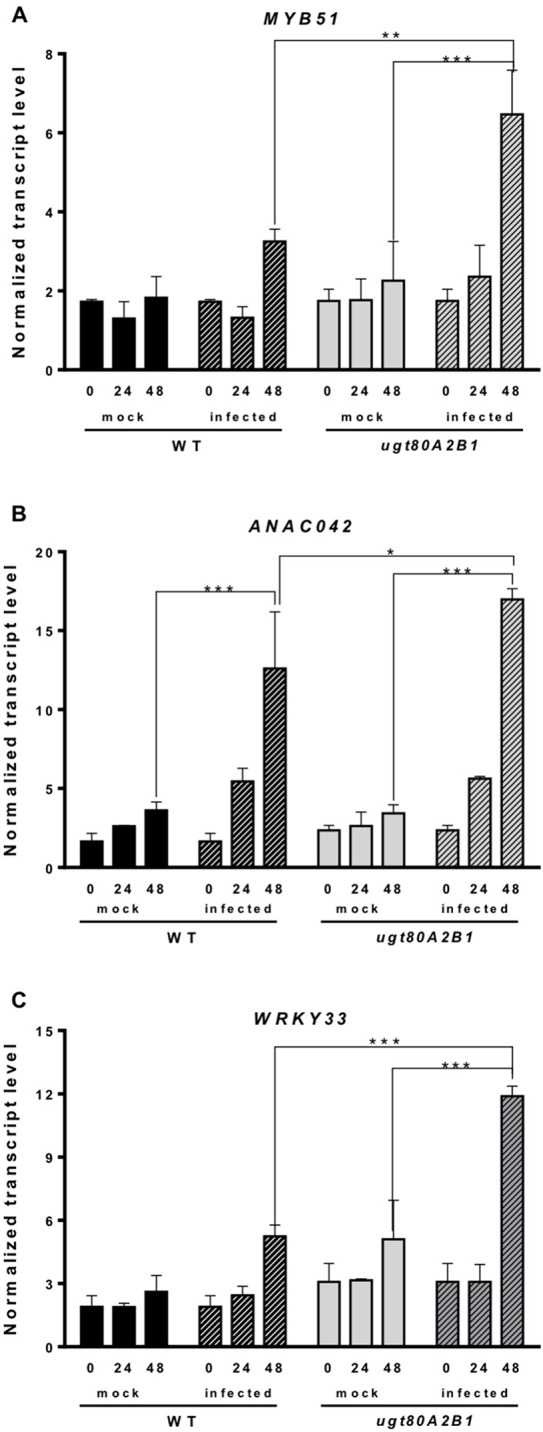
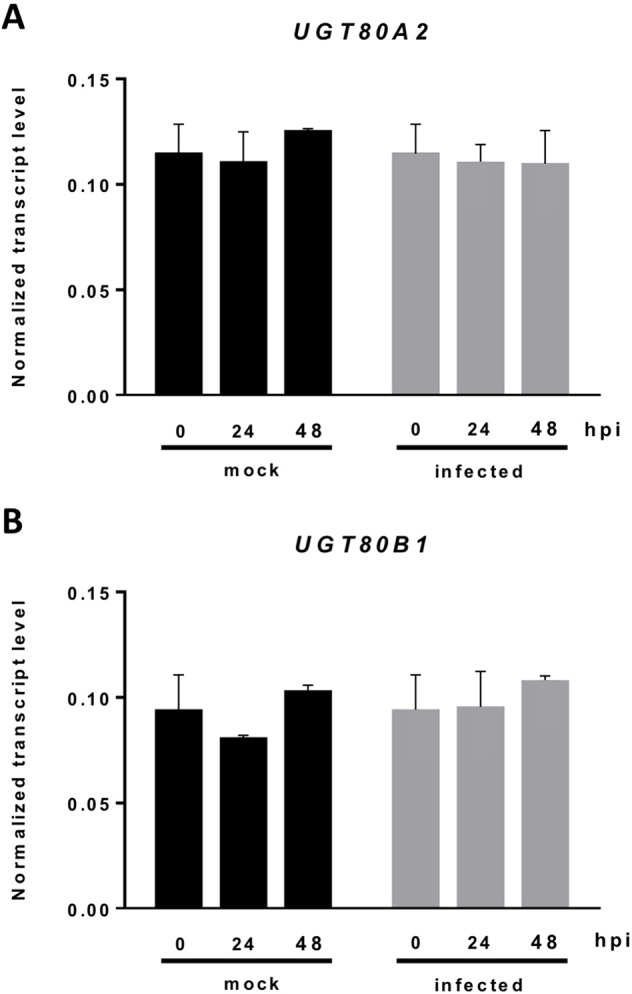
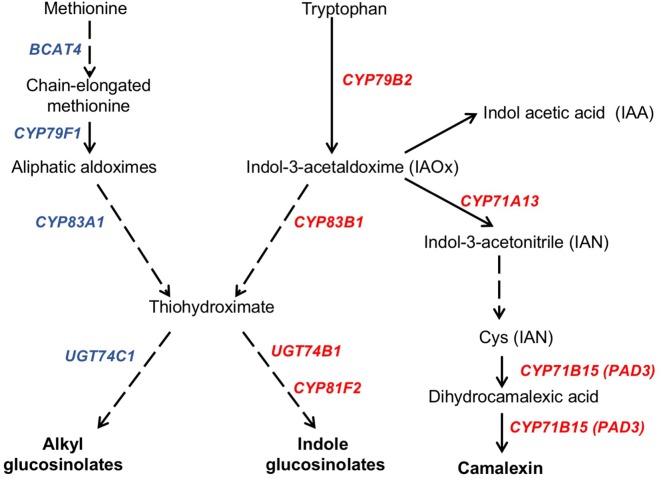
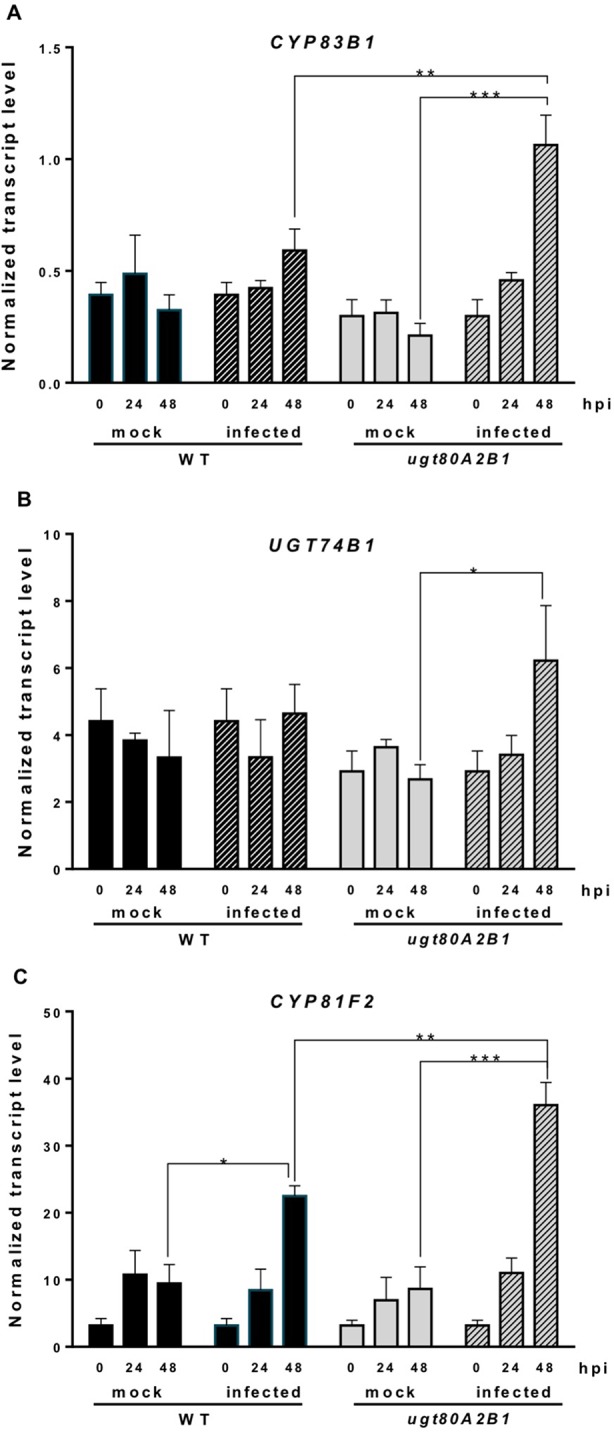
Free and glycosylated sterols are both structural components of the plasma membrane that regulate their biophysical properties and consequently different plasma membrane-associated processes such as plant adaptation to stress or signaling. Several reports relate changes in glycosylated sterols levels with the plant response to abiotic stress, but the information about the role of these compounds in the response to biotic stress is scarce. In this work, we have studied the response to the necrotrophic fungus in an mutant that is severely impaired in steryl glycosides biosynthesis due to the inactivation of the two sterol glucosyltransferases (UGT80A2 and UGT80B1) reported in this plant. This mutant exhibits enhanced resistance against when compared to wild-type plants, which correlates with increased levels of jasmonic acid (JA) and up-regulation of two marker genes ( and ) of the ERF branch of the JA signaling pathway. Upon infection, the double mutant also accumulates higher levels of camalexin, the major phytoalexin, than wild-type plants. Camalexin accumulation correlates with enhanced transcript levels of several cytochrome P450 camalexin biosynthetic genes, as well as of their transcriptional regulators , , and , suggesting that the -induced accumulation of camalexin is coordinately regulated at the transcriptional level. After fungus infection, the expression of genes involved in the indole glucosinolate biosynthesis is also up-regulated at a higher degree in the mutant than in wild-type plants. Altogether, the results of this study show that glycosylated sterols play an important role in the regulation of response to infection and suggest that this occurs through signaling pathways involving the canonical stress-hormone JA and the tryptophan-derived secondary metabolites camalexin and possibly also indole glucosinolates.
游离甾醇和糖基化甾醇都是质膜的结构成分,它们调节质膜的生物物理特性,进而影响不同的质膜相关过程,如植物对胁迫的适应或信号传导。有几份报告将糖基化甾醇水平的变化与植物对非生物胁迫的反应联系起来,但关于这些化合物在生物胁迫反应中的作用的信息却很少。在这项研究中,我们研究了一种突变体对坏死性真菌的反应,该突变体由于该植物中报道的两种甾醇葡萄糖基转移酶(UGT80A2和UGT80B1)失活,导致甾醇糖苷生物合成严重受损。与野生型植物相比,该突变体对[具体真菌名称未给出]表现出更强的抗性,这与茉莉酸(JA)水平的增加以及JA信号通路ERF分支的两个标记基因([具体基因名称未给出])的上调相关。在[具体真菌名称未给出]感染后,该双突变体还比野生型植物积累了更高水平的主要植物抗毒素——植保素。植保素的积累与几个细胞色素P450植保素生物合成基因及其转录调节因子[具体基因名称未给出]、[具体基因名称未给出]和[具体基因名称未给出]的转录水平增强相关,这表明[具体真菌名称未给出]诱导的植保素积累在转录水平上受到协调调节。真菌感染后,吲哚硫代葡萄糖苷生物合成相关基因的表达在突变体中也比野生型植物上调程度更高。总之,这项研究的结果表明,糖基化甾醇在调节植物对[具体真菌名称未给出]感染的反应中起重要作用,并表明这是通过涉及经典应激激素JA以及色氨酸衍生的次生代谢物植保素以及可能还有吲哚硫代葡萄糖苷的信号通路发生的。