Department of Breast Oncology, Aichi Cancer Center, Aichi, Japan.
Division of Breast Oncology, Saitama Cancer Center, Saitama, Japan.
Jpn J Clin Oncol. 2019 Dec 27;49(12):1083-1091. doi: 10.1093/jjco/hyz135.
In the randomised Phase 3 IMpassion130 trial, atezolizumab combined with nab-paclitaxel (atezo + nab-P) in 902 patients with triple-negative breast cancer (TNBC) showed prolonged progression-free survival (PFS) in both the intention-to-treat (ITT) population and programmed death-ligand 1 (PD-L1)-positive subgroup compared with placebo plus nab-P (plac + nab-P). This study assessed the efficacy and safety of atezo + nab-P in the IMpassion130 Japanese subpopulation.
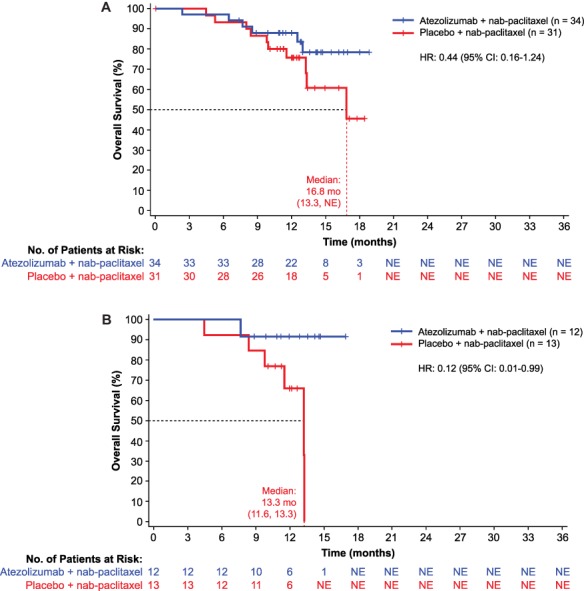
Eligible patients had unresectable locally advanced or metastatic TNBC previously untreated with chemotherapy for metastatic disease. Patients were randomised 1:1 to receive either atezo + nab-P or plac + nab-P. Co-primary endpoints were investigator-assessed PFS and overall survival (ITT population and PD-L1-positive subgroup). These were also assessed in the Japanese subpopulation.
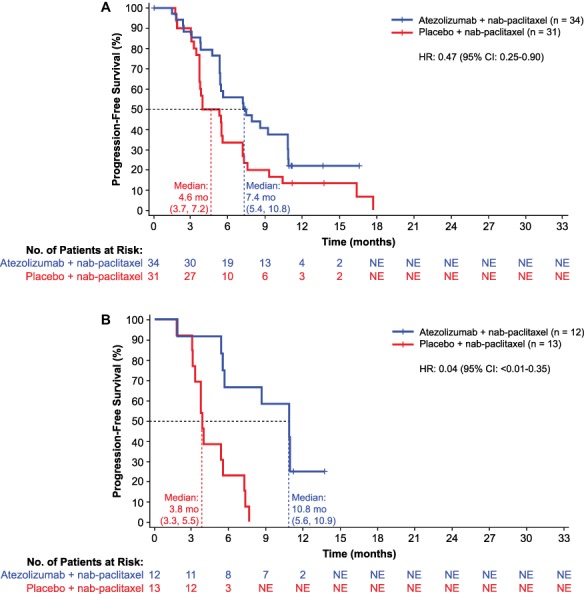
There were 65 Japanese patients (34 atezo + nab-P; 31 plac + nab-P). The PD-L1-positive subgroup included 25 patients (12 atezo + nab-P; 13 plac + nab-P). Median PFS was 7.4 months (atezo + nab-P) versus 4.6 months (plac + nab-P; hazard ratio [HR], 0.47; 95% CI, 0.25-0.90). In the PD-L1-positive subgroup, median PFS was 10.8 months (atezo + nab-P) versus 3.8 months (plac + nab-P; HR, 0.04; 95% CI, <0.01-0.35). Safety results in the Japanese subgroup were consistent with those in the overall population. The Japanese subgroup had a lower incidence of adverse events leading to treatment withdrawal than the overall population. More patients in the atezo + nab-P arm had neutrophil count decreases and stomatitis than patients in the plac + nab-P arm.
Atezo + nab-P efficacy in Japanese patients was consistent with the overall IMpassion130 population. No new safety signals were observed, and tolerability was consistent with that of the overall population.
在随机、3 期 IMpassion130 试验中,与安慰剂联合 nab-紫杉醇(plac + nab-P)相比,阿替利珠单抗联合 nab-紫杉醇(atezo + nab-P)在 902 例三阴性乳腺癌(TNBC)患者中,无论在意向治疗(ITT)人群还是程序性死亡配体 1(PD-L1)阳性亚组,均延长了无进展生存期(PFS)。这项研究评估了 atezo + nab-P 在 IMpassion130 日本亚人群中的疗效和安全性。
符合条件的患者为未经化疗治疗的局部晚期或转移性不可切除的三阴性乳腺癌患者,且先前未接受转移性疾病的化疗。患者按 1:1 随机分组,分别接受 atezo + nab-P 或 plac + nab-P 治疗。主要共同终点为研究者评估的 PFS 和总生存期(ITT 人群和 PD-L1 阳性亚组)。这些也在日本亚人群中进行了评估。
共有 65 例日本患者(34 例 atezo + nab-P;31 例 plac + nab-P)。PD-L1 阳性亚组包括 25 例患者(12 例 atezo + nab-P;13 例 plac + nab-P)。中位 PFS 为 7.4 个月(atezo + nab-P),而 plac + nab-P 为 4.6 个月(风险比 [HR],0.47;95%CI,0.25-0.90)。在 PD-L1 阳性亚组中,中位 PFS 为 10.8 个月(atezo + nab-P),而 plac + nab-P 为 3.8 个月(HR,0.04;95%CI,<0.01-0.35)。日本亚组的安全性结果与总体人群一致。日本亚组因不良事件导致停药的发生率低于总体人群。atezo + nab-P 组较 plac + nab-P 组有更多患者出现中性粒细胞计数下降和口腔炎。
阿替利珠单抗联合 nab-紫杉醇在日本患者中的疗效与 IMpassion130 总体人群一致。未观察到新的安全性信号,且耐受性与总体人群一致。