Ni Qun, Lu Xiaomin, Chen Congcong, Du Huaqing, Zhang Renbing
Healthcare Center, Zhejiang University Hospital, Hangzhou, China.
Medicine (Baltimore). 2019 Oct;98(42):e17597. doi: 10.1097/MD.0000000000017597.
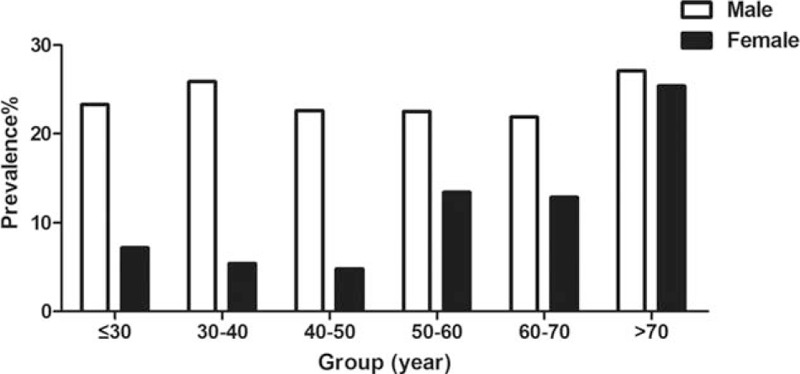
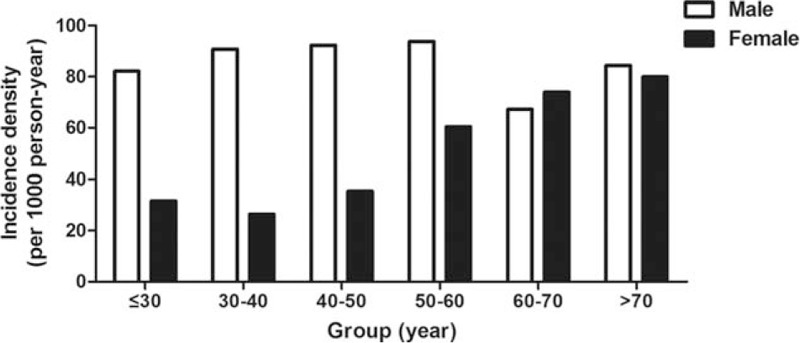
Hyperuricemia has received increasing attention as a major public health problem. This study aims to investigate the risk factors for hyperuricemia and to explore the relationship between changes in biochemical variables and incident hyperuricemia.A cross-sectional and subsequently prospective study was performed among adults who took their health checkups at Zhejiang University Hospital. The participants who were free of hyperuricemia at baseline received annual follow-up examinations during a 6-year period. Cox proportional hazards regression analyses were conducted to calculate the risks for incident hyperuricemia.Of the 9238 participants enrolled, 1704 (18.4%) were diagnosed as hyperuricemia. During 21,757 person-years of follow-up, 1492 incident hyperuricemia cases were identified. The incidence of hyperuricemia was 68.58 cases per 1000 person-year of follow-up in the overall participants. The prevalence and the incidence of hyperuricemia increased greatly in female older than 50 years. High levels of BMI, SBP, FPG, TG, LDL-C, ALT, BUN, and creatinine increased the risk of hyperuricemia. Suffering fatty liver also increased the risk of hyperuricemia. Subjects with increasing DBP, TG, BUN, creatinine, or decreasing HDL-C were more likely to incident hyperuricemia.This study revealed that the change of diastolic blood pressure (DBP), serum triglycerides (TG), blood urea nitrogen (BUN), creatinine, and high-density lipoprotein cholesterol (HDL-C) level were independently associated with incident hyperuricemia.
高尿酸血症作为一个主要的公共卫生问题已受到越来越多的关注。本研究旨在调查高尿酸血症的危险因素,并探讨生化变量变化与新发高尿酸血症之间的关系。
在浙江大学医院进行健康体检的成年人中开展了一项横断面研究以及后续的前瞻性研究。基线时无高尿酸血症的参与者在6年期间接受年度随访检查。进行Cox比例风险回归分析以计算新发高尿酸血症的风险。
在纳入的9238名参与者中,1704人(18.4%)被诊断为高尿酸血症。在21757人年的随访期间,共识别出1492例新发高尿酸血症病例。总体参与者中高尿酸血症的发病率为每1000人年随访68.58例。50岁以上女性高尿酸血症的患病率和发病率大幅上升。高BMI、收缩压、空腹血糖、甘油三酯、低密度脂蛋白胆固醇、谷丙转氨酶、血尿素氮和肌酐水平会增加高尿酸血症的风险。患脂肪肝也会增加高尿酸血症的风险。舒张压、甘油三酯、血尿素氮、肌酐升高或高密度脂蛋白胆固醇降低的受试者更易发生新发高尿酸血症。
本研究表明,舒张压(DBP)、血清甘油三酯(TG)、血尿素氮(BUN)、肌酐和高密度脂蛋白胆固醇(HDL-C)水平的变化与新发高尿酸血症独立相关。