Ningbo Institute of Materials Technology and Engineering, Chinese Academy of Sciences, 315201, Ningbo, China.
Hiroshima Synchrotron Radiation Center, Hiroshima University, Higashi-Hiroshima, Hiroshima, 739-0046, Japan.
Nat Commun. 2019 Oct 18;10(1):4765. doi: 10.1038/s41467-019-12805-2.
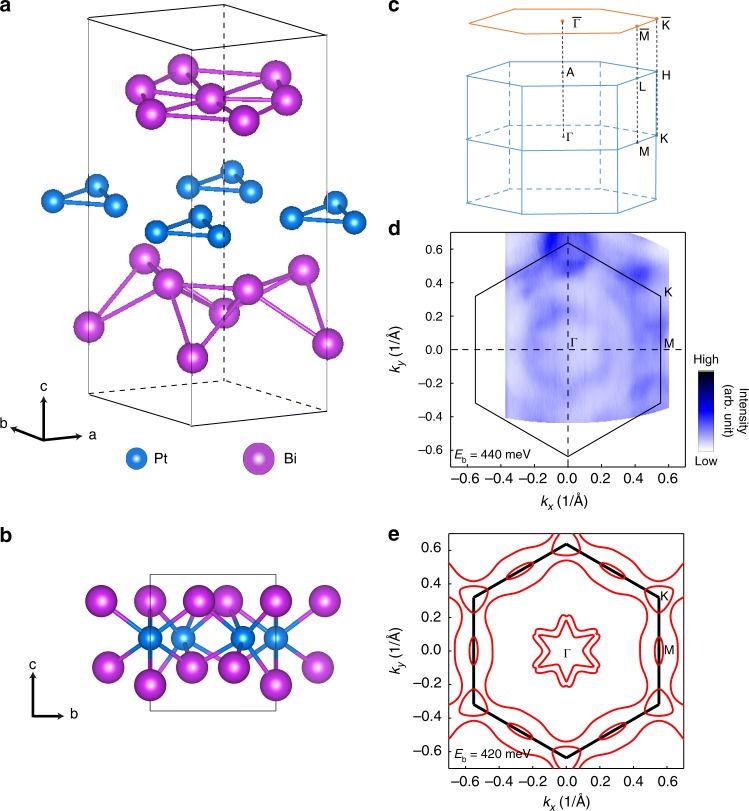
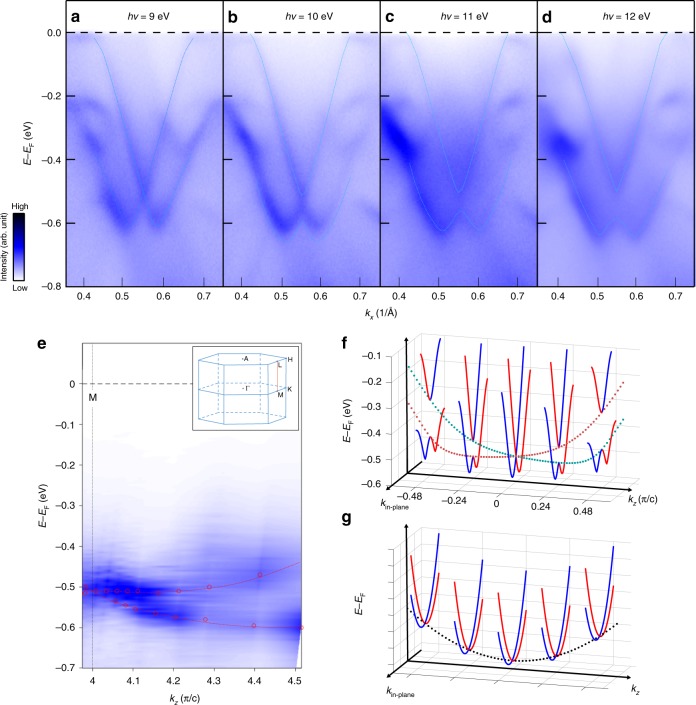
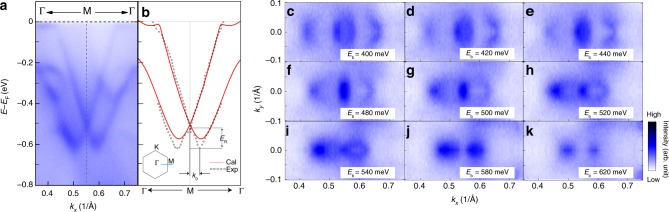
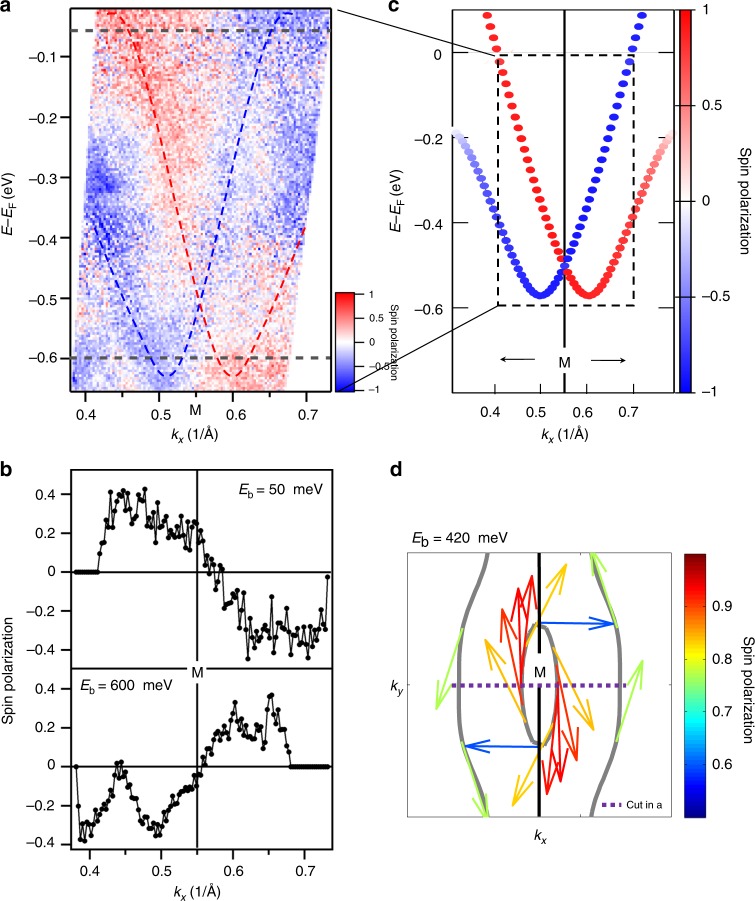
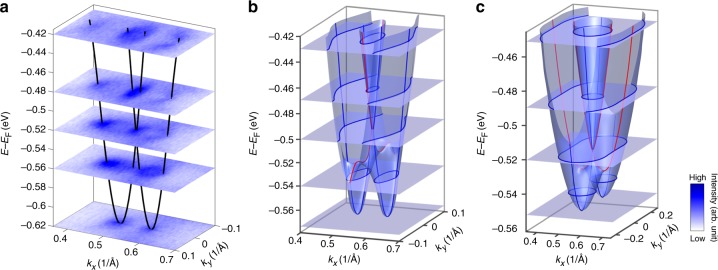
Spin-orbit coupling (SOC) has gained much attention for its rich physical phenomena and highly promising applications in spintronic devices. The Rashba-type SOC in systems with inversion symmetry breaking is particularly attractive for spintronics applications since it allows for flexible manipulation of spin current by external electric fields. Here, we report the discovery of a giant anisotropic Rashba-like spin splitting along three momentum directions (3D Rashba-like spin splitting) with a helical spin polarization around the M points in the Brillouin zone of trigonal layered PtBi. Due to its inversion asymmetry and reduced symmetry at the M point, Rashba-type as well as Dresselhaus-type SOC cooperatively yield a 3D spin splitting with α ≈ 4.36 eV Å in PtBi. The experimental realization of 3D Rashba-like spin splitting not only has fundamental interests but also paves the way to the future exploration of a new class of material with unprecedented functionalities for spintronics applications.
自旋轨道耦合(SOC)因其丰富的物理现象和在自旋电子器件中的极具前景的应用而备受关注。在具有反转对称性破坏的系统中,拉什巴型 SOC 特别适用于自旋电子学应用,因为它允许通过外部电场灵活地操纵自旋电流。在这里,我们发现了在三角层状 PtBi 的布里渊区的 M 点周围具有螺旋自旋极化的三个动量方向上的巨大各向异性拉什巴型自旋劈裂(3D 拉什巴型自旋劈裂)。由于其反转不对称性和 M 点的对称性降低,拉什巴型和 Dresselhaus 型 SOC 协同作用在 PtBi 中产生具有 α≈4.36eVÅ的 3D 自旋劈裂。3D 拉什巴型自旋劈裂的实验实现不仅具有基础研究的意义,而且为未来探索具有用于自旋电子学应用的前所未有的功能的新型材料铺平了道路。