University of North Carolina, School of Medicine, Chapel Hill, North Carolina.
University of North Carolina, School of Medicine, Chapel Hill, North Carolina.
Clin Gastroenterol Hepatol. 2020 Aug;18(9):1980-1986. doi: 10.1016/j.cgh.2019.10.022. Epub 2019 Oct 18.
BACKGROUND & AIMS: The prevalence of diverticulosis differs with demographic features of patients, but evidence is limited. Well-defined demographic studies are necessary to understand diverticulosis biology. We estimated the prevalence of diverticulosis among patients of different ages, sexes, and races and ethnicities and calculated odds ratios.
Using data from an endoscopic database, we identified 271,181 colonoscopy procedures performed from 2000 through 2012 at 107 sites in the United States. Our analysis included individuals 40 years and older who underwent colonoscopy examination for average-risk screening. The outcome was any reported diverticulosis on colonoscopy. Multivariate analyses were performed using logistic regression to estimate odds ratios (ORs) and 95% CI values, adjusting for confounding variables.
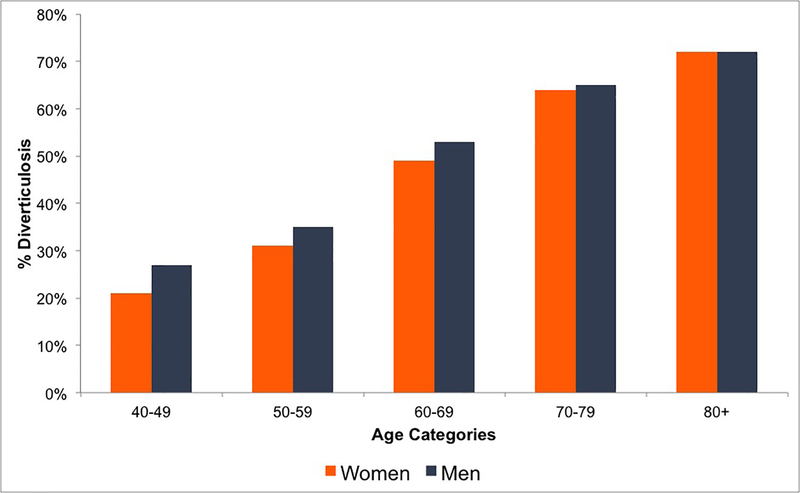
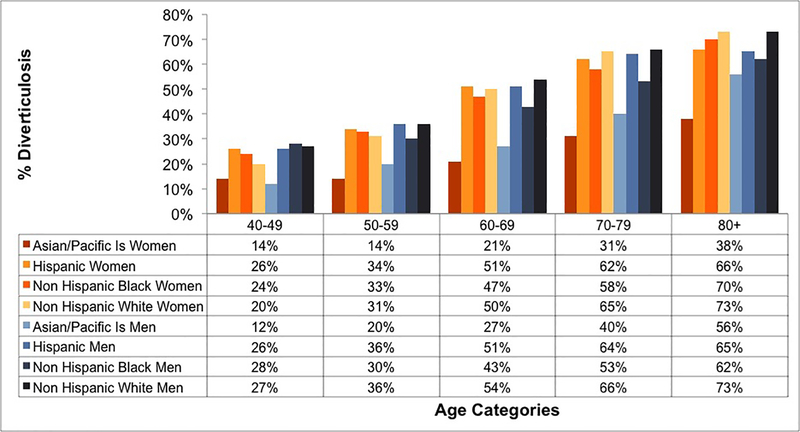
The prevalence of diverticulosis increased with age in men and women of all races and ethnicities. Women 40-49 years old had significantly lower odds of any diverticulosis (OR, 0.71; 95% CI, 0.63-0.80) compared with men 40-49 years old, after adjustment. The strength of this association decreased with age. Compared with non-Hispanic white individuals, non-Hispanic black individuals (OR, 0.80; 95% CI, 0.77-0.83) and Asian/Pacific Islanders (OR, 0.38; 95% CI, 0.35-0.41) had lower odds of any diverticulosis. However, non-Hispanic black individuals (OR, 1.53, 95% CI, 1.44-1.62) had increased odds of any proximal diverticulosis, whereas Asian/Pacific Islanders (OR, 3.12; 95% CI, 2.67-3.66) had increased odds of only proximal diverticulosis.
In an analysis of data from 271,181 colonoscopy procedures, diverticulosis was less prevalent in women compared with men in the same age groups, indicating that sex hormones might affect pathogenesis. Differences in the odds of diverticulosis by race and ethnicity indicate a genetic contribution to risk.
憩室病的流行率因患者的人口统计学特征而异,但证据有限。需要有明确的人口统计学研究来了解憩室病的生物学特性。我们估计了不同年龄、性别和种族的患者中憩室病的流行率,并计算了比值比。
利用来自内镜数据库的数据,我们从 2000 年至 2012 年在美国 107 个地点进行的 271181 例结肠镜检查中识别出 271181 例结肠镜检查。我们的分析包括年龄在 40 岁及以上的接受平均风险筛查的结肠镜检查的个体。结果是结肠镜检查报告的任何憩室病。采用 logistic 回归进行多变量分析,以估计比值比(OR)和 95%置信区间(CI)值,调整混杂变量。
在所有种族和族裔的男性和女性中,憩室病的患病率随年龄增长而增加。与 40-49 岁的男性相比,40-49 岁的女性任何憩室病的几率显著降低(OR,0.71;95%CI,0.63-0.80),调整后。这种关联的强度随年龄的增长而降低。与非西班牙裔白人相比,非西班牙裔黑人(OR,0.80;95%CI,0.77-0.83)和亚裔/太平洋岛民(OR,0.38;95%CI,0.35-0.41)患任何憩室病的几率较低。然而,非西班牙裔黑人(OR,1.53,95%CI,1.44-1.62)患任何近端憩室病的几率增加,而亚裔/太平洋岛民(OR,3.12;95%CI,2.67-3.66)患仅近端憩室病的几率增加。
在对 271181 例结肠镜检查数据的分析中,与同年龄组的男性相比,女性中憩室病的患病率较低,这表明性激素可能影响发病机制。按种族和族裔划分的憩室病几率差异表明风险存在遗传因素。