Department of Surgery, Leiden University Medical Center, Leiden 2333ZA, the Netherlands; Einthoven Laboratory for Experimental Vascular Medicine, Leiden University Medical Center, Leiden 2333ZA, the Netherlands.
Department of Surgery, Leiden University Medical Center, Leiden 2333ZA, the Netherlands; Einthoven Laboratory for Experimental Vascular Medicine, Leiden University Medical Center, Leiden 2333ZA, the Netherlands; Department of Laboratory Medicine, Medical University of Vienna, Vienna 1090, Austria; Department of Internal Medicine II, Medical University of Vienna, Vienna 1090, Austria.
Mol Ther. 2020 Jan 8;28(1):157-170. doi: 10.1016/j.ymthe.2019.10.002. Epub 2019 Oct 7.
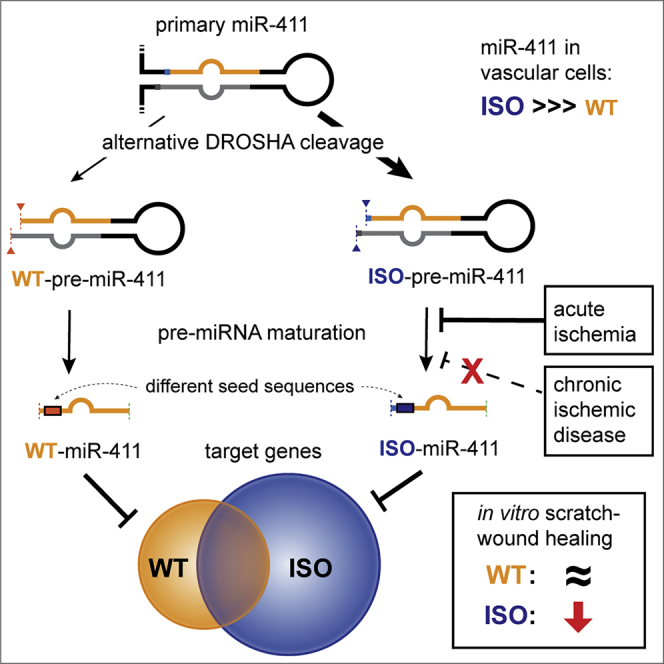
MicroRNAs are posttranscriptional regulators of gene expression. As microRNAs can target many genes simultaneously, microRNAs can regulate complex multifactorial processes, including post-ischemic neovascularization, a major recovery pathway in cardiovascular disease. MicroRNAs select their target mRNAs via full complementary binding with their seed sequence, i.e., nucleotides 2-8 from the 5' end of a microRNA. The exact sequence of a mature microRNA, and thus of its 5' and 3' ends, is determined by two sequential cleavage steps of microRNA precursors, Drosha/DGCR8 and Dicer. When these cleavage steps result in nucleotide switches at the 5' end, forming a so-called 5'-isomiR, this results in a shift in the mature microRNA's seed sequence. The role of 5'-isomiRs in cardiovascular diseases is still unknown. Here, we characterize the expression and function of the 5'-isomiR of miR-411 (ISO-miR-411). ISO-miR-411 is abundantly expressed in human primary vascular cells. ISO-miR-411 has a different "targetome" from WT-miR-411, with only minor overlap. The ISO-miR-411/WT-miR-411 ratio is downregulated under acute ischemia, both in cells and a murine ischemia model, but is upregulated instead in chronically ischemic human blood vessels. ISO-miR-411 negatively influences vascular cell migration, whereas WT-miR-411 does not. Our data demonstrate that isomiR formation is a functional pathway that is actively regulated during ischemia.
微 RNA 是基因表达的转录后调控因子。由于微 RNA 可以同时靶向多个基因,因此可以调节复杂的多因素过程,包括缺血后新生血管形成,这是心血管疾病的主要恢复途径。微 RNA 通过与其种子序列(即微 RNA 5'端的第 2-8 个核苷酸)完全互补结合来选择其靶 mRNAs。成熟微 RNA 的精确序列,以及其 5'和 3'末端的序列,由微 RNA 前体的两个连续切割步骤确定,即 Drosha/DGCR8 和 Dicer。当这些切割步骤导致 5'端的核苷酸发生转换,形成所谓的 5'-isomiR 时,就会导致成熟微 RNA 的种子序列发生移位。5'-isomiRs 在心血管疾病中的作用尚不清楚。在这里,我们描述了 miR-411 的 5'-isomiR(ISO-miR-411)的表达和功能。ISO-miR-411 在人原代血管细胞中大量表达。ISO-miR-411 与 WT-miR-411 的“靶标组”不同,只有很小的重叠。ISO-miR-411/WT-miR-411 的比值在急性缺血时在细胞和小鼠缺血模型中均下调,但在慢性缺血的人血管中反而上调。ISO-miR-411 负向影响血管细胞迁移,而 WT-miR-411 则没有。我们的数据表明,异构体形成是一种在缺血过程中被积极调控的功能途径。